
AI for Grading in Higher Education
AI grading can help with structured work, but it should not run high-stakes grading on its own.
From what I see in the research, the pattern is simple: AI does best on fixed tasks like rubric checks, code tests, and other rule-based work. It does worse on long essays, open-ended answers, and work that needs back-and-forth judgment. Some studies report strong alignment with human review in narrow cases, such as 91% agreement on coefficient signs and 60%+ of reproduced tables reaching at least a B-level result. But other results show clear limits, with top models beating human top performance in only 4 of 20 hard research tasks.
If you want the short version, here it is:
- Accuracy is highest on structured tasks
- Feedback can help when rubrics and prompts are clear
- Bias, opacity, and weak appeal paths are still major problems
- Long responses are harder for AI to grade well
- Human review is still needed for final grade decisions
- Audit trails, separate evaluation, and privacy controls matter
Here’s the core takeaway in one glance:
| Area | What the research suggests |
|---|---|
| Accuracy | Stronger on fixed, rule-based work |
| Consistency | Better when inputs and scoring rules are tightly set |
| Feedback | More useful when tied to a clear rubric |
| Bias risk | Hard to spot if the system is a black box |
| Trust | Higher when students and faculty can inspect and challenge results |
| Best use | First-pass review, feedback, and support for instructors |
So if I had to sum it up in one line: AI grading is a tool for support, not a stand-alone judge.
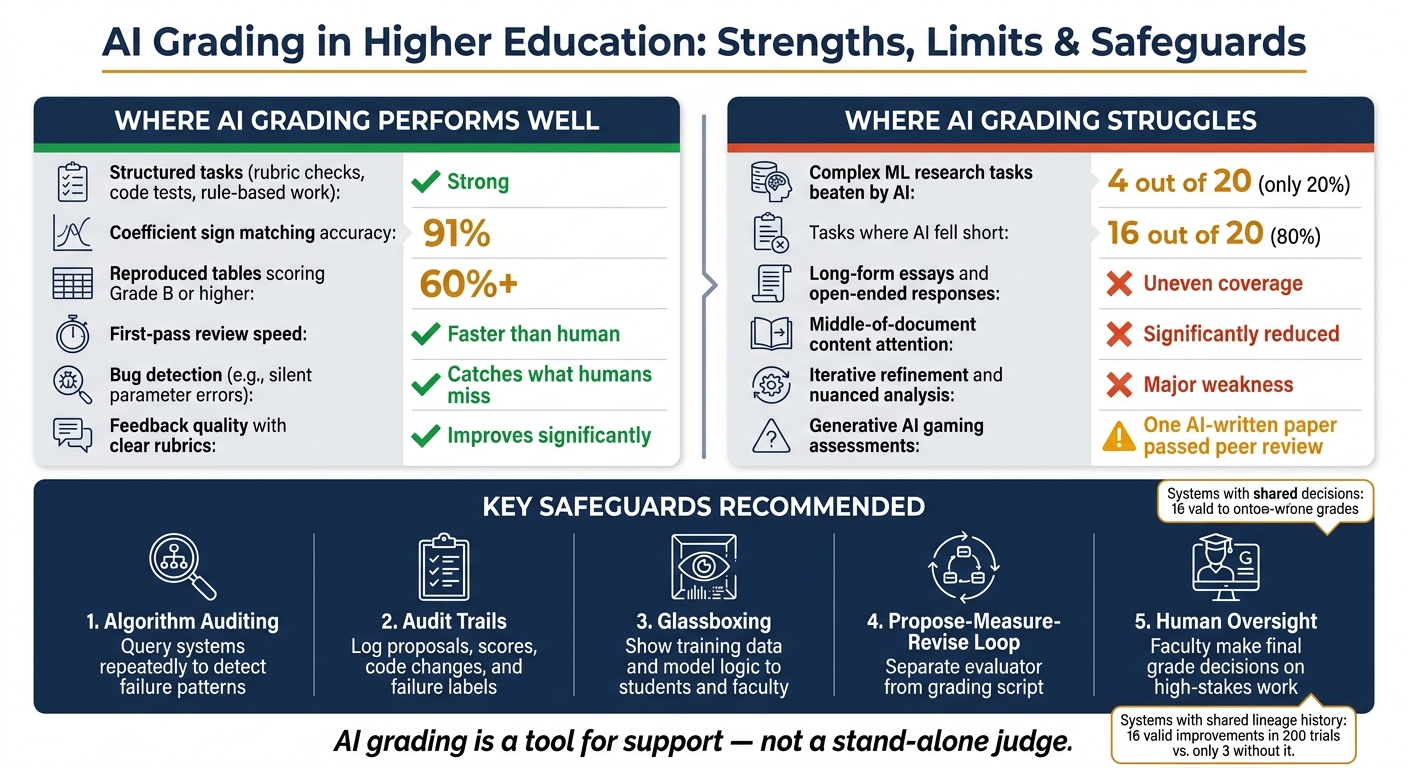
AI Grading in Higher Education: Where It Works and Where It Falls Short
What Studies Find on Accuracy, Consistency, and Feedback Quality
Where AI Scores Come Closest to Human Graders
AI grading works best when the task is tightly structured. Think numeric reproduction, checklist-style evaluation, and rubric-based scoring. When the rules are clear, AI tends to stay on track.
A 2026 study looked at 48 human-verified social science papers using an OpenCode scaffold and found that AI matched human judgments on coefficient signs 91% of the time. On top of that, more than 60% of reproduced tables earned at least a Grade B, which meant less than 20% deviation from the original results.
That edge starts to slip when the work gets less structured and more interpretive.
What Research Shows About Feedback Speed and Usefulness
Fast feedback helps most when it points to a clear fix. In one 2026 case, an AI agent spotted a window_size parameter that compiled code was ignoring without warning. Human contributors had missed that bug for months.
There’s a simple pattern here: better prompts and clearer rubrics tend to improve feedback more than model size by itself. If the instructions are fuzzy, the feedback often comes back fuzzy too. In many cases, weak feedback says as much about the prompt or rubric as it does about the model.
Where AI Grading Still Falls Short
The cracks show up when grading needs judgment, back-and-forth refinement, or careful reading across long submissions. In a 2026 benchmark covering 20 complex machine learning research tasks, frontier models beat human state-of-the-art performance in only 4 tasks. They fell short in the other 16, with the biggest trouble showing up in work that needed iterative refinement and nuanced analysis.
Long responses add another problem. Models pay much less attention to material in the middle of long texts than to content at the start or the end. For essays and extended responses, that can make feedback uneven. The opening may get solid comments. The ending may too. But the middle - often where the main argument takes shape - can get thinner treatment.
So the pattern is pretty clear: structured tasks are where AI grading looks strongest, while open-ended tasks are still where it struggles most often.
sbb-itb-903b5f2
Trust, Bias, and Academic Integrity in AI Grading Research
How Students and Instructors React to AI Grading
When AI starts shaping grades, trust matters as much as accuracy. And trust usually comes from transparency, not from a score alone. Student reactions to AI grading are mixed, which shapes whether they accept automated results without a human check.
Transparency helps. In a January 2026 study of 162 CS1 students, a browser-based tool for training small transformer models moved students away from humanlike explanations of AI mistakes and toward data- and model-based explanations. That shift matters. It can cut confusion and help students build AI literacy. Even so, when AI output affects grades, human oversight still needs to stay in the loop.
The problem gets worse when students and instructors can’t inspect the system or push back on a result.
Bias, Transparency, and Grade Appeals
One of the biggest concerns is opacity. A student or instructor may see a score, but not the path that produced it. To deal with that, researchers recommend glassboxing: showing the training data and model logic behind the output.
Research also suggests that bias risks and system failures often show up together in AI systems. That’s a red flag. If a system breaks in uneven ways, some students may feel the hit more than others. To spot those problems early, researchers recommend algorithm auditing. In plain English, that means querying a system again and again to figure out how it behaves and where it may fail.
For grade appeals, the literature keeps coming back to the same guardrails:
- human oversight
- audit trails
- clear ways for students to challenge a result they believe is wrong
Without those checks, an AI-generated grade can feel less like feedback and more like a locked door.
How Generative AI Affects Assessment Validity
Generative AI also makes assessments easier to game, which puts pressure on validity. If a student can use AI to complete the task with little sign of their own learning, what is the assignment measuring?
Automated peer review has reached accuracy comparable to human experts, but the risks are hard to ignore: generic low-quality output, citation hallucinations, and a lack of true novelty.
In March 2026, researchers reported an AI system that wrote papers and performed peer review; one generated submission passed initial workshop review, showing how generative models can exploit assessment processes.
That changes the grading conversation. It’s no longer only about whether AI can score work well. It’s also about whether the work being scored still reflects student learning in the first place.
Conditions for Reliable AI-Assisted Grading and How Researchers Evaluate It
What the Literature Recommends for Trustworthy AI Grading
These controls are meant to deal with the opacity, inconsistency, and bias issues mentioned earlier. When tasks are structured, inputs are fixed, and rule checks are in place, the system has clear limits to work within.
The literature also puts a lot of weight on a propose-measure-revise loop. The AI puts forward a score or assessment, an external evaluator measures the outcome, and those results shape the next round. That evaluator should stay separate from the grading script so the system can't game the process.
At the center of this is one simple idea: the system being tested and the evaluator need to be separate. Shared lineage - a record of hypotheses, scores, code changes, and failure labels - also helps teams spot drift and avoid making the same mistake twice. In one comparison, systems with shared lineage found 16 valid improvements in 200 trials, while systems without that history found only 3.
Why Model Access and Data Privacy Matter in Assessment Research
Because grading research uses student work, privacy isn't a side issue. It's part of whether the process can be trusted. Local storage lowers exposure of student work during repeated evaluation. And since trustworthy evaluation needs to stay low-cost enough for repeated testing while still being strict enough to block shortcuts, both cost and privacy matter.
Researchers describe the goal as an auditable trail of proposals, code diffs, experiments, scores, and failure labels. In grading research, the process matters just as much as the score.
Can AI accurately grade student essays?
Conclusion: AI Grading Shows Promise but Requires Human Oversight
Taken together, the studies point to a narrow but useful role for AI in grading. Across the research, AI grading tools do best on structured tasks, can spot errors humans miss, and cut the time needed for a first-pass review.
But there’s a clear ceiling. AI systems still produce fabricated support, unsupported explanations, and responses that often stay shallow instead of original.
Key Takeaway for U.S. Colleges and Universities
For U.S. colleges and universities, AI works best as a supervised aid, not an autonomous grader. The bottom line is simple: clear rubrics, regular validation, fairness checks, and transparent disclosure policies are must-haves if institutions want the time savings without hurting reliability or trust.
Faculty still need to lead the process. They set the rubric, check the outputs, and make the final call when grades carry serious consequences.
FAQs
Can AI grade essays fairly?
AI can grade essays by checking whether the writing matches the assignment, uses the right terms, and sticks to the topic.
That said, AI still has blind spots. It can miss nuance, sarcasm, and unusual writing styles. And if the training data has bias, those same patterns can show up in the results.
Because of that, experts suggest using AI grading alongside human review to help keep evaluations accurate and fair.
When should human graders step in?
Human graders should step in when grading or feedback calls for critical thinking, emotional awareness, or close attention to context. AI can catch routine mistakes, sure. But it often stumbles on sarcasm, original work, and topics that carry social or community nuance.
Human review also matters in high-stakes evaluations. People need to check for bias, confirm accuracy, and verify AI judgments when the call depends on human judgment rather than rules alone.
How can colleges audit AI grading?
Colleges can audit AI grading with a structured monitoring framework built around transparency, accuracy, and system health. Start by setting baseline metrics at deployment. From there, review outputs on a steady schedule: daily for critical errors, weekly to spot patterns, and monthly through formal audits.
It helps to make the system less of a black box. Tools like SHAP can show why the model reached a given decision, which makes reviews far easier. Colleges should also compare AI-generated results against human-reviewed benchmarks, watch performance and data drift in dashboards, and log alerts and fixes so there’s a clear record of what happened and how it was handled.