
Checklist for Implementing AI Image Audit Trails
AI image audit trails are essential for tracking every step of the image generation process - from input prompts to final outputs. They ensure transparency, accountability, and compliance with legal frameworks like the EU AI Act, HIPAA, and SOX. Without proper audit trails, businesses risk fines, legal challenges, and operational inefficiencies. Here's a quick breakdown of how to set them up effectively:
- Define Goals: Identify why you need an audit trail (e.g., compliance, security, IP protection).
- Map Workflows: Document all models, data flows, and stages (INGEST → TRAIN → GEN → EXPORT).
- Log Key Events: Record prompts, model versions, parameters, and decisions at every stage.
- Ensure Data Security: Use cryptographic protections, tamper-proof storage, and privacy safeguards.
- Set Retention Policies: Adhere to regulations (e.g., 6 months for EU AI Act, 6 years for HIPAA).
- Monitor and Review: Automate alerts for gaps and conduct regular compliance checks.
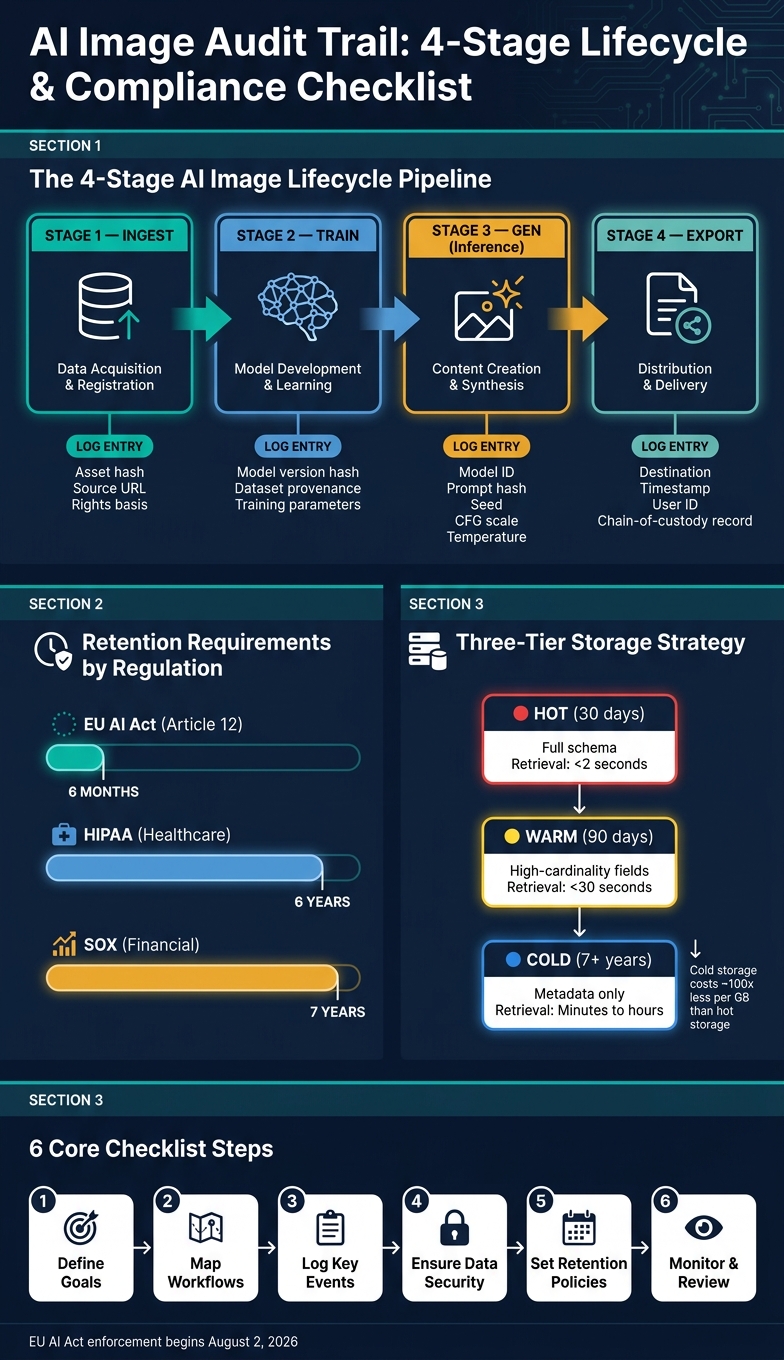
AI Image Audit Trail: 4-Stage Lifecycle & Compliance Checklist
CORKONIAN | Audit Trails | | The Day AI Became Untrustworthy (And How We Fix It)
sbb-itb-903b5f2
Planning and Setup for Audit Trails
Before diving into logging code, it’s crucial to have a solid plan. Without clear capture criteria, you’ll likely end up with incomplete or ineffective records.
Define Goals and Scope
Start by identifying the purpose of your audit trail. The “why” determines everything else. Common reasons include regulatory compliance, intellectual property protection, security monitoring, and ensuring internal accountability. Each of these requires tracking different kinds of data.
For compliance, the stakes are particularly high. The EU AI Act Article 12, effective August 2, 2026, mandates that high-risk AI systems must automatically log events throughout their lifecycle. Retention requirements vary by industry: at least 6 months under the EU AI Act, 6 years under HIPAA for healthcare systems, and up to 7 years for financial systems under SOX regulations.
Provenance tracking is another key component. It’s essential to log the lifecycle of assets - covering stages like ingestion, training, generation, and export. This helps defend against copyright disputes and even allows for “negative proof,” demonstrating that specific data was not used in training or generation.
"The question isn't if you'll need provenance records. It's when." - VeritasChain
Map Systems, Models, and Data Flows
After defining your goals, create a detailed inventory of all AI models and their integrations. It’s important to track specific model versions (e.g., "GPT-4o-2024-11-20") to ensure changes are detected when updates occur.
Next, map out how prompts, outputs, and metadata flow through your system using the four-stage lifecycle: INGEST → TRAIN → GEN → EXPORT. For each stage, pinpoint where logging connections are necessary. If your system uses agentic workflows - where one prompt triggers multiple model calls - make sure to log the parent/child call tree so events can be reconstructed later.
Keep in mind the scale of your operations. A system handling 100,000 requests daily will generate 36 million records annually, requiring roughly 72 GB of storage. Plan your infrastructure accordingly.
Assign Governance Roles
Clear governance is critical for maintaining compliance.
"A record that carries only the agent identity... fails the test because the agent serves many users and the auditor cannot identify the responsible human." - DeepInspect
The table below outlines key governance roles and their responsibilities:
| Governance Role | Primary Responsibility | Critical Field to Manage |
|---|---|---|
| System Operator | Initiating generation/prompts | Authenticated Human User ID |
| Human Reviewer | Approving or overriding outputs | Override Reason & Timestamp |
| Safety/Red-Team | Adversarial testing & risk mapping | Red-team Suite Version |
| Compliance/CISO | Policy setting & retention oversight | Policy Bundle Version |
| Legal/Comms | Incident response & transparency | Public Transparency Templates |
One essential principle: the application generating outputs should not control the audit log write-path. Instead, use an independent gateway or sidecar architecture to ensure no single service can alter or suppress its own records. This separation is what transforms a simple log file into a reliable and defensible audit trail.
With these foundational steps in place, you’re ready to move forward with logging events and metadata to capture operational details.
Logging Events and Metadata
Once your governance framework is in place, the next step is figuring out what to log - and when. Logging everything without discrimination wastes storage and creates privacy issues. On the other hand, logging too little can leave critical gaps, especially during audits or incident investigations.
Log Core Image Generation Events
Think of image generation as a four-stage process: INGEST → TRAIN → GEN → EXPORT. Each stage requires its own log entry. During the INGEST phase, log the asset hash, source URL, and the rights basis for any reference material. In the GEN stage (inference), capture details like the model ID, prompt hash, seed, and generation parameters. At EXPORT, record the destination, timestamp, and user ID to maintain a clear chain of custody.
Every log entry should include a unique UUID, an NTP-synced UTC timestamp, and the exact model version hash. For example, instead of just logging "Flux Pro", include the specific version hash. This precision is critical because model behavior can vary between versions, and vague identifiers won't hold up under scrutiny.
Don’t forget to log moderation events and human-in-the-loop actions. If a safety filter triggers, record the classifier score, the filter flag, and the exact policy version hash used. If a human reviews or overrides an output, log their identity, the timestamp, and a structural diff showing what changed.
"If you cannot replay the decision path, you do not truly control the output." - Jordan Ellis, Senior SEO Content Strategist
A key design principle: write the audit record synchronously before the model responds. If the audit writer fails, the system should "fail closed", blocking the action entirely rather than proceeding without a record.
For workflows involving multiple model calls triggered by a single prompt, log the parent/child call tree to reconstruct the entire decision path later. Additionally, recording detailed prompts and parameters can significantly enhance the accuracy of your audits.
Record Prompts and Parameters
Treat prompts like versioned code. Store the prompt template ID and version alongside the full text of the system prompt, user prompt, and any negative prompts or style constraints. The generation parameters are equally important: seed values, resolution, sampling method, CFG scale, and temperature all impact reproducibility.
Here’s a quick breakdown of the core metadata fields to capture for each log entry:
| Field Group | Specific Fields |
|---|---|
| Identity | Subject ID, Auth method (OIDC/SAML), Role, Tenant ID |
| Inference | Seed, Temperature, Resolution, Latency (ms) |
| Safety | Safety filter triggered (bool), Prompt injection score, Output filter action |
| Integrity | Previous hash, Writer signature (HMAC), Canonical JSON hash |
Log Data with Privacy in Mind
Precise logging is important, but it must be paired with privacy-conscious data handling. Raw prompts can contain personal information, which could violate GDPR if stored directly. A safer approach is to store SHA-256 hashes of prompts and generated images instead of the actual content. This allows forensic reconstruction without holding sensitive data.
For user identity, avoid generic API keys or service accounts. Instead, resolve credentials to a natural person identifier like an employee ID or customer ID at the gateway level. This ties actions to specific individuals without compromising security.
"Immutable commitments plus selective disclosure let you prove facts about AI outputs without building a vault of personal data you can't manage under GDPR." - nftpay
If your system uses reference images, consider storing perceptual hashes or low-resolution previews for routine tasks. Save full-resolution images - encrypted and in a separate storage tier - only for forensic escalation. For users requesting data deletion, crypto-shredding is the best option: encrypt sensitive data with per-user keys in a Key Management Service (KMS), then delete the key. This keeps the audit trail intact while making the raw data irretrievable.
Storing and Securing Audit Trail Data
Keeping audit trail data safe and accessible is essential for regulatory compliance, legal defense, and addressing security concerns. While comprehensive logging forms the backbone of this process, proper storage and protection measures are what complete the picture.
Set Storage and Retention Policies
Regulations vary widely when it comes to how long logs need to be retained. For example, the EU AI Act Article 12 mandates a 6-month retention for high-risk AI system logs, HIPAA requires 6 years, and SOX demands 7 years for work papers. A one-size-fits-all retention policy won’t work here.
A three-tier storage approach helps balance costs with accessibility:
| Retention Tier | Duration | Indexing Level | Typical Retrieval Time |
|---|---|---|---|
| Hot | 30 days | Full schema | Under 2 seconds |
| Warm | 90 days | High-cardinality fields | Under 30 seconds |
| Cold | 7+ years | Metadata only (date/tenant) | Minutes to hours |
Cold storage is far more economical - costing nearly 100 times less per gigabyte than hot storage. Automating lifecycle rules ensures records transition smoothly between tiers and are deleted once their retention period ends.
For formatting, JSONL (newline-delimited JSON) is a popular choice for AI audit trails. It's append-only by nature, supports nested data structures like tool-call trees, and integrates easily with log aggregators without extra processing steps.
Protect Data Integrity
Storing data isn’t enough - you also need to make sure it’s tamper-proof. Both insider threats and external attacks can compromise stored records. That’s where cryptographic integrity comes in, making any unauthorized changes immediately detectable.
Use HMAC-SHA256 signatures with hash chaining to protect each record. This method computes each record’s signature as an HMAC of the previous record’s signature combined with the current record’s content. If even a single byte is altered, the entire chain fails verification. To add another layer of security, periodically anchor your hash chain to an external Trusted Timestamping Authority (TSA) using RFC 3161. This creates an independent, verifiable snapshot of your ledger that regulators or courts can trust without relying solely on your systems.
"An audit record without the rendered prompt is a receipt. An audit record with the rendered prompt and a hash chain is a forensic instrument." - Digital Applied Team
Combine hash chaining with WORM (Write-Once-Read-Many) storage solutions such as AWS S3 Object Lock in compliance mode or Azure Immutable Blob. These systems physically prevent deletion or modification during the retention period, even by administrators. Additionally, run a daily automated check to verify the hash chain and alert your security team if any discrepancies are found.
An example of this in action: In late 2025, a major social platform successfully defended itself in a deepfake-related lawsuit by providing a court-ready evidence package within hours. Their system, which included signed manifests, per-object envelope keys, and TSA-stamped append-only ledgers, allowed them to prove that the content in question was generated by an external model, not their own systems.
Control Access to Audit Data
The integrity of an audit trail depends on strict control over who can access or modify it.
"The application that submitted the AI request cannot have custody of the write path. An application-controlled log fails the self-attestation test that regulators apply to compliance records." - DeepInspect
To address this, route audit logging through a gateway layer between your application and the AI model. This ensures the application itself can’t tamper with or omit records. On top of this, implement stringent RBAC (Role-Based Access Control) - only compliance officers, security teams, and auditors should have access to audit data, not general engineering staff.
Encrypt all audit data both in transit and at rest, and store signing keys in an HSM (Hardware Security Module) or KMS (Key Management Service) that’s separate from your storage system. This way, even if the storage is compromised, attackers can’t forge valid signatures without the keys. Finally, schedule quarterly reviews of access permissions to prevent unauthorized role changes from becoming a security risk. With these measures in place, your audit trail will be well-equipped to handle monitoring and compliance checks.
Monitoring and Reviewing Audit Trails
Once you've secured storage and access controls, the next step is to actively integrate audit trails into your operational workflows. This means connecting them to live pipelines, monitoring for issues as they occur, and conducting scheduled reviews to identify and address any gaps before regulators do.
Connect Audit Trails to Image Generation Pipelines
Every image generation event - whether triggered by a direct API call, a batch process, or an asynchronous background task - should generate a standardized audit record. To ensure this, place the audit writer between your application and the AI model endpoint. This setup guarantees that audit records are captured even if the application fails mid-request, and it prevents the application from tampering with its own logs.
It's critical to maintain complete call trees to allow for forensic reconstruction. Without this, a multi-step image generation process can appear as isolated events rather than a cohesive sequence.
Synchronous logging is another must-have. Audit records should be written before the model sends a response, ensuring no event is missed. These practices lay the groundwork for consistent logs, enabling effective real-time monitoring and alerting.
Set Up Monitoring and Alerts
Logging systems can fail without obvious errors. For example, a drop in log volume might go unnoticed unless actively monitored. Setting up automated alerts to flag when log volume falls below expected levels is a simple yet powerful safeguard.
"The cheapest insurance is automatic capture with self-monitoring - alarms when log volume drops below an expected baseline, before the auditor finds the gap." - Knowlee Team
In addition to volume-based alerts, monitor for unusual activity metrics like spikes in prompt injection scores or triggers from safety filters. Stream structured JSONL logs into a SIEM platform to enable real-time correlation and analysis. A practical approach is to automate responses for 90% of log activity while routing the remaining 10% - flagged anomalies - to human reviewers.
| Alert Category | Metric to Track | Compliance Driver |
|---|---|---|
| Security | Prompt injection scores & safety filter triggers | SOC 2 CC7.2, EU AI Act |
| Integrity | Log volume drops & HMAC chain breaks | EU AI Act Article 12 |
| Access | Unauthorized API calls & credential stuffing | HIPAA §164.312, FINRA 3110 |
These alerts not only help identify immediate issues but also streamline regular compliance audits.
Run Periodic Compliance Reviews
Regular compliance reviews are essential to maintaining the reliability of your audit trails. Building on your logging and monitoring framework, these reviews ensure that all components work seamlessly together.
Start by conducting forensic dry-runs: generate 1,000 requests across your policy surface and verify that each one produces a complete, cryptographically verifiable record. If any records fail chain replay, it’s better to uncover these gaps internally rather than during a regulatory inspection. During these reviews, confirm that cryptographic safeguards like HMAC chain integrity are intact to ensure stored records remain unaltered.
Cross-check recorded model versions against your change management system to detect silent upgrades. Additionally, verify that logs attribute actions to specific users - whether employee IDs or customer IDs - rather than shared service accounts. This is a common weak point in audits for regulations like HIPAA and SOX. For systems with higher risk AI outputs, schedule monthly reviews; for lower-risk operations, quarterly reviews are usually sufficient.
Building Privacy-First Local Audit Trails
Creating privacy-first local audit trails strengthens both auditability and compliance while ensuring sensitive user data stays protected. This approach complements centralized logging by keeping sensitive information under user control while maintaining a reliable record of all actions.
Store Audit Data Locally
Focus on commitments, not content. Instead of storing raw data like images or full prompts, save cryptographic commitments such as salted HMACs, Merkle roots, or signed provenance assertions. This method allows you to verify actions without holding sensitive personal data.
For local storage, use JSONL - an append-only format that's simple to parse and ideal for portability. Organize session logs into directories for clarity, such as ~/.local-sessions/:userId/:context/, ensuring clear separation by user.
"Store commitments, not content: keep cryptographic commitments (hashes, Merkle roots) and signed provenance assertions rather than raw content." - nftpay
When handling deletion requests, apply crypto-shredding. Encrypt each artifact with a user-specific key stored in a Key Management System (KMS), and delete the key when necessary. This approach ensures the audit commitment remains intact, while the underlying data becomes permanently inaccessible, meeting GDPR erasure standards without disrupting the audit trail.
This secure local storage approach is essential for accurate and privacy-respecting usage tracking.
Track Pay-as-You-Go Usage for Auditability
Usage logging is crucial for billing accountability while safeguarding privacy. Every inference call should log key details like prompt token count, response token count, total cost, and the model ID. These logs help align usage with billing records and flag anomalies. Add a calculateSessionCost() function to the local runtime to pull cost data directly from the model output.
Here’s a breakdown of the essential fields to log for pay-as-you-go auditability:
| Field Group | Data to Log | Purpose |
|---|---|---|
| Model Metadata | Model ID, version, parameters | Links billing to specific model pricing |
| Usage Metrics | Prompt tokens, response tokens, total cost | Ensures financial transparency and detects anomalies |
| Identity Context | Anonymized user ID, session ID | Tracks individual costs without exposing personal data |
| Integrity Proof | HMAC-SHA256 signature, hash chain pointer | Protects usage records from tampering |
To maintain privacy, use anonymized identifiers instead of raw user IDs or email addresses. This approach closes the "service account" gap - where costs and actions are untraceable to individuals - while keeping personal data out of the logs.
Platform Example: NanoGPT

NanoGPT offers a practical example of these principles in action. The platform stores data locally on the user’s device, ensuring the audit trail remains under user control.
NanoGPT's API responses include fields like cost, paymentSource, and remainingBalance, enabling developers to create per-inference audit records without additional tools. Generated image files are kept for just 24 hours, with signed, expiring download URLs available for about 1 hour. This design minimizes long-term data exposure while maintaining a verifiable usage record. NanoGPT integrates these fields into a unified JSONL event schema, covering identity, request details, model metadata, usage metrics, and integrity proofs.
Conclusion
Creating an AI image audit trail requires a strong commitment to transparency, accountability, and compliance. This process involves defining clear goals, mapping data flows, logging essential events, ensuring secure storage, and building privacy-focused local records that keep sensitive data under user control. These steps not only protect operations but also strengthen the trust and accountability crucial for AI image generation.
The key to a meaningful audit trail lies in its design. Parminder Singh, Founder and CEO of DeepInspect, emphasizes this point:
"A log file becomes a defensible record only through intentional design at commit time."
Following the outlined checklist ensures the integrity of your audit trail. Features like cryptographic signing, WORM (Write Once, Read Many) storage, anonymized identifiers, and regular compliance reviews are critical. These elements create records that can withstand legal and regulatory scrutiny. With the EU AI Act enforcing strict penalties starting in August 2026, skipping these steps could lead to significant risks.
The core idea to keep in mind: treat AI-generated images as cryptographically signed artifacts. Build your audit infrastructure around this concept from the very beginning, and conduct periodic reviews to maintain a system designed for lasting integrity. By embedding these practices early on, you’ll create a system ready to meet regulatory demands head-on.
FAQs
What’s the minimum data I must log to make an AI image audit trail defensible?
When creating an audit trail for AI-generated images, it's important to log sufficient data to accurately reconstruct interactions. Here's what to include:
- Unique Event ID: Assign a distinct identifier to each event for easy tracking.
- ISO-8601 UTC Timestamp: Record the exact time of the event in a standardized format.
- System and Model Details: Include the system's identity and the model version or build hash to ensure traceability.
- Authenticated User Identity: Log the identity of the user to confirm accountability.
- Prompt Template or Input Hash: Save the identifier for the prompt template or a hash of the input to capture the origin of the request.
- Final Output or Hash: Record the generated output or its hash to verify the result.
- Configuration Parameters: Document the settings used during the interaction.
- Human Overrides: If any manual changes are made, note them along with the reviewer's identity and the time of the modification.
- Tamper-Evident Integrity Proof: Use a cryptographic signature or similar method to ensure the data remains unaltered.
These elements form the backbone of a reliable audit trail, making it easier to verify and analyze the process behind AI-generated images.
How can I prove logs weren’t altered without storing raw prompts or images?
To ensure logs remain unaltered without needing to store raw data, you can rely on cryptographic commitments. Start by generating a salted hash - using an HMAC (Hash-Based Message Authentication Code) with a service key - at the time the log is created. Store this hash alongside the essential model metadata.
For added security, implement a hash chain that links each event chronologically. Pair this with a per-record digital signature. Together, these measures make tampering easy to detect and allow logs to be verified without keeping sensitive input or output data.
How do I choose retention periods and storage tiers for different regulations?
When determining how long to retain data, it's important to align with the regulations that apply to your industry or region. For instance:
- The EU AI Act requires a retention period of 6 months.
- In finance, records may need to be kept for 5–10 years.
- HIPAA mandates a minimum of 6 years for healthcare-related data.
To manage this effectively, consider using a tiered storage approach. For example, keep logs in hot storage (easily accessible) for 30–90 days to facilitate debugging or troubleshooting. After that, move them to long-term archival storage.
Automating deletion processes is another key step to ensure you don’t retain data longer than necessary, which can help you stay compliant and avoid unnecessary risks. Tools like NanoGPT offer local storage options, giving you better control over sensitive data retention and ensuring compliance with regulations.