
AI Regulation: Balancing Risks and Creativity
Artificial intelligence is transforming industries like journalism, marketing, and entertainment. It speeds up content creation, improves personalization, and enhances efficiency. However, this rapid growth brings risks, including misinformation, intellectual property disputes, and biases in AI outputs. Striking the right balance between regulation and innovation is critical to addressing these challenges without stifling progress.
Key takeaways:
- AI Risks: Misinformation, biased outputs, copyright issues, and misuse by bad actors.
- Regulation Needs: Clear rules on transparency, accountability, and authorship to build trust and prevent harm.
- Challenges of Overregulation: Increased costs, slowed innovation, and barriers for smaller developers.
- Solutions: Risk-based regulation, human oversight, ethical data use, and voluntary compliance frameworks like NIST AI RMF.
Balancing safety with flexibility ensures AI’s potential is maximized while minimizing harm.
Rep. Ami Bera on balancing AI regulation and innovation
sbb-itb-903b5f2
Dangers of Unregulated AI Text Generation
AI text generation, when left unchecked, can lead to serious consequences that extend beyond simple inaccuracies. These risks highlight the need for regulation to ensure AI is used responsibly. From intentional misuse to accidental harm, the dangers touch on critical areas like public health and democratic stability.
Misinformation and False Content
One of the biggest challenges with AI-generated text is its tendency to produce "hallucinations" - statements that sound factual but are entirely false. For example, a 2023 study found that over 25% of responses from major AI systems like Google Bard, Bing Chat, and Perplexity AI failed to meet expert-verified standards on topics like the Russia-Ukraine conflict. Even ChatGPT, which achieved an accuracy rate of over 81% when classifying conspiracy theories, still repeated debunked medical claims found in its training data.
The problem becomes even more alarming when bad actors intentionally manipulate AI training datasets. Research shows that even a small number of strategically placed documents can distort the outputs of language models, regardless of their size. These adversaries often exploit areas with limited reliable information, flooding them with false content that AI systems then treat as credible. For instance, this tactic has been used to promote pseudo-medical claims on social media, where false health information often outperforms scientifically accurate content.
What makes this issue particularly dangerous is the "machine heuristic" - a tendency for people to perceive AI-generated information as more objective and trustworthy than human-created content. This misplaced trust can lead users to accept false information without questioning it. Combined with AI's ability to craft misinformation tailored to specific demographics and biases, the potential for widespread manipulation grows exponentially.
But misinformation is only one piece of the puzzle. Unregulated AI also raises serious legal concerns.
Copyright and Intellectual Property Issues
The legal challenges surrounding AI-generated content are complex and pose significant risks for businesses. Generative AI systems, which rely on vast datasets of publicly available text, may unintentionally violate patents, trademarks, or copyrights, exposing developers and users to legal liability. As legal experts Lorena Niebla and Jeremy D. Glaser caution:
"If generative AI systems are used to create infringing content, it can lead to legal liability for the developer, user, or owner of the system".
A key issue is the ambiguity around ownership. Since AI can produce content without direct human involvement, determining who owns the rights to the output becomes murky. This uncertainty complicates intellectual property strategies and leaves companies vulnerable to lawsuits. To make matters worse, courts have yet to establish consistent rulings on IP disputes involving generative AI, forcing businesses to navigate an unpredictable legal landscape.
Beyond legal risks, unregulated AI also perpetuates harmful societal biases.
Bias and Lack of Diversity in AI Content
AI systems, when left unregulated, often reinforce societal biases, disproportionately affecting marginalized groups. Studies of major language models reveal that white characters dominate 71% to 84% of generated outputs, while names reflecting minoritized races are underrepresented by 33% to 78% compared to U.S. Census data. Additionally, characters using non-binary pronouns appear in less than 0.5% of outputs, and non-heterosexual romantic relationships are featured in under 3% of AI-generated stories.
The problem isn’t just about underrepresentation. When minoritized characters do appear, they are often depicted in subordinate roles. For example, Asian women in workplace narratives are nearly four times more likely to be portrayed as powerless rather than in leadership positions, with a subordination ratio of 3.75.
These patterns lead to what researchers call "representational harms" - content that reinforces stereotypes instead of reflecting reality. A study published in Nature Communications highlights the broader impact:
"Representational harms from generative LMs are therefore not limited to the scope of individual experiences. Rather, they are inextricable from systems that amplify societal inequities".
The effects are profound. Exposure to biased AI-generated content can harm self-perception among marginalized individuals and trigger stereotype threat, a psychological phenomenon that reduces performance in educational and professional settings.
How Excessive Regulation Limits Creativity
Too much regulation in the AI space can hold back innovation, particularly by placing heavy burdens on smaller developers and slowing down advancements. A major culprit here is regulatory uncertainty. Anna Vinals Musquera and Scott Babwah Brennen from NYU's Center on Technology Policy explain:
"Regulatory uncertainty - a lack of clarity over what the rules are or how they will be applied or enforced - is far more disruptive to innovation than regulation itself".
This lack of clarity forces companies to hold off on investments and product launches, unsure of how future rules might change. The financial toll is clear: after the EU introduced strict data regulations, firms operating in its markets saw profits drop by 8% on average, with sales falling by 2%. Europe’s share of global AI computing capacity has also dwindled to just about 5%, showing the broader impact of these policies. On top of that, such uncertainty makes it harder for smaller players to compete with established industry giants.
Barriers to New AI Tools and Startups
The costs of compliance weigh most heavily on smaller developers. Big players like Google and Microsoft can afford the legal teams, audits, and administrative work needed to meet regulations, but startups and independent developers often can’t. This creates a phenomenon called market entrenchment, where high regulatory costs shield established companies from competition [12, 13].
In the U.S., the situation is further complicated by differing state-level AI laws. For instance, California’s SB 53, along with rules in Colorado and Texas, imposes unique requirements on developers [13, 14]. Since AI models aren’t easily tailored to meet individual state laws, a single state’s strict regulations can end up influencing national development. For smaller developers, this patchwork of laws means navigating a maze of disclosure rules, data handling mandates, and liability standards [5, 11].
This fragmented system also creates what Jordan Ellis, an AI Strategy Lead, calls "dependency risk":
"If a workflow cannot survive a vendor change, a policy change, or a moderation change, it is not really a workflow. It is a dependency waiting to break".
When major AI platforms restrict features to reduce their own legal risks, smaller developers relying on these platforms can find themselves stuck. Without the resources to quickly switch vendors or rebuild systems, they’re left in a bind. As a result, these challenges push companies toward safer, less ambitious projects.
Less Experimentation Due to Compliance Fears
The costs of compliance often redirect resources away from research and into legal reviews, making companies favor small, incremental updates over bold, groundbreaking ideas [11, 12]. For example, the EU AI Act is expected to increase corporate spending on AI development or deployment by 5% to 17%. For startups operating on tight budgets, these added expenses can be the difference between launching a product and scrapping it altogether. In industries like medical technology, companies introducing entirely new devices in the U.S. face approval processes that take about one-third longer than those for follow-up products, further delaying innovation.
Kevin Frazier, writing for Lawfare, highlights the broader consequences:
"Innovation is a cumulative process - new ideas build on and combine what's come before. A slower rate of innovation today will necessarily slow progress tomorrow".
The fear of legal repercussions discourages experimentation not just at the corporate level but among individuals too. To avoid liability, companies often centralize AI adoption, cutting down on grassroots-level creativity. In creative fields like music and text generation, strict regulations could strip away much of the artistic freedom and spontaneity that fuel innovation. As Morgan Ellis, Senior Editor and SEO Content Strategist, points out:
"Over-regulation risks marginalizing emerging voices and shrinking the diversity of content available".
These concerns highlight the need for smarter, more balanced rules - ones that protect against harm without stifling the creativity and experimentation that drive progress forward. The goal isn’t to eliminate regulation but to design policies that safeguard innovation while addressing real risks.
Creating Balanced AI Regulation
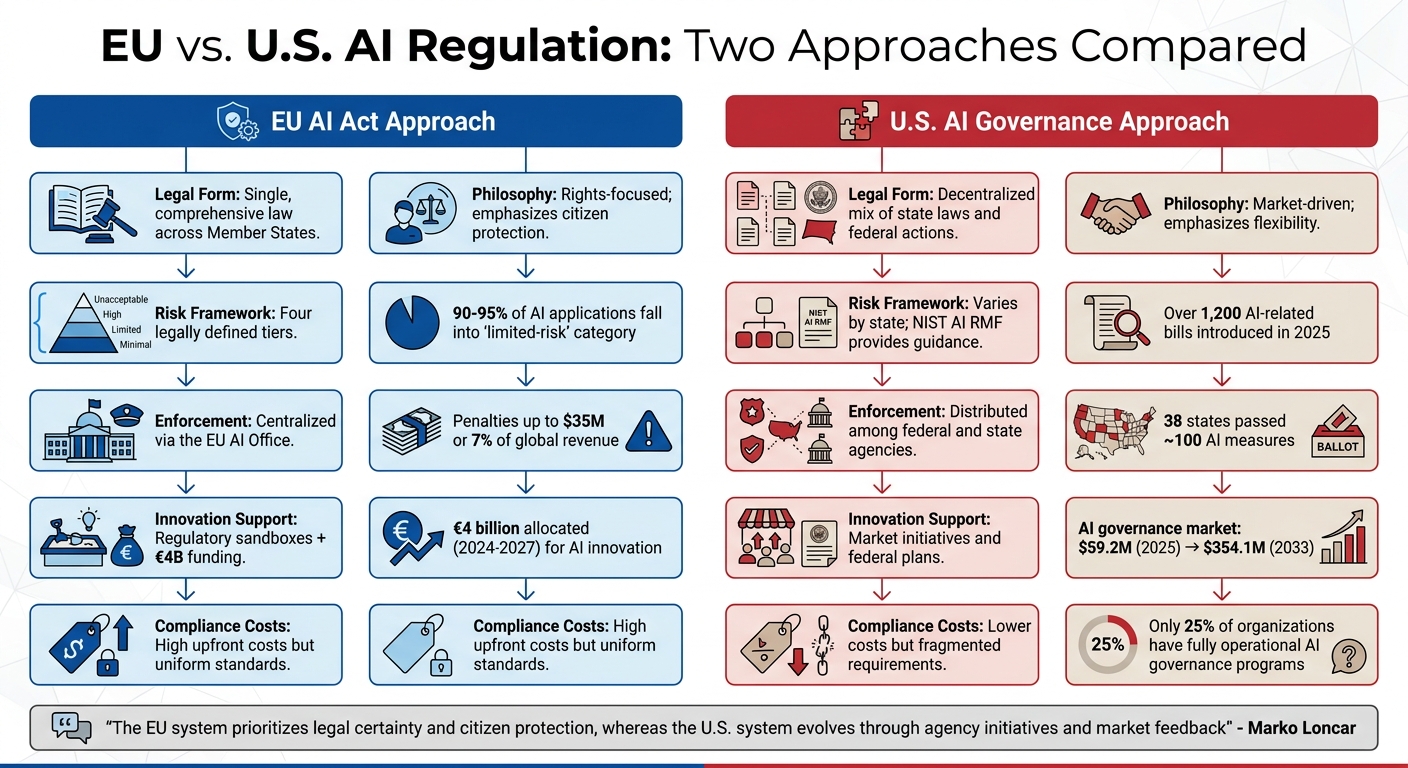
EU vs US AI Regulation Approaches: Key Differences in Governance Frameworks
Striking the right balance in AI regulation is essential to manage the risks of misinformation while preserving the creative energy that drives technological progress. The challenge lies in regulating AI effectively without stifling innovation. According to the Institute for Law & AI:
"The more precisely policymakers can identify the harm and the actor best positioned to prevent it, the more effective their interventions are likely to be".
Between 2024 and 2027, voluntary guidelines evolved into binding frameworks like the EU AI Act and various U.S. state laws. These frameworks aim to tailor rules to the actual risks posed by AI - imposing stricter requirements for high-risk systems and lighter ones for low-risk tools.
Clear Standards and Accountability
Clear and straightforward standards are more effective than overly complex rules. They allow developers to design compliant systems from the beginning. The EU AI Act employs a risk-based approach, categorizing AI systems by their risk levels. Notably, around 90% to 95% of AI applications fall into the "limited-risk" category, which only requires basic transparency measures rather than expensive audits.
Non-compliance can lead to steep penalties - up to $35 million or 7% of global revenue. However, when companies follow clear guidelines, they gain legal clarity and can operate confidently. By August 2025, the EU AI Office had adopted the General-Purpose AI Code of Practice after extensive consultations. Major players like Anthropic, Google, Microsoft, Mistral AI, OpenAI, and xAI committed to the Safety and Security Chapter, which turned broad legal principles into actionable safety measures ahead of full enforcement.
Accountability mechanisms such as human oversight, technical documentation, and conformity assessments help translate legal rules into everyday practices. However, as Kevin Frazier notes in Lawfare:
"Adopting misguided policies today may have long-term and irreversible impacts on the direction of AI development".
This highlights the importance of adaptable policies. Tools like sunset clauses, which require regular policy reviews, can prevent outdated laws from obstructing progress.
Multi-Stakeholder Policy Development
Effective AI regulation relies on collaboration among developers, affected communities, and regulators. The EU's Code of Practice exemplifies this approach, as it was created through joint efforts by developers, civil society groups, and academics to turn the AI Act's broad principles into practical technical standards.
This collaborative approach delivers real-world benefits. For example, in June 2026, Colorado enacted the AI Act (SB 24-205), becoming the first U.S. state to adopt comprehensive AI legislation. The law recognizes compliance with the NIST AI Risk Management Framework (NIST AI RMF) as evidence of "reasonable care". Dr. Faiz Rasool, Director of the Global AI Certification Council, explains:
"NIST AI RMF provides the closest thing to a universal foundation, because its structure aligns with ISO 42001 internationally and provides safe harbor domestically under Colorado law".
Regulatory sandboxes are another useful tool. These allow startups to test innovative AI systems under government supervision, enabling policymakers to base future regulations on real-world data. By 2025, the European Commission's Public Sector Tech Watch had identified 61 generative AI use cases across 20 Member States, including Italy's GENAI4LEX and Bulgaria's BgGPT, to facilitate safe experimentation.
The EU AI Innovation Package, which allocated approximately $4 billion between 2024 and 2027 for expanding computing capacity and developing AI factories, demonstrates how governments can encourage innovation while maintaining oversight. A national clearinghouse for AI policy experiments could further help U.S. regulators and industry leaders share best practices, ensuring that measures address societal risks like bias and misinformation alongside technical safety.
These initiatives provide a foundation for comparing how different regions approach AI regulation.
Comparing Different Regulatory Approaches
Regions like the EU and the U.S. are taking distinct paths to AI regulation, each with its own strengths and challenges. Understanding these differences is critical for businesses operating in a global market.
| Feature | EU AI Act Approach | U.S. AI Governance Approach |
|---|---|---|
| Legal Form | Single, comprehensive law across Member States | Decentralized mix of state laws and federal actions |
| Philosophy | Rights-focused; emphasizes citizen protection | Market-driven; emphasizes flexibility |
| Risk Framework | Four legally defined tiers | Varies by state; NIST AI RMF provides guidance |
| Enforcement | Centralized via the EU AI Office | Distributed among federal and state agencies |
| Innovation Support | Includes regulatory sandboxes and $4B funding | Relies on market initiatives and federal plans |
| Compliance Costs | High upfront costs but uniform standards | Lower costs but fragmented requirements |
As Marko Loncar explains:
"The EU system, often described as rigid but normatively consistent, prioritizes legal certainty and the protection of citizens, whereas the U.S. system evolves through agency initiatives and market feedback".
This "Brussels Effect" leads global companies to adopt EU-compliant practices even in jurisdictions with more lenient rules, effectively exporting European AI values worldwide.
The U.S. approach, though more flexible, presents its own hurdles. In 2025, lawmakers introduced over 1,200 AI-related bills, with 38 states passing around 100 measures. This fragmented landscape forces developers to navigate varying state rules, which can complicate compliance. For instance, a single state's strict regulations can affect national AI development because AI models cannot easily be tailored to meet individual state laws. As Susan Ariel Aaronson warns:
"Voluntary self-governance may be insufficient in high-risk contexts unless complemented by targeted legal requirements".
Despite the U.S. AI governance market being valued at $59.2 million in 2025 and projected to grow to $354.1 million by 2033, a study that year revealed only 25% of organizations had fully operational AI governance programs. This gap underscores the need for clear and coordinated standards to bridge the divide between regulatory demands and practical implementation.
Both the EU and U.S. frameworks aim to protect societal interests while enabling the growth of innovative AI applications.
Practical Ways to Balance Creativity and Risk Management
Managing AI risks without stifling creativity requires a thoughtful approach. By combining layered safeguards with proactive strategies, you can address potential issues while encouraging innovation.
Using Platforms Like NanoGPT

The platform you choose plays a big role in balancing cost, privacy, and functionality. NanoGPT, for example, offers a pay-as-you-go model that eliminates the need for costly monthly subscriptions. For just $0.10, users can experiment with a range of AI models like ChatGPT, Deepseek, Gemini, Flux Pro, Dall-E, and Stable Diffusion. This flexibility allows startups and developers to test various approaches and scale based on real needs, rather than locking into fixed fees.
NanoGPT also prioritizes privacy by storing data locally on users' devices. This design ensures that sensitive inputs - whether creative prompts or proprietary training data - stay under your control, reducing the risk of data leaks.
While platforms like NanoGPT provide a solid foundation, human involvement remains essential for ensuring trust and accuracy in AI-generated outputs.
Adding Human Review and Ethical Data Sources
As Zack Holland, Founder of Averi, puts it:
"AI‐generated content without human oversight isn't just risky… it's brand suicide waiting to happen".
Human oversight is critical, especially since 94% of AI content accuracy issues can be avoided through proper review processes. Companies that implement structured reviews see a 67% boost in content quality. For industries like legal, healthcare, or finance, where precision is non-negotiable, having a human-in-the-loop system is indispensable.
Arielle Newman, Senior Editor & AI Governance Strategist at Approves.xyz, underscores this:
"The most important control is a reliable human‑in‑the‑loop review for all customer‑facing and legally sensitive outputs".
Combining human oversight with Retrieval-Augmented Generation (RAG) enhances reliability even further. RAG uses curated data to reduce hallucination rates, which typically range from 15% to 27%. Platforms like CustomGPT.ai also emphasize the importance of claim-level verification. As they explain:
"Citations aren't proof. Citations show where the model looked; verification checks whether each factual claim is supported by approved sources".
CustomGPT.ai, which has processed over 19,000 queries for more than 5,000 monthly visitors, demonstrates how scalable and effective claim-level verification can be.
Adopting Voluntary Ethical Standards
Instead of waiting for regulations, many companies are taking the lead by adopting voluntary ethical frameworks. The NIST AI Risk Management Framework (AI RMF) and its Generative AI Profile offer structured guidelines for developing AI responsibly. These frameworks help mitigate risks like bias and misinformation while creating an environment where innovation can thrive.
Rahul Yadav, CTO of Milestone Systems, views compliance as a chance to stand out:
"Treat evolving oversight as an opportunity for experimentation and ethical differentiation and to get ahead of AI regulations as a leader in the field".
This proactive approach is especially important given that 39% of marketers currently avoid AI tools due to safety concerns. By adopting responsible practices, companies can not only address these concerns but also gain a competitive edge.
Practical steps include treating prompts like source code by versioning and reviewing them, using red teaming to identify vulnerabilities before release, and maintaining detailed audit trails. These trails should document user inputs, retrieved sources, final outputs, and human approvals to meet any regulatory requirements. Additionally, clearly labeling AI-generated content helps maintain transparency and trust with audiences.
Conclusion
A balanced approach to AI regulation is not just possible - it’s essential. Such regulation should merge innovation with safety, ensuring that high-stakes industries are carefully monitored while still leaving room for creative exploration. Karen Robinson, Senior Vice President and Deputy General Counsel at Adobe, puts it best:
"Regulation doesn't have to mean overregulation. Rather than narrowly tailored policies that struggle to keep pace with rapid technological change, the goal should be to establish flexible frameworks that promote fair competition and protect creators".
Trust plays a critical role in unlocking AI's economic potential. Studies indicate that even a handful of high-profile cases involving AI-driven financial fraud could severely undermine public confidence. To address this, transparency measures like watermarking and secure metadata are essential tools.
Collaboration across various stakeholders is also key. By setting standards for both the inputs and outputs of AI systems, we can ensure accountability while safeguarding the rights of creators. For example, China's Deep Synthesis Law, implemented on January 10, 2023, highlights a growing trend in regulation that now includes text generation alongside visual deepfakes.
Blending technical safeguards - such as Retrieval-Augmented Generation and adversarial post-training - with human oversight has proven to deliver better results. The 70-20-10 framework (70% AI automation, 20% human oversight, 10% strategic refinement) is a practical model for maintaining quality while utilizing AI's efficiency. By committing to ongoing AI governance, organizations can adapt to emerging risks without stifling the creative possibilities AI offers. These strategies align with earlier discussions on managing misinformation while preserving room for innovation.
FAQs
What makes an AI system “high risk” vs “limited risk”?
AI systems are generally grouped into two categories: high risk and limited risk, depending on their potential impact and the level of oversight they require. High-risk systems, such as those used in healthcare or finance, carry the potential to influence safety or fundamental rights, making strict oversight essential. On the other hand, limited-risk systems, like those designed for entertainment purposes, present minimal potential for harm and therefore face fewer regulatory requirements. Factors like context, ethical considerations, and the presence of safeguards also play a role in determining where a system falls within this classification.
Who owns the copyright for AI-generated text?
In the United States, whether AI-generated text qualifies for copyright protection depends on the level of human involvement. If a piece includes substantial human creative input, it may be eligible for copyright. However, content created entirely by a machine, without any human contribution, usually doesn't meet the criteria for protection. This approach follows the current guidelines set by U.S. copyright authorities.
How can I reduce AI hallucinations without slowing creation?
To keep AI outputs accurate without slowing things down, you can use strategies like grounding, retrieval-augmented generation (RAG), and guardrails. Grounding involves real-time fact-checking, which helps ensure the information is accurate. RAG works by pulling in relevant data as needed, cutting down on mistakes while maintaining efficiency. Guardrails, combined with output monitoring, act as a safety net, catching errors early and keeping the results reliable - all without disrupting creativity.