
Ultimate Guide to AI Text Quality Scoring Platforms
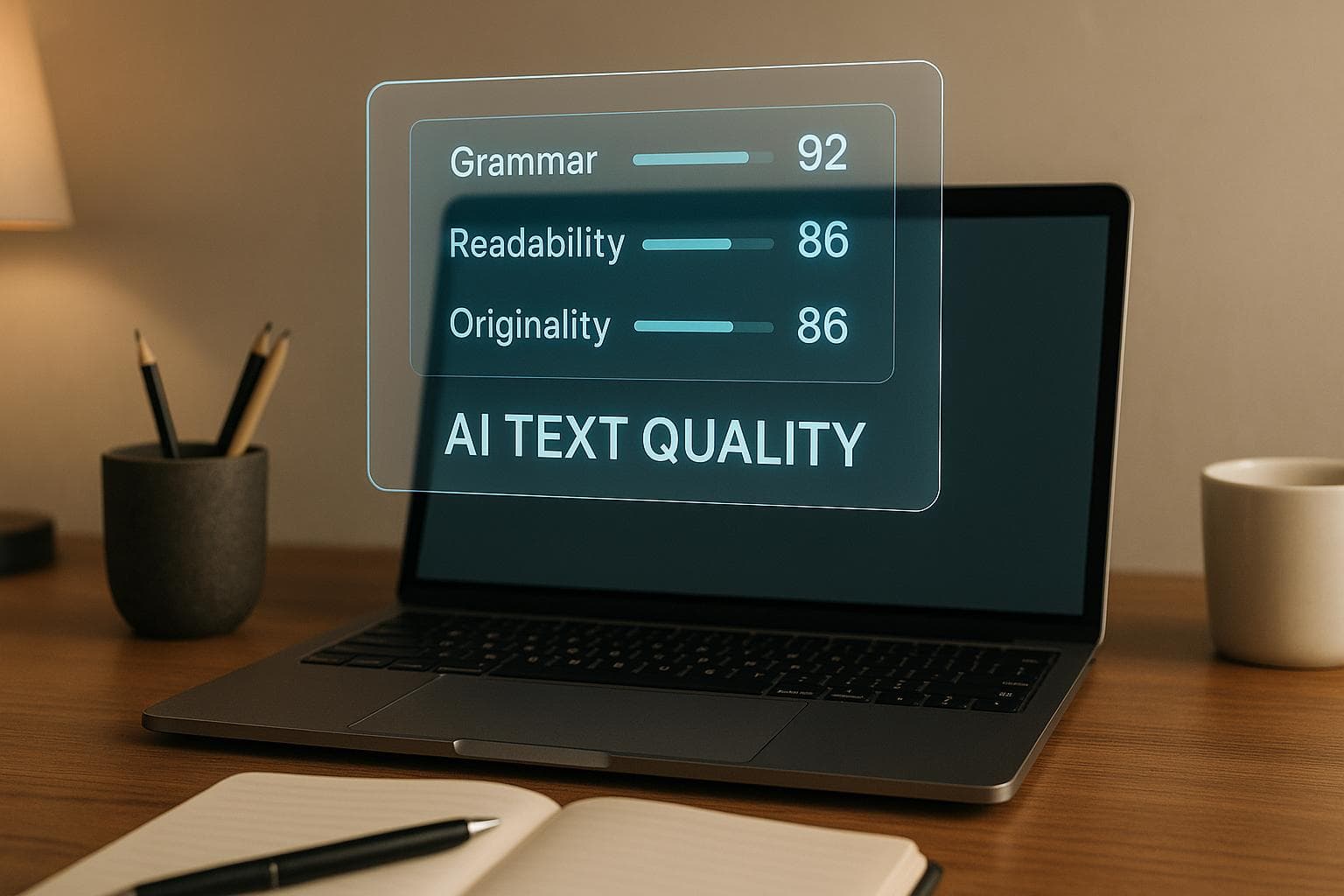
AI text quality scoring platforms are tools that automatically assess and improve written content using advanced technologies like natural language processing and machine learning. These platforms evaluate grammar, readability, tone, and originality, providing actionable feedback to help users enhance their writing. They’re widely used in industries like education, marketing, and publishing to save time, ensure consistency, and maintain high content standards.
Key Takeaways:
- What They Do: Analyze text for grammar, readability, tone, originality, and relevance.
- Why They’re Useful: Save time, provide unbiased evaluations, and deliver real-time feedback.
- Core Features: Grammar checks, readability scoring (e.g., Flesch-Kincaid), tone analysis, plagiarism detection, and sentiment analysis.
- Use Cases: Academic grading, content editing, customer feedback analysis, and SEO optimization.
- Limitations: Struggles with context, creativity, and nuanced writing; human review remains essential for critical tasks.
Spotlight on NanoGPT:
NanoGPT stands out for its privacy-first approach and pay-as-you-go pricing. Unlike cloud-based tools, it processes and stores data locally, ensuring sensitive information stays secure. It integrates multiple AI models (e.g., ChatGPT, Gemini) for cross-checking text evaluations, making it a flexible option for users with varying needs.
NanoGPT Highlights:
- Privacy: Data stays on your device; no account required.
- Cost: Starts at $0.10 per use, avoiding subscription fees.
- Versatility: Supports text and image generation, suitable for diverse workflows.
AI text scoring tools are indispensable for managing today’s massive content demands. By combining AI’s efficiency with human judgment, you can achieve higher-quality results while maintaining control over sensitive data.
How to measure LLM writing quality when there is no right answer?
Core Metrics for Evaluating Text Quality
AI text quality scoring platforms evaluate written content using several important metrics. These go beyond basic spell-checking to provide a detailed assessment of a text's strengths and areas for improvement, covering various aspects of writing quality.
Grammar, Spelling, and Readability
This metric focuses on ensuring that the text is both structurally accurate and easy to understand. AI tools identify grammatical errors, spelling mistakes, and awkward phrasing while assessing readability. Metrics like the Flesch-Kincaid Grade Level measure sentence length and word complexity - an 8th-grade level is often recommended for broader accessibility, while higher levels indicate more advanced writing.
Many platforms provide detailed feedback on these aspects, helping writers create polished, error-free content that aligns with their audience's reading level.
Clarity, Tone, and Style Consistency
Beyond correcting errors, this metric evaluates how well the text communicates its message. AI systems analyze sentence structure, word choice, and context to flag unclear sections. They also assess tone and formality, ensuring the writing matches the intended audience's expectations. For instance, style consistency tools help maintain a uniform voice by comparing the text to predefined guidelines or earlier samples.
These capabilities are particularly useful in professional settings. Businesses, for example, use such tools to analyze customer feedback for clarity and sentiment, aiming to enhance service quality.
Originality and Topic Relevance
This metric ensures content is authentic and focused. Advanced plagiarism detection tools compare text against extensive databases to identify copied or closely paraphrased material. Many platforms are also adept at spotting AI-generated content, with high accuracy rates.
For topic relevance, semantic analysis is used to confirm that the content stays on track, incorporates relevant keywords, and meets audience expectations. This is especially important for SEO, academic work, and customer communications, as straying off-topic can harm engagement and credibility. Academic tools, for example, rely on these metrics to grade essays and verify that students address assignment requirements.
While these metrics make AI scoring platforms highly effective, experts suggest pairing automated evaluations with human reviews for critical content that requires a more nuanced understanding.
How AI Text Quality Scoring Platforms Work
To get the most out of AI text quality scoring platforms, it's helpful to understand how these systems operate. The process involves several technical steps that turn raw text into usable insights. However, human involvement remains essential to ensure accuracy and fairness.
Steps in the Scoring Process
The scoring journey begins with content ingestion, where platforms receive text through various methods like direct input, file uploads, or integrations with existing tools. This step ensures the system can handle different file formats and prepares the text for analysis.
Next is data preprocessing, a crucial phase that organizes the text for accurate evaluation. Here, the system breaks the text into smaller units (a process called tokenization), standardizes features like punctuation and capitalization, and applies techniques like lemmatization (reducing words to their base forms) and entity recognition for better understanding.
Once preprocessed, the text moves to feature extraction, where the AI examines linguistic and semantic details. This includes checking grammar, spelling, readability, tone, and originality. The result is a detailed profile that highlights the text’s strengths and weaknesses.
The extracted features are then fed into scoring models, which use machine learning or deep learning algorithms to evaluate the text against predefined quality benchmarks.
Finally, the platform generates actionable feedback. Modern tools go beyond a simple score, providing detailed reports that pinpoint grammar errors, readability problems, and originality concerns. Some platforms even offer real-time feedback with sentence-level analysis, helping users identify exactly where improvements are needed. Advanced features can identify AI-generated sentences, offer certification options for content authenticity, or link sentiment analysis to performance metrics, such as coaching suggestions for call center agents.
Despite these sophisticated steps, human oversight is still necessary to address certain limitations.
Limitations and the Role of Human Review
While AI text scoring platforms are advanced, they aren’t without flaws. One major challenge is understanding context, sarcasm, or cultural references. AI models trained on standard patterns often struggle with creative writing, nuanced arguments, or unconventional stylistic choices.
Another issue is bias in training data, which can skew results. For instance, models may favor specific writing styles or perspectives, leading to unfair scores for content that deviates from these norms. This can disadvantage diverse voices or innovative approaches.
AI’s lack of appreciation for creativity and rhetoric also poses problems. For example, sentence fragments in creative writing might be flagged as errors, and unconventional structures in persuasive content could be misjudged.
These challenges make human review essential in areas like academia, publishing, and customer service. In these contexts, AI works best as a first pass, identifying obvious issues while human reviewers handle the nuanced evaluation of arguments, cultural appropriateness, and creative merit.
The constant evolution of AI writing tools adds another layer of complexity. As these tools improve, detection systems must keep pace, which can sometimes lead to misclassifications, especially with heavily edited or paraphrased content.
For organizations, the key is to see AI text scoring platforms as assistants rather than replacements. Combining AI's speed and precision with human expertise in meaning and context creates the most effective approach.
sbb-itb-903b5f2
Practical Applications and Use Cases
AI-driven text quality scoring tools are transforming a variety of industries by offering consistent evaluations and insights that are tough to replicate manually. From education to publishing and customer service, these tools are making processes more efficient and results more reliable.
Academic and Educational Use Cases
In education, AI text quality scoring has become a go-to resource for tasks like automated grading, plagiarism detection, and providing detailed feedback. These tools save educators time by analyzing grammar, originality, and overall coherence, delivering instant results that are both standardized and actionable. For instance, they can highlight common student struggles, like crafting strong thesis statements, allowing instructors to tweak their teaching strategies. When faced with evaluating hundreds of essays, AI ensures every submission is judged by the same criteria, eliminating inconsistencies that often arise with multiple human graders. Beyond academia, this technology also helps content creators improve their work by identifying areas for refinement.
Content Creation and Publishing
For content creators and publishers, AI platforms are invaluable in ensuring quality, originality, and consistency before material goes public. By catching errors or plagiarism early, these tools help protect a brand’s reputation and improve SEO rankings. Many publishers have noted faster production times, higher-quality content, and reduced editing costs thanks to automated checks. Advanced detection features also help maintain a brand’s authenticity and boost SEO. Additionally, tools designed for content enhancement enable large teams to maintain a consistent tone and voice, making it easier for marketing managers to oversee multiple projects without sacrificing quality.
Customer Feedback and Service Analysis
AI also shines in analyzing customer feedback, whether it’s from reviews, surveys, or support tickets. Natural language processing tools can identify sentiment, recurring issues, and service quality trends, offering actionable insights for businesses. Companies use these insights to track performance metrics and make data-driven improvements. For example, a retail company might analyze post-purchase surveys to pinpoint product weaknesses or improve customer support.
Call centers benefit, too, by using AI to evaluate agent performance through chat transcripts and email reviews. This helps identify top-performing agents and those who need more training. In high-pressure situations, like managing a surge of negative feedback after a product defect, AI tools can alert management within hours, enabling a swift and effective response. By unifying feedback from multiple channels and focusing on privacy, these platforms ensure consistent quality across all customer interactions.
NanoGPT: A Different Approach to AI Text Scoring
While many AI platforms require subscriptions and store data remotely, NanoGPT sets itself apart by focusing on privacy and cost flexibility. It offers access to multiple advanced AI models, all designed to enhance text evaluation and improvement.
Building on these principles, NanoGPT introduces fresh features to redefine AI text scoring.
Key Features and Benefits of NanoGPT
NanoGPT gathers a variety of AI models - ChatGPT, Deepseek, Gemini, Flux Pro, Dall-E, and Stable Diffusion - into one user-friendly interface. This multi-model setup allows users to cross-check text quality assessments and choose the most suitable AI engine for specific tasks.
What truly stands out is the platform's privacy-first approach. All conversations and data are stored locally on the user's device. Unlike cloud-based services, which process and store data on external servers, NanoGPT ensures that sensitive information remains secure. This feature is particularly appealing to industries like healthcare, legal, and education, where strict data compliance is essential.
"Conversations are saved on your device. We strictly inform providers not to train models on your data. Use us, and make sure that your data stays private."
– NanoGPT Website
NanoGPT also eliminates the need for account creation. Users can access its services without registration, reducing the collection of personal information. For those opting for pay-as-you-go features, a secure cookie links funds to their device, bypassing the need for a full account.
How NanoGPT Supports Text Quality Scoring
NanoGPT integrates effortlessly into existing workflows for evaluating text quality. Its diverse AI model ecosystem helps content creators fine-tune their work. For instance, ChatGPT can analyze tone, while Gemini or Deepseek focuses on grammar and originality. This multi-model validation provides a more nuanced and accurate assessment compared to relying on a single AI engine.
The platform has proven particularly useful in education. A U.S.-based academic institution, for example, adopted NanoGPT for its writing center. Students received instant feedback on grammar and originality, all while keeping their data secure.
Digital marketing agencies have also benefited. One agency used NanoGPT to refine blog posts before publication, which led to higher reader engagement and less time spent on editing. Comparing outputs from different models allowed them to discover effective strategies for improving content.
NanoGPT's versatility extends beyond text. It supports both text and image generation, making it a comprehensive tool for content workflows. Users can draft, evaluate, and refine their work while maintaining consistent quality across different formats.
Pricing and Accessibility
NanoGPT’s pay-as-you-go model, starting at $0.10 per use, removes the barriers of traditional subscriptions. This makes it especially appealing to freelancers, small businesses, and educational institutions with varying usage needs.
"We believe AI should be accessible to anyone. Therefore we enable you to only pay for what you use on NanoGPT, since a large part of the world does not have the possibility to pay for subscriptions."
– NanoGPT Website
A satisfied user shared:
"I use this a lot. Prefer it since I have access to all the best LLM and image generation models instead of only being able to afford subscribing to one service, like Chat-GPT."
– Craly, @craly
In educational settings, the affordability is a game-changer:
"It's absolutely brilliant - I share it with anyone who ever mentions Chat-GPT including when I did a panel for ARU on the AI revolution - the students were pretty excited at not paying a subscription!"
– George Coxon, @yap-rai
This pricing structure allows users to experiment with AI text scoring without committing to long-term financial obligations. Organizations can test and evaluate the platform before scaling its use. The transparent, usage-based billing resonates with U.S. preferences for clear, predictable costs without hidden fees.
Conclusion and Key Takeaways
Why AI Text Quality Scoring Matters
In today’s fast-paced, content-heavy world, AI text quality scoring platforms have become indispensable. With projections estimating 175 zettabytes of data by 2025, relying on manual reviews alone simply isn’t practical. These platforms provide quick, unbiased evaluations of grammar, readability, tone, and originality, helping to manage content volumes that would overwhelm traditional editorial teams.
Industries such as education, publishing, and customer service increasingly rely on AI tools to streamline evaluations and improve feedback. However, the best results come from blending AI’s efficiency with human expertise. While AI handles the heavy lifting, human judgment ensures context and nuance are preserved in final editorial decisions.
NanoGPT as a Privacy-Focused Solution
NanoGPT takes these principles a step further by offering a privacy-first approach to AI text scoring. Unlike cloud-based services that store data externally, NanoGPT keeps all data local, giving users full control over sensitive content. This feature is especially valuable in sectors like healthcare, legal, and education, where maintaining data security is non-negotiable.
NanoGPT’s multi-model ecosystem allows users to compare evaluations from multiple AI models, including ChatGPT, Deepseek, and Gemini, delivering a well-rounded analysis of text quality. Its pay-as-you-go pricing model - starting at just $0.10 - removes the barrier of subscriptions, making advanced AI tools accessible to freelancers, small businesses, and educational institutions with varying needs.
When selecting an AI text scoring solution, organizations should focus on factors like accuracy, privacy, integration, and cost. NanoGPT’s combination of multi-model access, local data control, and flexible pricing makes it a standout option. By balancing efficiency, data security, and affordability, NanoGPT positions itself as a forward-thinking tool for anyone seeking smarter, safer content workflows in the evolving AI landscape.
FAQs
How does NanoGPT protect my data while using its AI text quality scoring tools?
NanoGPT takes your privacy seriously by ensuring that all your data stays securely on your device. This means your information never leaves your hands. On top of that, the platform guarantees that your data won't be used to train AI models, so you can use its features with complete confidence.
What are the benefits of NanoGPT's pay-as-you-go pricing compared to traditional subscriptions?
NanoGPT’s pay-as-you-go model gives users the freedom to pay solely for the AI resources they use. There’s no need for long-term contracts or upfront subscription costs, making it a smart choice for those with changing or unpredictable requirements.
On top of that, NanoGPT puts a strong emphasis on privacy. By keeping all data stored locally on the user’s device, it ensures users have greater control and security over their personal information.
How does NanoGPT's multi-model system improve the accuracy and depth of text quality evaluations?
NanoGPT offers a multi-model system that simplifies text quality evaluations by bringing together various AI models - like GPT 4o, Claude, DeepSeek, and Gemini - on a single platform. This setup allows users to easily switch between models, tailoring their experience to find the most accurate and context-specific insights for their needs.
By tapping into the distinct capabilities of each AI model, NanoGPT provides more thorough and dependable text quality assessments. This approach ensures a comprehensive and precise analysis of any content.