
7 Battery Storage Trends for AI Data Centers
AI data centers are hitting a power wall, and battery storage is now part of capacity planning. I’d sum it up this way: when racks move from about 10 kW to 60 kW, 80 kW, or 100+ kW, backup power stops being a side topic and becomes part of how a site gets built, opened, and expanded.
If you want the short answer, here it is:
- I see battery systems moving from minutes of backup to hours of support
- I see behind-the-meter storage helping sites deal with 3-to-5-year grid delays
- I see hybrid setups pairing batteries with on-site generation
- I see DC-coupled and grid-aware designs helping campuses use power more efficiently
- I see chemistry choice shaping fire risk, cooling, space use, and supply-chain exposure
- I see control software turning battery fleets into usable site capacity
- I see modular battery blocks helping teams grow in phases instead of overbuilding on day one
That shift matters because U.S. data center demand is expected to climb from 35 GW in 2024 to more than 100 GW by 2035, while many projects still face power delays. At the same time, electricity can account for 10%+ of TCO, so battery choices affect both uptime and day-to-day cost.
Quick Comparison
| Trend | What it helps with most | Main trade-off |
|---|---|---|
| Long-duration storage | Multi-hour support | Higher upfront cost and more space |
| Behind-the-meter BESS | Opening sites before full grid build-out | Fire safety and site integration work |
| Hybrid backup | Short ride-through plus long runtime | More system and permitting complexity |
| DC-coupled / grid-interactive BESS | Better power flow and phased growth | More control coordination |
| New battery chemistries | Safety, runtime, footprint, sourcing | Different performance and supply limits |
| Site-level control software | Dispatch, thermal control, failover | More reliance on software quality |
| Modular, high-density systems | Phased expansion in tight spaces | Heat and cooling planning |
In short, I’d treat battery planning as part of site design, not just backup procurement. The main question is no longer “Do we need batteries?” It’s which battery setup fits the load, timeline, site limits, and build phase.
sbb-itb-903b5f2
Why Battery Strategy Affects AI Data Center Capacity Plans
Battery choices now shape when, where, and how fast an AI campus can add load. In the U.S., grid interconnection queues now run three to five years, and nearly 50% of all AI data center projects are expected to hit delays in 2026 due to power limits. That turns storage architecture into a capacity-planning decision, not just a backup system choice.
At about 60 kW per rack, AI workloads use around six times more power than general-purpose servers. And that changes the math. A battery built for flat, steady demand can fall short when AI workloads swing fast. So duration, chemistry, and controls need to match the load profile. Those choices affect how much storage the site needs, how fast it has to respond, and how operators control it. They also ripple into the facility’s electrical and physical design.
Battery design affects the building itself too. It changes layout, fire protection, and usable footprint. Lithium-ion systems come with thermal runaway risk, so chemistry choice affects fire suppression needs and how much floor area must be set aside for safety systems. Higher-density enclosures shrink the storage footprint, which means more of the building can go to compute. That matters when space is tight. Cooling already uses 30% to 40% of a data center’s total energy budget, so battery heat output has to be planned alongside the rest of the site.
Cost is part of the picture as well. Electricity already makes up more than 10% of TCO at high-density facilities. So a battery system that supports peak shaving or energy arbitrage can lower operating costs over time. Many operators use behind-the-meter storage to open sooner and push back grid dependence. But there’s a trade-off: lower power costs and faster site readiness on one side, higher upfront capital on the other.
The same thinking applies to phased buildouts. Modular, high-density systems let operators add capacity in stages without overbuilding electrical infrastructure in phase one. Those pressures are driving seven clear storage shifts across AI campuses.
1. Long-Duration Energy Storage
The first shift is moving from short UPS backup to storage built for sustained AI loads. Long-duration energy storage (LDES) pushes backup from minutes to hours, which changes how teams plan capacity. The focus is no longer just power output. It’s also about how much energy the system can hold.
AI training jobs can run for long stretches, so a battery that only bridges a brief outage doesn’t cut it anymore. That changes planning from simple outage coverage to energy duration.
Behind-the-meter LDES also gives operators a way to absorb load spikes when grid power lags. That matters more as AI campuses get bigger. When storage is sized for duration, not just peak demand, the battery system starts to look less like a last-resort backup and more like part of the site’s core capacity setup.
Power disruptions are a bigger concern in AI facilities because they can cause silent data corruption in training runs. So lifecycle cost now sits near the center of planning. Operators have to model lifecycle cost against build phases, not just outage length.
2. Behind-the-Meter Battery Energy Storage Systems
Behind-the-meter (BTM) BESS sits on the customer side of the meter. That means a facility can use stored power directly instead of waiting on the utility first. For AI data centers, that matters a lot because grid interconnection can take 3 to 5 years in many regions. In practice, BTM storage is more than a backup asset. It's a deployment tool.
AI racks draw about 60 kW each, so BTM storage helps fill the gap when utility upgrades move too slowly. That gap isn't small. When power demand shows up before grid capacity does, operators need another way to keep projects moving.
From there, many teams pair BTM storage with backup systems that can handle both short outages and longer site constraints. By late 2025, some AI campuses were already using on-site generation and BTM batteries to work around local grid limits.
BTM BESS also changes how operators plan for both MW and MWh. It can cover peak loads and help sustain long training cycles. That push in planning is what leads to hybrid backup designs built for AI campuses.
3. Hybrid Backup Architectures
A hybrid backup architecture combines multiple power layers into one coordinated system. In AI data centers, that usually means a grid connection paired with on-site generation - such as natural gas turbines or reciprocating engines - plus a Battery Energy Storage System (BESS).
Each layer covers a different part of an outage. Batteries handle millisecond ride-through. Generators take over for longer outages that BESS can't support cost-effectively at campus scale.
That setup changes capacity planning in a pretty direct way. Operators can size batteries for short ride-through and size generators for sustained runtime. In plain English, each system does the job it’s best at.
That split also gives teams more room to phase buildouts without oversizing batteries for multi-hour runtime. And that matters, because it can help avoid expensive utility infrastructure upgrades and the long timelines that often come with them.
xAI's Colossus in Memphis uses on-site gas generation with battery storage to stay online while utility upgrades lag.
The trade-off is added battery fire-safety planning and more emissions permitting. That coordination matters even more in DC-coupled and grid-interactive designs.
4. DC-Coupled and Grid-Interactive BESS Designs
These designs take hybrid backup a step further by changing how batteries connect to on-site power and the grid. They solve different capacity problems in different ways. A DC-coupled BESS connects storage straight into the site’s power setup, which can improve efficiency and speed deployment for high-density AI workloads. A grid-interactive BESS reacts to utility signals and changing site demand.
For AI campuses, that matters a lot. These setups can reduce reliance on immediate utility upgrades and give operators more room to grow load in phases instead of waiting for the full grid build-out.
A big part of the push comes from grid delays. Grid-interactive systems let operators shift load, support peak periods, and keep expansion plans moving while utility work catches up. A 2025 FERC order allowing direct connections to power plants is a key piece of this. It gives large AI facilities a way to secure capacity outside the usual utility bottlenecks.
There’s a catch, of course. The system needs tighter coordination across storage, generation, and facility loads. But that tighter control can pay off. Grid-interactive systems can also help reduce blackout risk during peak AI load, especially when it overlaps with residential demand. That same need for closer coordination is also driving interest in new chemistries and better site controls.
5. New Battery Chemistries for AI Facilities
Battery chemistry shapes runtime, footprint, cooling load, fire risk, and replacement cycles. And as rack density climbs, those trade-offs matter a lot more.
For many large AI battery systems, LFP has become the default pick. It lowers thermal runaway risk compared with other lithium-ion types, which changes fire suppression needs and how much floor space a site has to set aside for safety systems. xAI's Colossus uses lithium-ion, EV-derived battery infrastructure. So the next decision isn't whether batteries matter. It's which chemistry fits the site's runtime target, safety needs, and space limits.
Sodium-ion gives operators another path on sourcing. That's a big deal as more teams try to cut reliance on China-linked battery supply chains. U.S. data center operators still face heavy dependence on China-linked supply chains, so chemistry choice now carries a direct deployment risk on top of the usual performance trade-offs.
Flow batteries make sense for sites that need longer runtime without the thermal density that comes with lithium-ion. Because power loss can corrupt training runs, battery chemistry affects both reliability and capacity planning. It also changes how much software control a site needs, which makes control software the next layer in battery planning.
6. Site-Level Control Software and Storage Management
Chemistry sets the ceiling. Software decides how much of that ceiling you can actually use.
New battery chemistries don’t deliver much on their own. They need controls that can run them safely, keep them efficient, and help them respond the right way under pressure. That’s why controls matter just as much as battery type.
In AI data centers, control software helps keep power stable and stops faults before they spread into training errors. It manages thermal load, dispatches battery reserve, and throttles demand during stress events so teams can protect hardware and cut waste.
Software also affects how a site grows. With the right control layer, operators can scale storage in phases instead of reworking the full electrical design each time. Software-managed storage blocks let teams add capacity bit by bit as load climbs, without the permitting delays and physical limits that come with redesigning electrical infrastructure from scratch.
At its core, the job is orchestration. The software syncs batteries, generators, and load control so storage supports capacity growth, not just backup. That orchestration layer is what turns storage into usable capacity.
7. Modular, High-Density Battery Systems
Software matters, but hardware has to keep pace. Modular, high-density battery systems are storage units built to scale, often using lithium-ion cells or EV-derived battery tech. They deliver strong power output in a small footprint, which is a big deal when space is tight. Instead of betting on one massive buildout, operators can add battery blocks over time as demand climbs.
That flexibility matters because load is often growing faster than utility upgrades. In many cases, modular hardware is the simplest way to add capacity without reworking the entire site. If software tells storage when and how to respond, modular hardware decides how fast that storage can grow.
The space savings are pretty straightforward. These systems let operators add capacity inside existing building limits instead of pushing outward. That changes the planning equation. High-density backup storage is now something teams need to plan for early, and compact, stackable designs make that a lot easier without major civil or electrical work.
Modular blocks also fit phased builds well. Capacity needs can shift much faster than infrastructure timelines, so adding storage in smaller chunks makes more sense than overbuilding on day one. Electricity already makes up more than 10% of total cost of ownership at high-density facilities. So tying storage additions to actual load growth can keep capital spending tighter.
For planning teams, this comes down to timing. Modular battery blocks make it easier to line up storage growth with:
- GPU refresh cycles
- Facility load growth
- Phased capacity expansion
That’s why these systems matter. They let operators add capacity in smaller, faster steps without redesigning the whole site.
Comparing the Seven Trends Side by Side
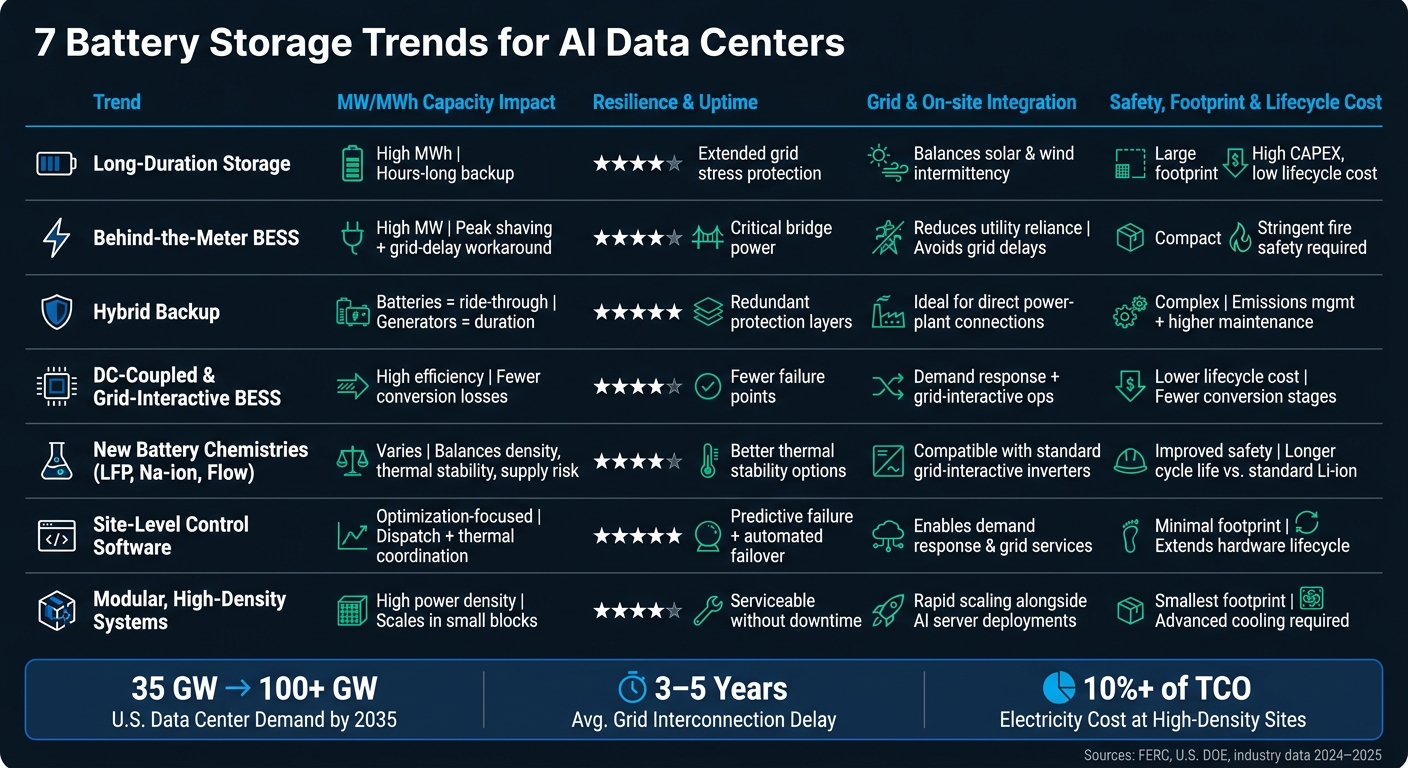
7 Battery Storage Trends Shaping AI Data Centers in 2025
Each trend in this article tackles a different capacity bottleneck. The reason is simple: load is growing fast, while grid buildout is moving a lot slower. Some options add more MW or MWh. Others cut lifecycle costs, reduce site space, or help keep systems online when the grid gets shaky. The table below puts those trade-offs next to each other.
| Trend | MW/MWh Capacity Impact | Resilience & Uptime | Grid & On-site Integration | Safety, Footprint & Lifecycle Cost |
|---|---|---|---|---|
| 1. Long-Duration Storage | High MWh; supports hours-long backup and renewable firming | High; helps protect against extended grid stress | Essential for balancing intermittent solar and wind | Large footprint; higher upfront CAPEX, lower long-term lifecycle cost |
| 2. Behind-the-Meter BESS | High MW; supports peak shaving and grid-delay workarounds | Critical bridge power during grid fluctuations | Reduces reliance on utility infrastructure and helps avoid grid delays | Compact; requires stringent fire safety for near-site use |
| 3. Hybrid Backup | Batteries handle ride-through; generators provide duration | Very high; provides redundant layers of protection | Ideal for sites with direct power-plant connections | Complex; involves emissions management and higher maintenance |
| 4. DC-Coupled and Grid-Interactive BESS | High efficiency; reduces conversion losses | High; fewer conversion stages mean fewer failure points | Supports grid-interactive operation and demand response | Lower lifecycle cost due to fewer conversion losses |
| 5. New Battery Chemistries | Varies; balances density, thermal stability, and supply risk | High; some chemistries offer better thermal stability | Compatible with standard grid-interactive inverters | Improved safety; potentially longer cycle life than standard Li-ion |
| 6. Control Software | Optimization-focused; coordinates dispatch, thermal limits, and failover | Critical; enables predictive failure analysis and automated failover | Enables demand response and grid services | Low footprint; extends hardware lifecycle and lowers total cost of ownership |
| 7. Modular, High-Density | High power density; scales in small blocks within tight footprints | High; serviceable without downtime | Designed for rapid scaling alongside AI server deployments | Smallest footprint; requires advanced cooling to manage heat |
No single trend wins across every column. Long-duration storage has the deepest MWh effect. Hybrid backup gives the strongest resilience. DC-coupled designs and control software stand out on lifecycle cost, while modular, high-density systems make the most sense when space is tight.
The best mix comes down to a few on-the-ground constraints: utility timing, site size, and permitting rules. In practice, that means the right answer often isn’t one system. It’s a combination that fits the site you have, not the one you wish you had.
U.S. Planning Considerations
In the U.S., the right battery mix is often shaped less by the battery itself and more by interconnection, permitting, and local support. In plain English: the best design on paper doesn't matter if you can't get it built. That reality tends to favor BTM, hybrid, modular, and grid-interactive setups over options that rely on fast utility upgrades.
Interconnection delays still push many operators toward behind-the-meter storage. A 2025 FERC order allowing direct connections to power plants gives large facilities another route around utility bottlenecks. That's why these limits often steer buyers toward storage that can go in place before full grid upgrades show up.
Local pushback is another big factor. Concerns about power draw, water use, and noise have already stalled about $130 billion in AI data center projects across the country. Smaller, denser, safer systems are often easier to permit, and on-site storage plus peak shaving can help a project make a better case in front of local planning boards.
Federal and state incentives also have a direct effect on battery buying decisions and build schedules. Michigan, for example, approved tax breaks for data center equipment and construction materials in 2024. Then, in April 2025, the U.S. Department of Energy identified federal sites as candidates for data center development. Those site limits are the practical test for the seven trends above.
Conclusion
The shift is already here. BESS is now core infrastructure that shapes site selection, scaling speed, and uptime.
Put the seven trends together, and one thing becomes clear: storage now needs to support capacity growth, not just backup during outages. Long-duration storage and hybrid architectures extend runtime. DC-coupled and grid-interactive designs add more flexibility. Site-level control software helps coordinate dispatch. Modular high-density systems and new chemistries give planners room to add capacity in phases instead of oversizing builds from day one.
And that matters more than ever. U.S. data center power demand is projected to reach 134.4 GW by 2030, while interconnection queues now stretch three to five years. In that kind of market, flexibility isn't optional - it's the plan.
That’s why battery design now belongs in early campus planning, right alongside power, cooling, and interconnection. Battery strategy is now a capacity-planning decision, not a procurement afterthought. The right mix will shape how fast AI campuses can build, run, and expand.
FAQs
Why are AI data centers moving from minutes of backup to hours of battery support?
AI data centers are shifting to batteries that can support operations for hours, not just minutes. The reason is pretty simple: AI workloads often run flat out, and they don't handle power hiccups well.
Even a small disruption can do more than pause a job. It can lead to silent data corruption and expensive mistakes, which is the kind of problem operators want to avoid at all costs.
Longer battery backup also gives these sites more breathing room when the local grid is under pressure. That matters most during peak demand and extreme weather, when power systems are more likely to be stretched thin.
How can behind-the-meter batteries help data centers open before grid upgrades are finished?
Behind-the-meter battery storage can help data centers start operating before local grid upgrades are finished. It does that by giving the site a steady, independent power source right on location.
These batteries are often paired with renewable energy. That setup helps data centers maintain consistent, high-energy performance while utilities work through long timelines for regional capacity expansion.
The big upside is flexibility. Data centers can move ahead on their own schedule instead of waiting on external grid development.
Which battery chemistry is best for AI data centers?
The sources do not point to one best battery chemistry for AI data centers.
Instead, they talk about battery storage in broad terms. They also note that lithium-ion batteries have been used for data center backup power in at least one case.
But there’s a catch: the sources do not compare battery chemistries side by side, and they do not name one option as the best choice.