
Blockchain for AI Content Verification
Blockchain can show where a file came from, when it was logged, and whether it changed later - but it cannot show whether the file is true.
If I had to sum up the article in plain English, it comes down to this:
- Use hashes to fingerprint AI text, images, or other files
- Use signatures to link that file to a person or team
- Use C2PA metadata to store source, tool, and edit records
- Use blockchain anchoring before upload so proof stays available even if platforms remove metadata
- Treat missing or broken records as risk signals, not proof of fraud
- Keep human review in the loop, because provenance is not the same as factual accuracy
This matters because platforms often remove metadata during upload, screenshots break the chain, and AI detection tools still make too many mistakes. In one case cited in the article, a worker was fooled by a deepfake call and sent $25.6 million. That kind of loss shows why teams need a clear check process before publishing or approving content.
If I were setting this up, I’d keep it simple: hash at creation, sign with approved keys, anchor to a public ledger, verify before sharing, and label files as Verified, Derived, Unverified, or Suspected Tampered.
Quick comparison:
| Method | Main job | Best use | Main issue |
|---|---|---|---|
| C2PA | Records source and edit history | File-level provenance | Platforms may strip metadata |
| Blockchain anchoring | Proves file hash existed at a set time | External proof that survives upload loss | Does not explain production details by itself |
| Watermarking | Helps trace source after edits | Tracking across resized or recompressed files | Can be removed |
| AI detection | Estimates whether AI made the content | Screening older or unlabeled files | Results are uncertain |
Bottom line: I’d use blockchain as a tamper-check layer, not as a truth machine. The article shows that the best setup is a stacked one: C2PA + signatures + blockchain anchor + human review.
How blockchain-based AI content verification works
From content creation to hash, signature, and timestamp
The process begins the moment an AI model generates text or an image. That output gets hashed, which creates a digital fingerprint for the file. If even one character or pixel changes, the hash changes too.
Next, the creator or signer signs the set of assertions with a private key linked to a Decentralized Identifier (DID) or blockchain wallet. After that, a compact record with the content hash, metadata hash, and digital signature is anchored to a blockchain. That anchor creates a tamper-evident record tied to the content.
Later, anyone can hash the file again and compare it to the on-chain record. If the hashes match, the file has not changed since anchoring. If they don't match, the file was changed after anchoring. That proves integrity, but it doesn't show the file's entire history.
Manifests, chain of custody, and edit history
Hashing tells you whether a file changed. Manifests tell you more of the story.
A C2PA manifest can include the creator's identity, the AI model used, the timestamp, a disclosure of AI involvement, and an edit history - all cryptographically signed and bound to the file. If someone makes an unauthorized change to either the manifest or the file, the signature breaks, which makes tampering plain to see. For AI-generated text, the manifest can also include the prompts and parameters used during generation.
Each time the file is edited, a new entry can be added to the manifest. Over time, that builds a chain of custody from the first generation through each later change, even after routine processing like reformatting, compression, or export. In plain English, a publisher can check who made it, which model produced it, and what changed later.
There's one practical point that matters a lot: anchor before you share. Many platforms strip file metadata during upload. When that happens, the manifest goes with it. Anchoring the file's hash to a blockchain before upload closes that gap, because the on-chain record stays in place even if the file's embedded metadata is removed.
"A blockchain anchor doesn't live in the file. It lives on a public ledger... this specific hash existed at this specific moment." - Craig Solomon, Founder, Fulcrum Enterprises
Where NanoGPT fits in a provenance-aware workflow
In day-to-day use, this matters most before upload.
Teams can use NanoGPT to generate text or images, then apply provenance tagging and verification controls right after. The safest move is to hash and anchor the output before uploading it, since platforms often strip metadata. NanoGPT stores prompts and outputs locally on the user's device, which helps privacy-conscious teams handling sensitive content.
So NanoGPT can sit at the content generation step, while separate verification tools handle the hashing, signing, and anchoring.
sbb-itb-903b5f2
C2PA, blockchain anchoring, and related verification methods

How C2PA and Content Credentials fit into the process
C2PA handles the record. Blockchain preserves the proof.
C2PA, also called Content Credentials, is a signed provenance label embedded in the file. It records who made the content, which tools were used, timestamps, and a detailed edit history. Those records are cryptographically signed inside a standard metadata container.
There’s one big catch: C2PA metadata is fragile. Platforms often strip it out during upload or re-encoding.
That’s where blockchain anchoring comes in. C2PA keeps provenance inside the file. Blockchain keeps proof outside the file, on a ledger that exists apart from the file itself. So if the manifest gets stripped, the on-chain hash can still be retrieved.
Put them together, and each one covers a weak spot in the other. C2PA on its own can be lost in transit. Blockchain on its own can show that a file existed and stayed intact, but not who made it or how it was produced. Add a DID, and C2PA plus blockchain anchoring form a much stronger provenance chain.
Blockchain anchoring, C2PA, watermarking, and AI detection compared
These methods often get lumped together, but they do different jobs. If you pick the wrong one - or lean on only one - you leave holes in your process.
| Method | What It Verifies | Strongest At | Key Limit |
|---|---|---|---|
| C2PA | Origin, tools used, and edit history | Structured, detailed provenance chain | Metadata is easily stripped by platforms and re-encoding |
| Blockchain Anchoring | File integrity and existence at a specific time | Immutable, platform-independent audit trail | Does not inherently store "who" or "how" without C2PA |
| Watermarking | Source or AI-generated status | Surviving resizing, cropping, and recompression | Can be removed |
| AI Detection | Likelihood content is AI-generated | Screening unlabeled or legacy content | Probabilistic; accuracy varies widely |
Verification is moving away from detection and toward provenance. The main question is now simpler: does this content have a valid cryptographic provenance chain signed by a trusted authority?
AI detection tools still matter when content has no metadata at all. But for high-stakes content, they shouldn’t be the main verification method.
For most teams, the practical move is to layer these methods:
- Use C2PA for structured provenance and edit history
- Anchor the original file hash to a blockchain before upload
- Treat watermarking as a fallback for tracking content across platforms that strip metadata
For teams, the issue now isn’t which single method to choose. It’s how to stack them before publication so verification doesn’t fall apart the moment a file gets uploaded, compressed, or passed between platforms.
Using AI and Blockchain: Verifying Content Authenticity and Ensuring Trust #web3 #filecoin #crypto
A practical verification workflow for teams and publishers
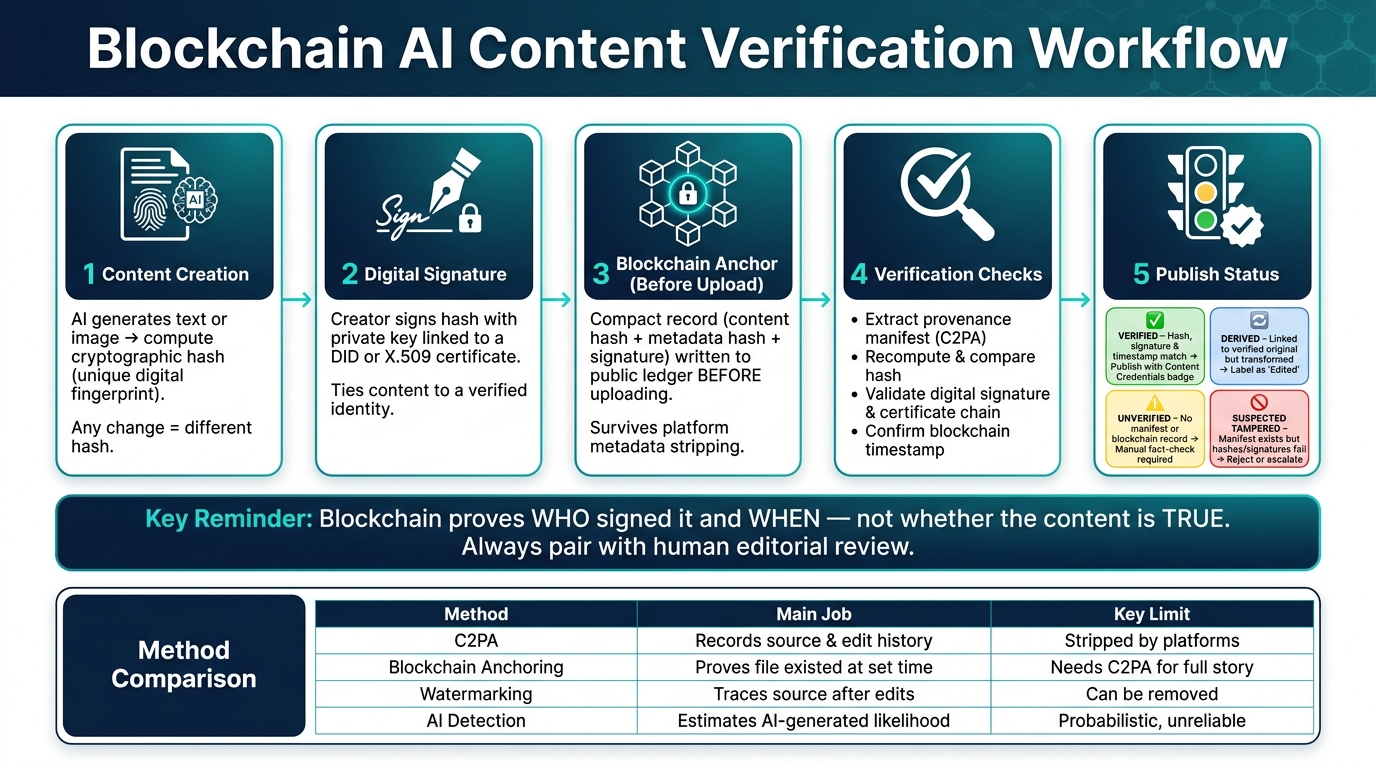
Blockchain AI Content Verification Workflow: Hash, Sign, Anchor & Verify
How to verify a file before publishing or sharing
Use this workflow after a file is generated and before it’s published or shared.
Verification isn’t one box to check. It’s a short chain of checks that helps a team build confidence before anything goes live. The aim is simple: confirm origin, integrity, and custody before publication.
Here’s the core sequence to run on any AI-generated asset before publishing:
- Extract provenance metadata
Read the manifest first. If there isn’t one, mark the file Unverified and keep going.
- Compute and compare hashes
Recompute the file hash and compare it with the anchored record. If the image was resized or re-encoded, use a perceptual hash, since an exact hash won’t match.
- Validate the digital signature
Verify the signature against the signer’s certificate chain. This shows who signed the content and whether their credentials are current and trusted.
- Check the timestamp
Query the blockchain to confirm the content existed at the claimed time. A valid timestamp anchored to an immutable ledger is much harder to fake than a file’s internal metadata.
- Assign a publish status
After the checks are done, place the asset into one of four statuses:
| Status | What It Means | Action |
|---|---|---|
| Verified | Hash, signature, and timestamp all match | Publish with a Content Credentials badge |
| Derived | Linked to a verified original, but transformed | Review edit history; label as "Edited" |
| Unverified | No manifest or blockchain record found | Treat as low-trust; run manual fact-checking |
| Suspected Tampered | Manifest exists, but hashes or signatures fail | Reject or escalate for immediate review |
What to do when metadata is missing, altered, or stripped
Missing metadata is common after upload, re-encoding, or platform processing.
Treat missing metadata as Unverified, then try recovery through a perceptual fingerprint or watermark to look up the manifest. If the original provenance record exists, you can often reconnect the file to it even after re-encoding or platform processing.
If recovery fails, document the gap. Log the asset as unverified, note the source and the date received, and send it to a human reviewer. Never present an unverified asset as authenticated, even if it looks credible. The C2PA specification is explicit on this point: provenance tools confirm whether assertions can be validated, not whether the content itself is accurate or trustworthy.
If the cryptographic match fails, reject or escalate at once and log the result. Keeping a record of Suspected Tampered outcomes can also help teams spot patterns that may point to coordinated disinformation.
Implementation priorities for a small business or content team
Small teams don’t need enterprise systems to put a working provenance process in place. The priorities are pretty direct.
Start with hashing at the source. As Thomas Hepp, Co-Founder of OriginStamp, puts it:
"Instead of analyzing a file after the fact to guess its origin - a process riddled with false positives - you need to prove authenticity from the exact moment of creation."
Hash content at the moment it’s created or approved, not after it passes through a CDN or third-party editor. Every authorized change - a crop, a caption update, a re-export - should create a new hash linked to the prior record.
Assign signing authority clearly. Use organizational X.509 certificates or Decentralized Identifiers (DIDs) to define who can sign content on behalf of the team. Treat private signing keys with the same care as sensitive financial credentials: limit access, rotate them on a set schedule, and revoke them right away if someone leaves.
Attach provenance at publish time. The cleanest place to do this is the publish trigger, so every asset gets hashed and anchored before it reaches distribution, not after. If your team uses NanoGPT to generate text or images, capture the initial hash at the generation stage before any editing or formatting happens later.
Once verification becomes routine, lock down who can sign and revoke content records.
Track two simple metrics to see whether the system is doing its job: Coverage Rate - the percentage of published assets with a valid provenance record - and Verification Latency - the time from creation to blockchain anchor confirmation. If coverage drops or anchor time increases, something in the workflow is breaking.
Limits, governance, and conclusion
Limits and failure modes to understand
Even a full provenance workflow has blind spots.
Blockchain can lock in provenance, but it can't tell you what's true. A bad actor can sign and anchor made-up content with a valid certificate, and the ledger will still show a valid signature. Put simply, blockchain tells you who signed something and when. It does not tell you whether the content is accurate.
One of the most common failure points is a lot less dramatic. When someone uploads a file to a social platform or messaging app, the platform may re-encode it and strip out the C2PA manifest and other metadata needed for verification. If the content hash was anchored on-chain, the provenance record can sometimes be rebuilt even after the original metadata is gone.
Screenshots create another problem. The second someone takes a screenshot of verified content, they create a new file with no provenance at all. That means the cryptographic chain breaks right at capture. Hard cryptographic hashes are also bit-sensitive, so even harmless changes like resizing, cropping, or re-encoding can break the link to the anchor unless a softer binding method, such as watermarking, is used.
Detection tools are unreliable. Provenance is the stronger path.
Governance: who can sign, who is trusted, and how policies are enforced
A provenance system works only if the right people can sign and the wrong ones can't.
That means organizations need a clear trust model. They need to define who is allowed to sign, which certificate authority or trust list backs that identity, and how credentials are revoked when someone leaves. Decentralized Identifiers (DIDs) can bind a signer's public key to an identity in a way that stays portable across platforms. It also helps to use graduated trust levels, so teams can separate verified institutional identities from anonymous or low-cost commercial certificates. In practice, verified status depends on trusted signers, active credentials, and enforced revocation rules.
When disputes come up, auditors can check the ledger and pull proof from the on-chain record. The stakes here aren't small. In February 2024, in the Arup case, a finance employee transferred $25.6 million after being fooled by a deepfake video call impersonating the company's CFO. That's the kind of failure that shows up when verification controls are weak.
No policy wipes out synthetic content risk. Internal signing rules, trust lists, key rotation schedules, and human editorial review still matter.
Conclusion: what blockchain does well in AI content verification
The practical issue isn't whether provenance can be recorded anymore. It's whether people trust the record.
When paired with C2PA's structured signed metadata, blockchain gives teams a durable audit trail and a clearer way to check origin. But technical proof doesn't replace editorial judgment. As the Editors Weblog put it:
"Blockchain verification promised to solve media trust. Technical considerations should not overshadow editorial fundamentals - strong sources, rigorous reporting, and experienced judgment remain essential."
Blockchain can make provenance tamper-evident. Human review still decides whether the content is credible.
FAQs
Can blockchain prove content is true?
No. Blockchain can verify where a piece of content came from, when it was created, and whether anyone changed it. But it can’t prove the content is factually true.
If someone makes false text or a fabricated image, blockchain can still confirm that file’s source and integrity. In plain English, it protects the chain of custody - not the truth of what’s inside.
What happens if a platform strips metadata?
If a platform strips metadata, such as C2PA manifests, the file loses the built-in record of where it came from and what happened to it over time. That tends to happen during re-encoding, resizing, or format conversion.
Once that internal metadata is gone, the content no longer carries its own verifiable credentials unless there’s a second, immutable anchor in place. A cryptographic hash stored on a blockchain can still be used to verify provenance.
How should teams verify edited or screenshot content?
Teams should shift from gut-checks to cryptographic provenance.
Here’s the problem: metadata often gets stripped out or changed during editing, exporting, or re-encoding. So instead of leaning on metadata alone, use C2PA content credentials to log who made the file, which tools were used, and what edits happened along the way. Then tie those credentials to an immutable blockchain ledger.
That setup helps with end-to-end integrity checks. You can confirm that the current file hash matches the latest signed record in the chain of custody.
For screenshots, depth-mapping tools such as LiDAR can also help spot images taken from flat screens.