
Fault-tolerant task scheduling for edge AI traffic
If I had to boil this down to one line: edge AI stays up under burst traffic and node loss by putting urgent work first, limiting what enters the system, duplicating only a small set of short jobs, and shifting overflow to healthier nodes or sites.
I’d explain it like this: when text and image requests hit at the same time, a simple balancer can send work to the wrong place, queues grow, and one failed GPU can turn a short slowdown into user-facing errors. The article’s answer is clear: split traffic by job type, use deadline-based queueing, apply backpressure with 429 and Retry-After, drain weak nodes before they die, and offload work across nearby edge sites.
Here are the main points I’d keep:
-
Text and image jobs should not share one queue policy
- Text requests are short and delay-sensitive
- Image jobs are longer and can tie up a node by themselves
-
Queue depth and P95 wait time matter more than raw GPU use
- High GPU use can look fine while wait times get worse
- Rising queues often show trouble before users complain
-
EDF beats FIFO for mixed AI traffic
- FIFO lets long jobs block short urgent ones
- Deadline-based ordering gives short, urgent jobs a better shot at finishing on time
-
Admission control stops queue collapse
- If wait time + run time misses the deadline, the system should delay, downgrade, or reject the task
- Lower tiers can get
429 Too Many Requestsduring overload
-
Replication should be selective
- Active-active or speculative copies fit short, high-value interactive jobs
- Long text runs and high-res image jobs usually cost too much to duplicate
-
Placement rules matter
- Copies should be split across racks, zones, or regions
- Checkpoint-aware recovery helps long image workflows resume instead of restart
-
Failure handling starts before a node dies
- Health checks, draining, and metadata-aware rescheduling cut failed jobs and extra retries
- The article cites 6%–19% higher task success and 9%–27% lower latency with metadata-aware primary-backup rescheduling
-
A two-layer traffic model works well
- Work stealing smooths short local spikes
- Hierarchical scheduling shifts larger overflow across sites every 10–30 seconds, while local decisions can run every 1–5 seconds
A short way to frame the full design: I’d use priority queues for urgent work, EDF for deadline-bound traffic, admission control for overload, selective replication for short high-value requests, and regional offload when one site starts to fill up.
For NanoGPT-style traffic, the article lands on a simple four-tier setup:
- P0: critical interactive jobs
- P1: deadline-bound image or text work
- P2: bulk runs
- P3: background tasks
That means the system protects live user requests first, pauses background work first, and avoids wasting GPU time on blanket duplication.
| Area | What I’d do | Why it helps |
|---|---|---|
| Queueing | Separate text, image, and background classes | Cuts head-of-line blocking |
| Ordering | Use EDF inside deadline-driven classes | More jobs finish before deadline |
| Overload | Admit only jobs likely to finish on time | Stops runaway queues |
| Failure handling | Drain weak nodes and reschedule by metadata | Lowers failed work and bad retries |
| Replication | Copy only short, high-value jobs | Limits wasted compute |
| Site balancing | Use work stealing + regional offload | Handles both local spikes and site-level pressure |
Bottom line: I see this article as a guide for keeping latency down and failed jobs in check when edge AI traffic gets spiky. The smallest working setup is priority queues, deadline-aware ordering, admission control, selective replication, placement rules, and cross-site balancing.
That’s the whole playbook in plain English.
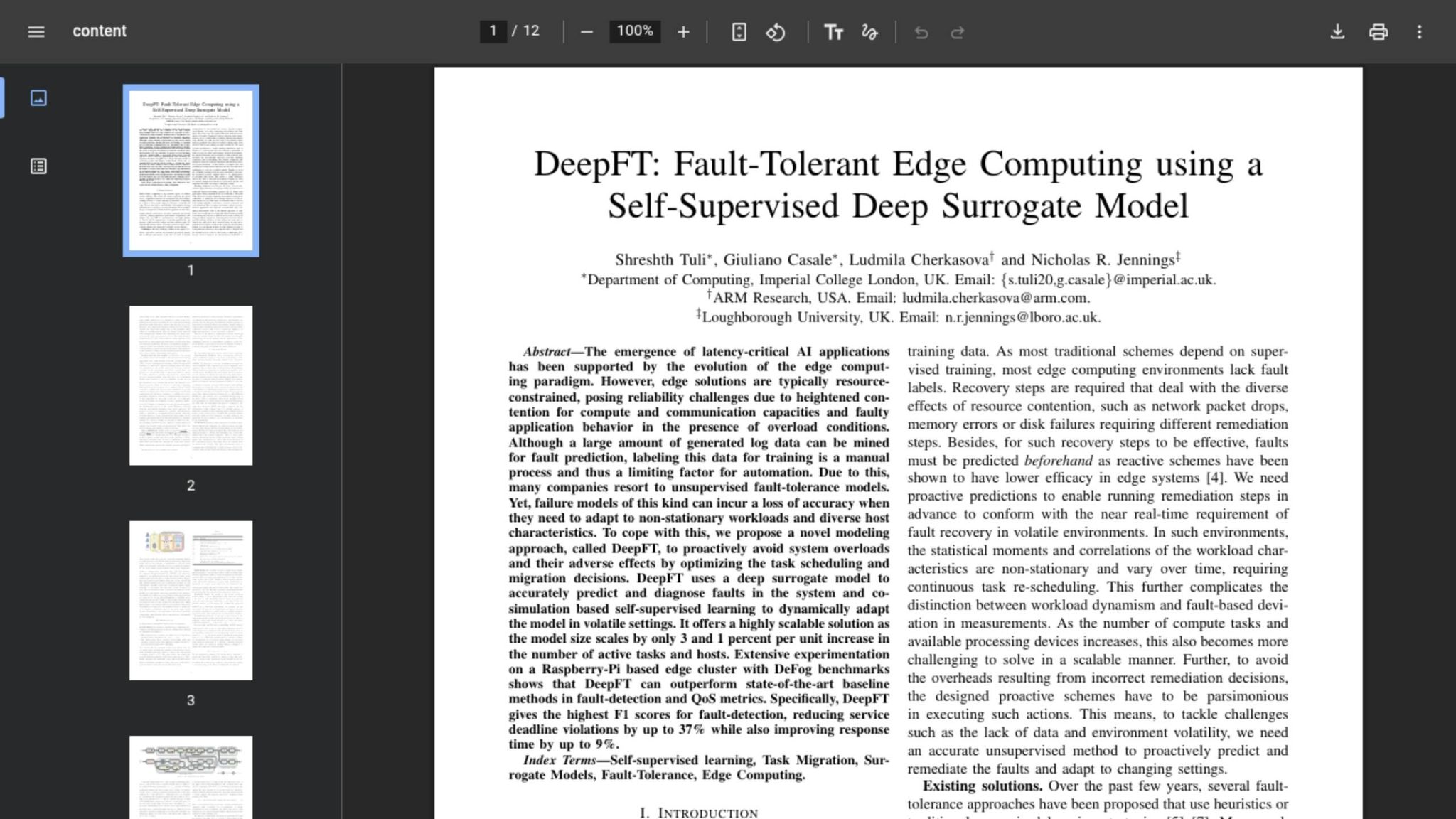
DeepFT: Self-supervised fault tolerance (IEEE INFOCOM 2023)
sbb-itb-903b5f2
Core scheduling tools that absorb bursts and failures
Edge scheduling decides when and where each AI job runs while still hitting latency, throughput, and error-rate SLOs. At the edge, bursts happen fast. Nodes also fail. So the scheduler needs a few simple levers that keep text and image jobs moving instead of stalling out.
The main ones are queues, priorities, replication, and placement rules. Each one deals with a different kind of problem. Used together, they help the scheduler absorb traffic spikes without dropping requests or burning GPU time. The next step is deciding what to do when there just isn’t enough capacity left.
Queues and priority classes for text and image jobs
Each edge node should keep separate logical queues for interactive, latency-sensitive requests and for background work. A text chat request that’s waiting on a reply is not the same as a batch image generation job running quietly in the background. Treating them the same is a good way to miss deadlines.
A practical setup splits jobs into three classes:
- interactive text
- interactive image generation
- background jobs with no latency deadline
Within each class, earliest-deadline-first ordering beats FIFO when runtimes vary. Why? Because FIFO is blind. It handles jobs in arrival order, even when a short, urgent task gets stuck behind a slower one. Research on tail-latency-aware queuing systems like TailGuard shows that pairing deadline-aware ordering with admission control can help meet SLOs when resources are tight. Background jobs should run only when capacity is open, with rate limiting so they don’t crowd out interactive traffic during peak periods.
When demand still goes past capacity, the queue can only do so much. That’s where replication comes in.
Replication and placement rules for fault tolerance
Replication adds backup so one node failure doesn’t kill an in-flight job. Active-active replication sends the same task to two nodes at the same time and returns the result from whichever finishes first, then cancels the duplicate. That fits high-value interactive requests where missing the deadline carries a high cost.
Speculative execution is a lighter option. The backup copy launches only if the primary is running slower than expected, based on past runtime data or live progress metrics. In plain terms, it’s like keeping a spare runner on the sideline and sending them in only when the first runner starts limping.
Placement rules are what make replication worth doing. If both replicas land in the same rack, one power issue or network problem can wipe out both copies at once. Good placement rules account for separate racks, zones, and regions, along with model locality, open capacity, and distance to the user. For longer image generation workflows, checkpoint-aware recovery stores intermediate state so a rescheduled image job can resume near its last completed step instead of starting over from zero.
Hardware-aware placement also helps cut queueing delay and out-of-memory failures.
These tools matter most when overload forces the scheduler to delay, reject, or reroute work.
How queueing, backpressure, and failover work in practice
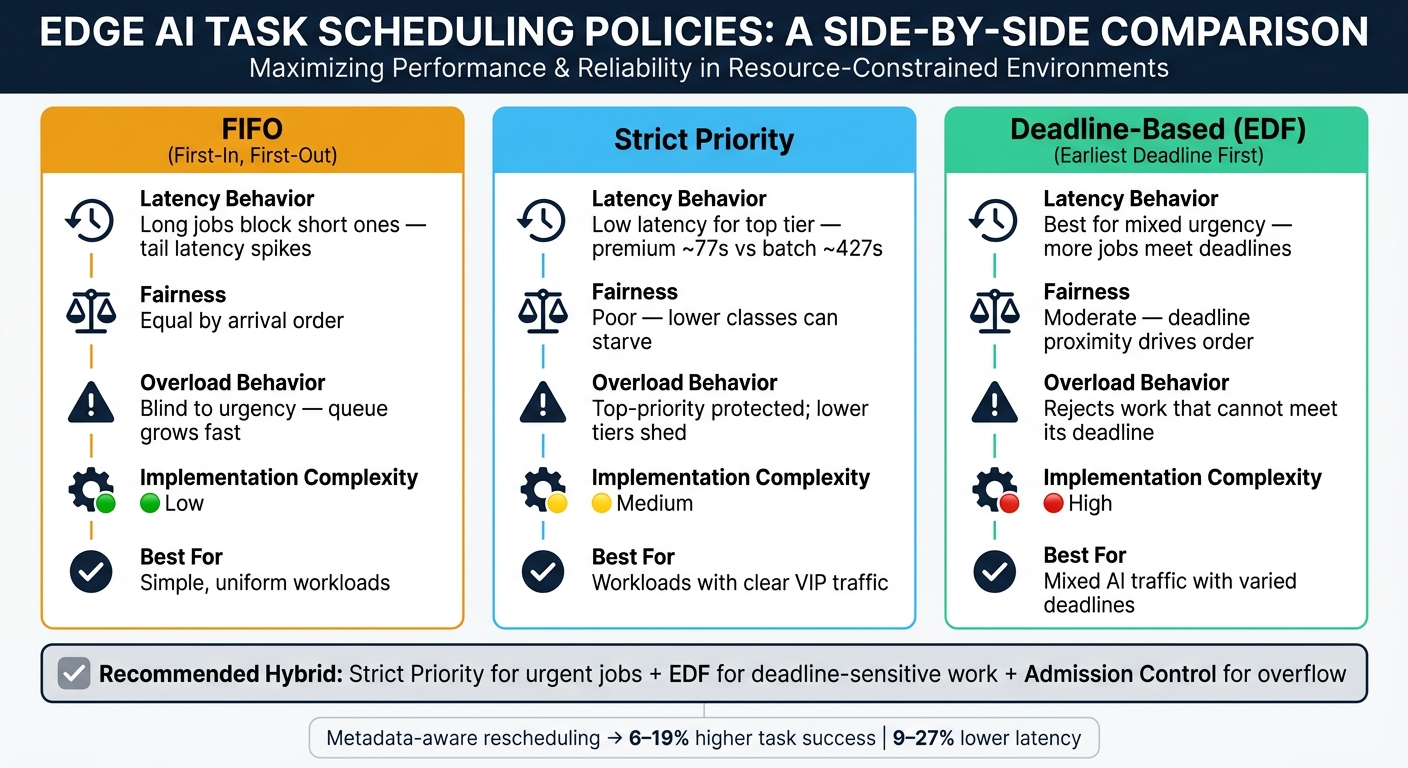
Edge AI Scheduling Policies: FIFO vs Priority vs EDF Compared
Admission control and backpressure during overload
Once queues and placement rules are set, the runtime has to make a hard call during overload: what gets in, and what has to wait.
The scheduler should admit only the work it can finish on time. To do that, admission control estimates wait time + run time. If a task is unlikely to hit its deadline, the scheduler can reject it, delay it, or move it to a lower service tier. In practice, that often means interactive text comes first, while long image jobs get pushed back.
If that still isn’t enough, backpressure moves the slowdown upstream to gateways or APIs. Lower-priority requests may get 429 Too Many Requests plus Retry-After, while interactive traffic stays protected.
Node health checks, draining, and task rescheduling
When overload turns into node loss, the scheduler stops throttling and starts failing over.
It first spots failure through heartbeat timeouts, marks the node unavailable, and stops sending new work there. But there’s usually a stage before full failure, and that’s where draining helps. If a node shows early warning signs, start draining it before it drops. That gives the node time to finish in-flight work or pass off task metadata cleanly instead of killing jobs halfway through.
Rescheduling also needs more than a simple retry. The scheduler has to look at priority, deadline, model type, cost, and retry safety. Non-idempotent tasks need extra care because replay can trigger duplicate side effects.
That detail matters. Metadata-aware primary-backup rescheduling can improve task execution success rates by 6–19% and cut latency by 9–27% compared with mainstream benchmarks.
Scheduling policies under bursty traffic: a comparison
The best policy depends on how the workload breaks when traffic arrives in bursts. Edge AI systems don’t fail the same way for every job type, so one policy rarely fits all cases.
| Policy | Latency behavior | Fairness | Overload behavior | Implementation complexity |
|---|---|---|---|---|
| FIFO | Long jobs block short ones; tail latency spikes | Equal treatment by arrival order | Blind to urgency; queue can grow quickly | Low |
| Strict priority | Low latency for the top-priority class | Poor; lower classes can starve | High-priority traffic protected; lower tiers shed | Medium |
| Deadline-based (EDF) | Best fit for mixed urgency; jobs meet deadlines more often | Moderate; deadline proximity drives order | Rejects work that cannot meet its deadline | High |
FIFO tends to struggle most under bursts. A long image generation job can sit at the front of the line and block a short text prompt with a tight deadline. That’s the classic traffic jam problem: one slow truck holds up a lane full of cars.
Strict priority solves that for top-tier traffic, but the tradeoff is harsh. It can push batch tenant latency to roughly 427 seconds while cutting premium tenant latency to around 77 seconds. Great for the front of the line, rough for everyone behind it.
EDF usually works better for mixed workloads because it favors jobs by deadline, not just by arrival time or class. But it comes with more moving parts, since the system has to keep estimating service time and tracking deadlines as conditions change.
For mixed edge AI traffic, a hybrid setup usually works best:
- Strict priority for urgent jobs
- EDF for deadline-sensitive work
- Admission control for overflow
That mix gives urgent traffic a fast lane without letting the whole system drift into chaos when bursts hit.
Dynamic load balancing across edge sites
When one site starts running out of room, the scheduler needs to send work to nearby edge sites. Dynamic load balancing moves work to less-busy sites in real time, instead of relying on fixed assignments. The goal is simple: make live decisions from current metrics without creating one brittle control hub.
Work stealing, hierarchical scheduling, and regional offload
Work stealing uses a pull model. Idle nodes pull work from a neighbor's queue when their own queues dry up. In edge AI, that could mean a node with low GPU use pulling short text prompts from an overloaded neighbor while the busy node stays focused on longer image jobs.
A few guardrails matter here. Use low-watermark thresholds so nodes steal work only when they have spare room, then stop once their own load starts climbing. And capability matching is a must. A node that only runs text models shouldn't grab image jobs it can't process.
For small local bursts, nearby nodes should help each other first. When demand shifts are bigger, the regional layer steps in.
Hierarchical scheduling adds one more layer of coordination above individual nodes. Each site has a local scheduler for immediate queueing and GPU assignment. Above that, a regional scheduler takes in rolled-up metrics from each site. If a local site runs out of room, the regional scheduler can reroute non-urgent image jobs to a less-busy site. That adds a bit of latency for batch work, but it protects interactive text traffic. If the regional layer goes down, local schedulers keep running, so a controller failure doesn't bring the whole system to a halt.
Metrics that should drive rerouting decisions
The metrics that warn you before users notice trouble are queue length by priority class, P95 wait time, GPU utilization, deadline misses, and retries. Add node health signals too: failed heartbeats, rising hardware error counters, local temperature limits, and observed network latency between sites.
Use queue length, P95 wait time, and node health to decide when to steal work inside a site and when to offload it to another site in the region. Sampling for intra-site decisions usually runs every 1–5 seconds. Regional offload decisions usually rely on aggregation windows of 10–30 seconds, which helps avoid reacting to every tiny spike. High GPU use paired with rising latency is a warning sign of overload, not good performance.
Load-balancing approaches: a comparison
Each approach deals with bursts and failures in its own way.
| Approach | Responsiveness to Bursts | Fault Tolerance | Operational Overhead | Recovery Speed After Node/Link Failure |
|---|---|---|---|---|
| Centralized routing | High at first; can bottleneck during very large bursts | Exposed if the controller fails; needs strong HA setup | High; needs durable, stateful control services | Fast when healthy; slow or catastrophic if the controller degrades |
| Work stealing | Very good locally; idle nodes react fast to neighbor overload | Decentralized by nature; no single point of failure | Moderate; less global control, more node-side logic | Usually fast; neighbors pull work away from failing nodes |
| Hierarchical scheduling | Good balance; local layer handles intra-site bursts, regional layer handles cross-site events | Better resilience; local schedulers keep working if the regional layer degrades | Medium to high; two layers, though each is simpler than one global controller | Fast local recovery with coordinated regional rerouting |
In practice, a hybrid of hierarchical scheduling and work stealing tends to fit edge AI best. Work stealing smooths out micro-bursts inside a site, while the regional layer handles larger demand shifts across sites. Those same rules shape how NanoGPT text and image jobs should be classified and rerouted.
Applying the model to NanoGPT and closing takeaways

Applied to NanoGPT, the scheduling rules above turn into a simple priority-and-failover policy. NanoGPT handles a mix of chat and image workloads. That kind of traffic is exactly where fault-tolerant scheduling matters, because one dropped node during a burst can lead to failed jobs and wasted spend.
How NanoGPT tasks can be classified and prioritized
Each incoming request can include a small job header - workload type, model class, latency priority, and a fault-tolerance flag - without exposing any prompt content. Since prompts stay local, the scheduler works from anonymized job metadata, not the content itself. In plain English: scheduling stays content-blind and privacy-safe.
A four-tier queue fits NanoGPT’s traffic well:
- P0 = critical interactive jobs
- P1 = deadline-bound creative work
- P2 = bulk runs
- P3 = background work
Critical jobs get tight deadlines and immediate failover to a healthy nearby node if the primary drops. Urgent work runs against a defined deadline. Bulk runs can be rescheduled across hours. Background work is the first thing to pause when burst load hits.
That priority map decides which jobs deserve replication and which ones can wait.
Where replication pays off and where it adds waste
Once jobs are ranked, the next step is simple: is a duplicate copy worth the extra cost?
Replicate only short, high-value jobs when the cost of failure is higher than the cost of duplicate compute. For a critical chat completion, running a copy on a second healthy node makes sense when one node is showing elevated error rates.
Heavy jobs are a different story. Long-form text generation or high-resolution image generation should not be replicated. In those cases, fast failure detection and rescheduling on a fresh node is the better move.
Conclusion: the minimum design for resilient edge AI scheduling
Taken together, these rules describe the minimum setup for resilient edge scheduling. The two big problems are bursty traffic and routine node loss. The smallest set of mechanisms that deals with both is priority queues, admission control, selective replication, placement rules, and hierarchical balancing.
| Mechanism | Main Benefit | Main Tradeoff | Best Fit |
|---|---|---|---|
| Priority queues | Protects interactive latency during bursts | Batch jobs wait longer under sustained load | Chat completions, live image prompts |
| Admission control / backpressure | Prevents queue collapse under overload | Users see explicit delays instead of silent failures | All traffic classes during peak bursts |
| Selective replication | Reduces failed critical and urgent jobs under node loss | Extra compute cost per replicated job | Time-critical, low-cost requests |
| Placement rules | Keeps jobs on capable, healthy nodes | Reduces scheduling flexibility | GPU-specific image models, larger text jobs |
| Hierarchical scheduling / regional offload | Smooths local bursts and shifts overflow to healthier regions | Adds coordination overhead across sites | Mixed text and image workloads across edge regions |
For a pay-as-you-go service like NanoGPT, that mix means fewer failed jobs, less wasted spend, and a smoother experience for every user - whether they’re generating a single chat reply or queuing hundreds of images overnight.
FAQs
When should EDF replace FIFO?
EDF should replace FIFO when your edge AI setup needs strict timing guarantees for unpredictable, high-priority workloads. FIFO is simple, but it doesn’t account for deadlines.
Use EDF when tasks have clear time requirements and missing a deadline could hurt system reliability. It helps make sure critical AI traffic runs before its deadline expires.
How do you choose which jobs to replicate?
Replicate business-critical jobs like core pipeline configurations, stream definitions, and scheduled tasks. Start by mapping the critical path so you can see where redundancy is worth the cost.
If a job is complex, break it into smaller parts, such as ingestion or transformation. Then replicate only the parts you need for fast recovery after node failures.
What metrics should trigger offloading or backpressure?
Trigger offloading or backpressure when local nodes start to hit their limits or miss performance targets. Watch for signals like:
- Rising queue depth or queue-to-compute ratio
- Breaches in P95/P99 latency or TTFT
- Higher 429 or 503 error rates
- High CPU, memory, or energy use, especially when throughput stays low
- More requests moving to pricier or secondary fallback models