
Energy Optimization with Machine Learning
Machine learning (ML) is transforming how industries manage energy. By analyzing patterns and making real-time adjustments, ML helps reduce energy costs, improve efficiency, and address challenges like fluctuating renewable energy sources. Key areas impacted include data centers, smart grids, and industrial operations.
Key Takeaways:
- Buildings contribute 30% of global energy use and 26% of CO2 emissions.
- ML improves energy forecasting, demand management, and system reliability.
- Google DeepMind reduced data center cooling energy by 40%.
- Hybrid models (e.g., CNNs + LSTMs) improve renewable energy predictions by 12–15%.
- Optimization-aware algorithms combine prediction and decision-making, cutting costs by up to 10%.
- Resource-efficient ML (e.g., pruning, quantization) reduces energy consumption during training.
- Industrial applications like mining and manufacturing save up to 15% on energy costs using ML.
Challenges:
- Quality data is critical, but many datasets are incomplete or noisy.
- ML models often struggle to generalize across different environments.
- Deployment gaps exist between simulations and operational systems.
Machine learning offers a powerful way forward, but addressing data quality and deployment issues is essential for maximizing its impact.
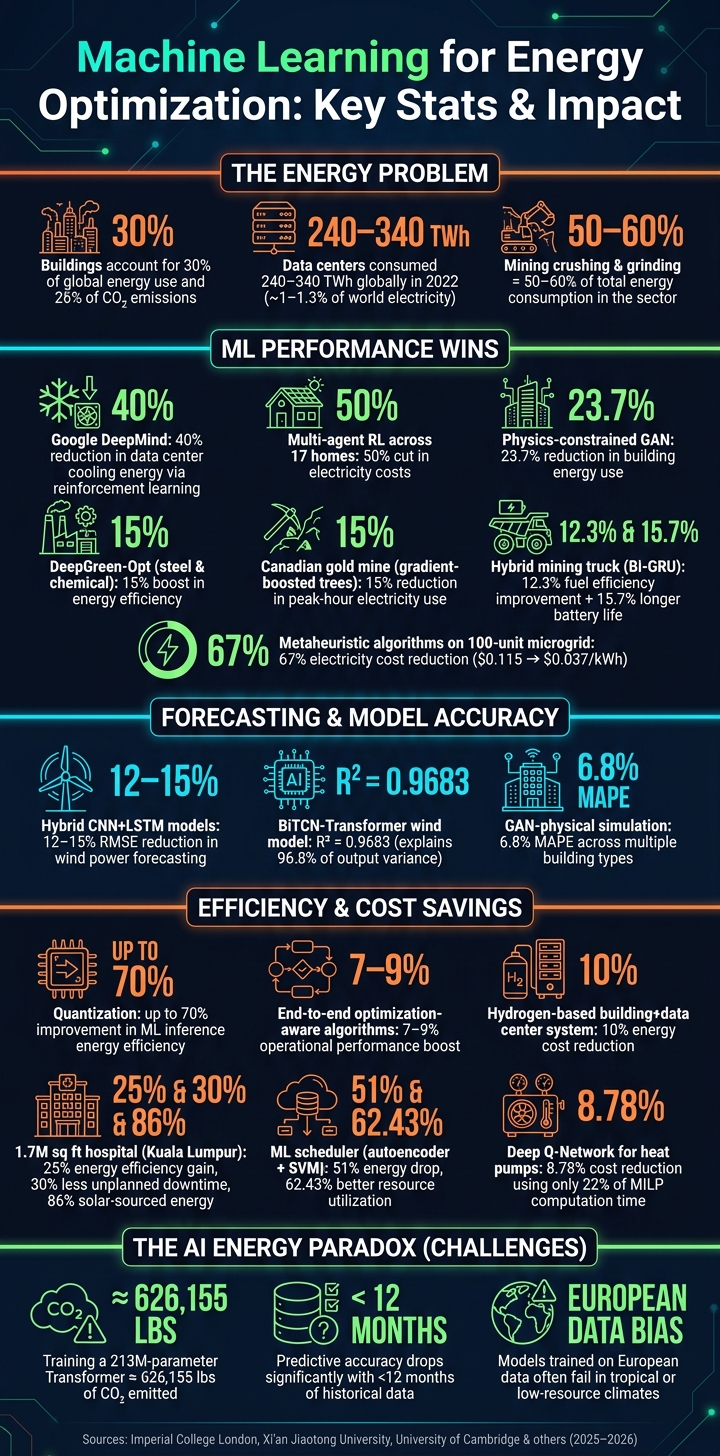
Machine Learning for Energy Optimization: Key Stats & Impact
Scope of Research and Methods Reviewed
Types of Studies Included
Research on machine learning (ML) for energy optimization spans a variety of approaches, including literature reviews, simulations, and practical applications. For example, a July 2025 review by Tai Zhang and Goran Strbac from Imperial College London examined 129 studies out of 3,000 records, identifying four key themes: reinforcement learning for adaptive control, multi-agent systems for distributed coordination, planning under uncertainty, and AI-driven resilience.
Simulations, such as residential energy modeling, and industrial-scale implementations are also widely used to evaluate algorithm performance. One standout study from April 2025, led by Mohammed Amine Hoummadi at Sidi Mohammed Ben Abdellah University, applied metaheuristic algorithms to a 100-unit residential microgrid. The result? Electricity costs were slashed by 67%, dropping from $0.115/kWh to $0.037/kWh.
These diverse study formats lay the groundwork for the advanced methods explored in the next section.
Common Research Methods in Energy Optimization
To tackle energy system challenges, researchers employ a range of advanced methodologies. Hybrid optimization models are a popular choice, combining convolutional neural networks (CNNs) for spatial data and long short-term memory (LSTM) networks for temporal patterns. These models have shown to reduce root mean square error (RMSE) by 12–15% in wind power forecasting.
Another widely used approach involves sensor-driven and IoT-based systems, which utilize real-time data from smart meters, weather feeds, and supervisory control systems to enable dynamic energy scheduling. In simulation-based research, digital twins - virtual replicas of physical systems - are gaining attention. These allow reinforcement learning agents to be trained in a controlled environment before being deployed in the real world.
"Traditional model-based and rule-based approaches are often insufficient to fully capture the nonlinear dynamics and stochastic behavior inherent in modern energy systems." - Grzegorz Dudek and Marcin Blachnik
Physics-informed ML is another emerging technique, integrating physical constraints directly into ML models. A February 2026 study demonstrated its potential by achieving a 6.8% mean absolute percentage error (MAPE) and reducing energy consumption by 23.7% using a GAN-physical simulation framework across multiple building types.
sbb-itb-903b5f2
Key Machine Learning Approaches for Energy Optimization
Predictive Modeling for Energy Systems
Accurate forecasting is at the heart of energy optimization, enabling better scheduling while cutting down on waste and costs. Reliable models are essential for predicting energy demands under varying conditions, which supports smarter and more efficient energy management.
Models like LSTM and GRU are often used to track and predict dynamic energy load patterns. For longer-term forecasting, Transformer-based models take center stage. Their self-attention mechanism helps identify patterns across long time spans, making them especially useful for handling the unpredictability of renewable energy sources. For example, a hybrid BiTCN-Transformer model demonstrated its strength in wind power forecasting, achieving an R² of 0.9683 - explaining over 96% of the variance in output.
For short-term load predictions, ensemble methods offer a balance of speed and accuracy. Meanwhile, NARMAX models provide a transparent, mathematical breakdown of the factors driving energy consumption, making them a go-to choice for applications requiring interpretability.
But forecasting accuracy isn’t the only focus - reducing the energy consumption of these models is just as important.
Resource-Aware and Frugal Machine Learning
Sustainable energy management doesn’t just demand accurate models; it also calls for efficient ones. Machine learning models can consume an enormous amount of energy during training. To put it into perspective, training a Transformer with 213 million parameters can emit around 626,155 pounds of CO2. This challenge has led to the rise of "Green AI", where algorithms are designed to be energy-efficient by default.
Techniques like pruning, quantization, and knowledge distillation are key to improving efficiency. Quantization, for instance, can enhance inference energy efficiency by up to 70%. In January 2026, the University of Cambridge introduced the ECOpt framework, which uses Bayesian optimization to strike the perfect balance between accuracy and energy consumption. When tested on CIFAR-10 models, ECOpt identified seven configurations that outperformed existing methods across both dimensions.
"By optimizing hyperparameters for both energy efficiency and performance, we can reduce the energy cost of ML without sacrificing the quality of inference." - Emile Dos Santos Ferreira, University of Cambridge
Optimization-Aware Algorithms
Efficient prediction and resource-aware models are essential, but integrating prediction with decision-making takes optimization to the next level. Traditional methods often separate these two steps, but focusing solely on minimizing prediction error doesn’t always lead to lower operational costs. Optimization-aware algorithms combine prediction and decision-making into a single framework, enabling models to directly improve real-world outcomes.
These end-to-end learning frameworks have shown a 7–9% boost in operational performance. In March 2026, researchers at Xi'an Jiaotong University and Tsinghua University applied this concept to a hydrogen-based system used in buildings and data centers. By recovering low-grade waste heat (ranging from 77°F to 176°F) from data centers to heat buildings, they achieved a 10% reduction in energy costs.
"Prediction accuracy does not necessarily translate into enhanced operational performance, despite their close correlation." - Zhenyu Pu, Researcher, Xi'an Jiaotong University
For smart grids and microgrids, Multi-Agent Reinforcement Learning (MARL) has proven effective. It enables real-time coordination of distributed assets - like batteries, EVs, and solar panels - without requiring a centralized controller. This makes MARL ideal for edge deployments, where low latency and data privacy are critical.
Findings Across Energy Application Domains
Energy Optimization in Data Centers
In 2022, data centers globally consumed an estimated 240–340 TWh, accounting for approximately 1–1.3% of the world's electricity demand. By 2027, AI-focused data centers are expected to see their average rack power density jump from 8 kW to 30 kW.
A key strategy for reducing energy use in data centers is integrating power, computing, and cooling systems. This approach can cut power consumption by 30.56% compared to traditional constant air volume systems. For instance, an Ericsson data center in Linköping, Sweden, used K-means clustering to adjust PID parameters across 21 liquid cooling units between January 2021 and December 2022. This method not only identified cooling anomalies but also enhanced operational efficiency.
A noteworthy innovation in this space is DCoPilot, which uses large language models and hypernetworks to update cooling policies without the lengthy retraining periods typical of deep reinforcement learning. During a 40-day trial, DCoPilot maintained temperature deviations within 0.2°C, while traditional methods allowed fluctuations of up to 4°C.
These integration techniques are also influencing advancements in thermal energy systems and smart grid management.
Thermal Energy Systems and Smart Grids
Machine learning is also reshaping thermal energy systems and smart grids, which face unique challenges like managing distributed and unpredictable energy resources in real time. Research highlights the importance of time-of-use (TOU) pricing in driving efficiency. For example, multi-objective deep reinforcement learning algorithms such as TEPTS have achieved electricity cost reductions of 14.09% to 45.33% by shifting deferrable tasks to low-cost periods. Additionally, price-aware models have shown task migration rates exceeding 33.90% during peak pricing hours.
Mining and Industrial Energy Optimization
In industries like mining, where energy demands are among the highest, machine learning is delivering tangible results. Mining processes such as crushing and grinding are particularly energy-intensive, accounting for 50–60% of total consumption and up to 30% of operational costs in regions like South Africa.
Machine learning models are helping to optimize these operations. In 2025, a Canadian gold mine used gradient-boosted trees to analyze real-time torque sensor data and mill feed rates, reducing peak-hour electricity use by 15%. Similarly, Brazilian iron ore mines implemented LSTM models to predict energy peaks in grinding mills 30 minutes ahead, enabling load adjustments that minimized downtime and energy waste. In April 2026, researchers tested a multi-objective energy management system on a 130-ton hybrid mining truck in Heilongjiang Province, China. Using a Bi-GRU network for condition recognition, the system improved fuel efficiency by 12.3% and extended battery life by 15.7% compared to traditional rule-based methods.
"Mining is among the most energy-intensive industrial sectors, with processes such as drilling, crushing, and ore processing driving substantial operational costs and environmental impacts." - Sravani Parvathareddy, Department of Electrical and Communications Systems Engineering, BIUST
Machine learning is also making strides in industrial manufacturing. For example, multi-modal frameworks like DeepGreen-Opt combine LSTM networks with advanced optimization techniques, achieving a 15% boost in energy efficiency in industries such as steel and chemical processing. AI-driven defect detection tools have further enhanced material identification accuracy by 42.8%, reducing waste and the energy costs tied to it.
Optimization in the Loop Machine learning for Energy and Climate | Priya Donti
Impact on Resource Management and Operational Decisions
Machine learning (ML) isn't just about energy optimization - it’s also reshaping how resources are managed and operational decisions are made.
Load Balancing and Efficiency Gains
ML is revolutionizing load distribution by going beyond traditional scheduling tools, which often focus solely on CPU usage. Instead, ML models take a broader view, factoring in memory needs and network bandwidth. This comprehensive approach helps avoid resource contention and ensures service level agreements (SLAs) are met, especially during virtual machine consolidation.
Take, for example, a study published in February 2026 in the Journal of Cloud Computing. Researchers tested a scheduling algorithm using Google's workload trace data. The method combined an autoencoder for feature extraction with a Support Vector Machine (SVM) for classification. The results? A 51% drop in energy consumption and a 62.43% boost in resource utilization compared to Google's standard scheduler.
But ML doesn’t stop at classification. It also leverages temporal flexibility by shifting deferrable workloads to off-peak pricing windows and spatial flexibility by routing tasks to data centers with cheaper electricity or greater access to renewable energy.
Cost-Effective Optimization Workflows
In the world of real-time decisions, speed and accuracy are critical. Traditional methods like Mixed-Integer Linear Programming (MILP) can find globally optimal solutions but struggle with lengthy computation times as systems grow more complex. Enter reinforcement learning (RL), which, once trained, can deliver near-instant results.
A 2025 study of a residential energy community - three single-family homes sharing a centralized heating system, thermal energy storage, and a photovoltaic (PV) installation - illustrates this perfectly. Researchers used a Deep Q-Network (DQN) to optimize heat pump operations. The RL agent cut energy costs by 8.78%, coming close to MILP's 10.06% reduction while using only 22% of MILP's computation time.
"The trained RL agent achieves a near-optimal outcome while requiring only 22% of the MILP's computation time." - Energies
For large-scale systems, this trade-off makes RL an appealing choice. Its ability to deliver fast, near-optimal results also supports proactive maintenance strategies.
System Performance Prediction and Maintenance
Predictive ML models are changing the game in facility maintenance by moving from reactive fixes to proactive interventions. Instead of waiting for equipment to fail or relying on rigid maintenance schedules, operators can now use predictions to address potential issues before they escalate. This approach minimizes energy waste and prevents performance degradation.
Consider the example of a 1.7 million square foot hospital in Kuala Lumpur. In 2026, the facility adopted an AI-driven smart grid framework that combined LSTM forecasting with reinforcement learning. The results were striking: daily energy demand was optimized to 91,080 kWh, with 86% of the energy sourced from solar PV. Grid dependence dropped to 12.6%, energy efficiency improved by 25%, and unplanned downtime was reduced by 30%. The system’s predictive capabilities allowed the hospital to detect and resolve anomalies before they caused major disruptions.
This shift toward predictive maintenance highlights ML's broader role in improving energy use, cutting costs, and ensuring smoother operations. For industries with complex systems requiring high uptime, these advancements translate directly into lower operating expenses and more reliable services.
Challenges and Research Gaps
While the results discussed earlier are promising, the studies reviewed share several limitations that deserve attention.
Dependence on High-Quality Data
Machine learning (ML) models thrive on high-quality data. Unfortunately, energy-related datasets often suffer from issues like noise, missing entries, and non-stationary patterns caused by sensor malfunctions, network outages, or incomplete records. Complicating matters further, many urban monitoring systems are relatively new, meaning they lack the historical depth needed to capture complete seasonal cycles. For example, studies reveal that predictive model accuracy drops significantly when historical data spans less than 12 months. Ensemble models, in particular, require 18–24 months of data to deliver reliable results.
Geographic bias also limits the versatility of these models. Models trained on datasets from Europe or other regions with abundant data often fail to perform well in tropical or low-resource climates. Additionally, there’s a noticeable focus on refining algorithms while overlooking the importance of robust data preprocessing.
"The success of a model is often determined more by the data and the features than by the learning algorithm itself." - Hastie et al.
Generalizability of Machine Learning Models
Even when models perform well in controlled settings, they often struggle in new systems or environments. For instance, a 2026 study tested Time-Series Foundation Models - "Chronos" and "MOMENT" - on 32 homes from the ecobee DYD dataset. Despite their advanced capabilities, these models performed worse than basic statistical methods for short-term indoor air temperature predictions. This highlights the challenge of transferring strong results from one context to another.
Legacy infrastructure adds another layer of complexity. Older energy systems frequently operate with siloed data and incompatible formats, making it harder to scale ML solutions. To address these issues, researchers are exploring techniques like transfer learning, federated learning, and physics-informed machine learning. However, these methods are still evolving and not yet widely applicable.
Deployment itself introduces additional hurdles, further complicating the generalizability of these models.
Simulation vs. Deployment
A persistent gap exists between simulations and real-world deployments. Real-world environments bring challenges - such as sensor failures and aging hardware - that simulations rarely account for.
Another issue lies in how success is measured. Models optimized for statistical metrics like RMSE don’t always translate to better financial or operational outcomes in live energy markets. As Grzegorz Dudek and Marcin Blachnik note:
"Energy-related data are often incomplete, noisy, and nonstationary, while operational environments are subject to physical constraints, safety requirements, and regulatory frameworks."
Adding to these challenges is the environmental cost of training AI models. Large deep learning systems can emit hundreds of kilograms of CO₂-equivalent during training, potentially negating some of the environmental benefits they aim to achieve. These issues highlight the need for continued efforts to align simulation success with real-world impact.
Conclusion and Key Takeaways
Summary of Findings
Machine learning (ML) is now a cornerstone in managing, predicting, and improving energy efficiency across various sectors, including data centers, smart grids, buildings, and industrial operations. Its ability to outperform traditional methods in both precision and flexibility is reshaping energy systems.
For example, DeepMind's reinforcement learning reduced cooling energy consumption in data centers by an impressive 40%. Similarly, a physics-constrained GAN achieved a 23.7% reduction in energy use compared to code-compliant standards. In Fontana, California, a multi-agent RL framework applied to a community of 17 homes equipped with solar arrays and batteries cut electricity costs by 50% by aligning energy use with solar-rich periods.
One key insight is the shift from narrow predictive models to more integrated and hybrid approaches. Combining ML with physical simulations, such as EnergyPlus, yields better results than purely data-driven models, as these methods remain grounded in thermodynamic principles. Additionally, end-to-end learning frameworks - where prediction and optimization are handled simultaneously - show operational improvements of 7–9% over traditional "predict-then-optimize" methods.
"AI is not merely an incremental improvement but a fundamental enabler of the clean, reliable, and efficient energy systems required for sustainable development." - Tai Zhang and Goran Strbac, Imperial College London
These examples not only validate the current applications of ML but also underline its untapped potential for future advancements.
Future Directions
Looking ahead, the focus will shift to creating scalable, low-carbon AI solutions that integrate seamlessly with existing energy systems. Federated learning offers a promising path by enabling collaborative model training across organizations without exposing sensitive raw data, a critical feature for privacy-conscious energy systems. Meanwhile, Explainable AI (XAI) is becoming essential for building trust with grid operators, who need clear insights into why a model makes specific decisions. Another key trend is edge computing, which brings lightweight AI models directly to the hardware they manage, reducing latency and improving cybersecurity.
However, the field faces a critical challenge: the energy demands of training large AI models. This so-called AI "paradox" raises concerns about whether the energy savings generated by these models outweigh the environmental costs of their development. To address this, the focus must shift toward developing low-carbon AI systems that ensure the environmental benefits surpass the energy costs of training and implementation.
"Achieving low-carbon AI systems has become a central challenge to ensure that their environmental benefits outweigh their costs." - Nature Reviews Electrical Engineering
FAQs
What data do I need to start using ML for energy optimization?
To apply machine learning for energy optimization, start by gathering a range of data, including:
- Real-time metrics from smart meters and IoT sensors to monitor energy usage as it happens.
- Historical usage patterns to establish performance benchmarks and identify trends.
- External factors such as weather conditions, energy prices, and renewable energy generation trends that can influence energy consumption.
It's crucial to work with clean and consistent data. Incomplete or noisy records can significantly impact the accuracy of your predictive models.
Why do energy ML models fail when moved to a new building or grid?
Energy ML models often face challenges when applied to new buildings or grids due to data distribution shifts. These shifts arise from differences in factors like building architecture, operational practices, and sensor configurations. A few key hurdles include the scarcity of labeled data, variations in data formats, and unique building-specific traits such as thermal properties. Additionally, models can struggle to account for local patterns and biases that were not part of their training data, which can significantly reduce their accuracy in these unfamiliar settings.
How can ML cut energy use without the model’s training footprint canceling the gains?
Reducing energy use in machine learning requires tackling both operational energy (the energy used during model training and inference) and the impact of hardware production. Addressing these areas can lead to more efficient and sustainable practices.
Techniques such as model compression, pruning, and quantization are key to lowering computational demands. These strategies simplify models, reducing the resources needed without compromising performance.
There are also specialized tools designed to enhance energy efficiency. For instance:
- ECOpt: This tool optimizes machine learning models specifically for energy efficiency.
- AgentStop: A system that prevents unnecessary energy use by stopping tasks that are no longer productive.
Additionally, benchmarking tools play a crucial role. They help identify energy inefficiencies in real-world applications, offering insights to fine-tune systems and eliminate bottlenecks.
By combining these approaches, it's possible to make machine learning both effective and energy-conscious.