
Ethical AI Certification vs. Regulatory Compliance
AI governance requires two main approaches:
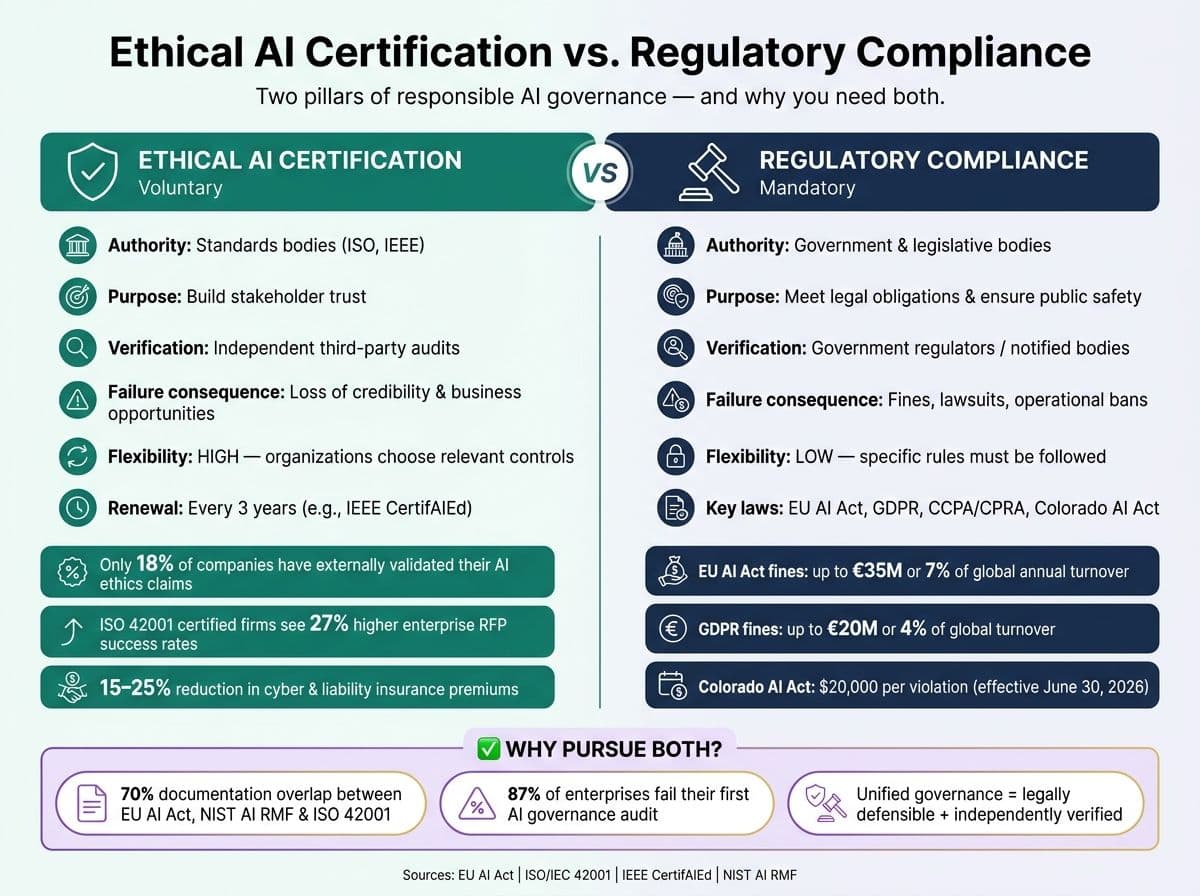
- Ethical AI Certification: Voluntary, third-party evaluation (e.g., ISO/IEC 42001, IEEE CertifAIEd) to show AI systems meet fairness, transparency, and privacy standards.
- Regulatory Compliance: Mandatory adherence to laws like the EU AI Act, GDPR, or U.S. state-level AI laws to avoid fines and legal risks.
Key Takeaways:
- Certification builds trust with customers and partners, while compliance ensures legal safety.
- Certification is voluntary but involves independent audits; compliance is enforced by governments.
- 70% of documentation overlaps between frameworks like ISO 42001 and the EU AI Act, reducing duplication.
- Non-compliance penalties can be severe, such as €35M fines under the EU AI Act.
- Combining both enhances governance, reduces risks, and improves operational efficiency.
Quick Comparison:
| Aspect | Ethical AI Certification | Regulatory Compliance |
|---|---|---|
| Status | Voluntary | Mandatory |
| Authority | Standards bodies (ISO, IEEE) | Government regulators |
| Purpose | Build stakeholder trust | Meet legal obligations |
| Verification | Independent third-party audits | Government oversight |
| Failure Consequences | Loss of credibility | Fines, lawsuits, bans |
Both approaches are complementary and increasingly interconnected, helping organizations meet legal requirements while demonstrating responsible AI practices.
Ethical AI Certification vs. Regulatory Compliance: Key Differences & Stats
What Is Ethical AI Certification?
Definition and Goals
Ethical AI certification is a voluntary process where a third party evaluates AI systems to ensure they align with principles like fairness, transparency, accountability, and privacy. The goal is to confirm these values are embedded in how the AI operates, fostering trust among stakeholders. With AI adoption in workplaces set to nearly double between 2023 and 2025 and the global AI market projected to hit $1.77 trillion by 2032, the demand for organizations to demonstrate responsible AI practices is growing rapidly.
"Certification offers a method to both incentivize adoption of these principles and substantiate that they have been implemented in practice." - Peter Cihon et al., IEEE Transactions on Technology and Society
Certification Bodies and Standards
Several organizations have created frameworks to assess AI ethics. Among the most recognized is the IEEE Standards Association (IEEE SA), which offers the IEEE CertifAIEd program. This program evaluates AI systems based on four key areas: Transparency, Accountability, Algorithmic Bias, and Privacy. Other notable frameworks include ISO/IEC 42001:2023, the first AI management system standard covering 38 controls across the AI lifecycle, and Singapore's AI Verify Foundation, which emphasizes fairness, explainability, and safety through voluntary labeling. In the U.S., the NIST AI Risk Management Framework (AI RMF) 1.0 provides flexible, non-certifiable guidance for managing AI risks.
| Framework | Body | Certifiable? | Primary Focus |
|---|---|---|---|
| IEEE CertifAIEd | IEEE SA | Yes | Ethics of autonomous AI systems |
| ISO/IEC 42001 | ISO/IEC | Yes | AI management system structure |
| NIST AI RMF 1.0 | NIST | No | Risk management guidelines |
| AI Verify | AI Verify Foundation | Yes | Ethical AI labeling (Singapore) |
These frameworks offer different approaches to operationalizing certification, which we’ll explore in the next section.
How Certification Works
The certification process typically unfolds in four phases:
- Enquiry: Define the scope of the AI system and its intended use.
- Ethical Profiling: Conduct an ethical risk assessment based on specific values.
- Assessment: Gather evidence, including technical documentation, bias testing results, and governance records.
- Certification: An independent body reviews the evidence and, if approved, issues the certification mark.
For instance, the City of Vienna utilized the IEEE CertifAIEd program to validate the ethical standards of its software.
"Data security and data protection must be at the forefront when using AI from the very beginning. That's why we relied on international expertise (from IEEE) during the development of the software and had our program ethically certified." - Peter Weinelt, Deputy Director General, City of Vienna
Once issued, IEEE CertifAIEd certifications remain valid for three years before renewal is required. However, only 18% of companies have externally validated the ethical claims they make about their AI products, highlighting a competitive edge for those that achieve certification.
While ethical certifications are voluntary, they serve as a trust-building mechanism. In contrast, regulatory compliance imposes mandatory standards - a distinction to be examined further.
sbb-itb-903b5f2
What Is Regulatory Compliance?
Definition and Scope
Regulatory compliance refers to following mandatory legal rules established by governments and regulatory bodies. Unlike voluntary certifications, these rules are not optional - organizations must comply or face potential penalties. In the AI industry, some of the key regulations include the EU AI Act, GDPR, and CCPA/CPRA in California.
The EU AI Act, considered the most detailed AI law, categorizes risks into four levels: Unacceptable, High, Limited, and Minimal. The obligations for compliance increase with the level of risk. For example, high-risk systems - like those used in hiring processes, credit evaluations, or medical devices - must meet strict requirements. These include creating technical documentation, ensuring human oversight, maintaining tamper-resistant logs, and undergoing conformity assessments.
"Non-compliance is not a governance gap - it is a legal exposure." - The AI Journal
How Requirements Vary by Region
Compliance rules differ significantly depending on the region and even the location where an AI system’s results are used. The European Union adopts a broad, all-encompassing approach, with a single regulation covering multiple sectors. On the other hand, the United States lacks a unified federal AI law, relying instead on guidelines from specific agencies like the FTC, FDA, and EEOC, as well as state-level laws. For instance, Colorado’s AI Act, effective June 30, 2026, focuses on critical decisions in areas like housing, employment, and insurance, imposing penalties of $20,000 per violation.
China takes a different route, requiring algorithmic impact assessments and mandatory registration with the Cyberspace Administration of China (CAC).
Interestingly, the EU AI Act has an extraterritorial reach. If an AI system affects EU residents, the regulation applies, creating what’s often called the "Brussels Effect", where EU standards influence global practices.
| Jurisdiction | Legal Nature | Enforcement Date | Max Penalty |
|---|---|---|---|
| EU AI Act | Binding regulation | August 2, 2026 | €35M or 7% of global turnover |
| Colorado AI Act | Binding state law | June 30, 2026 | $20,000 per violation |
| GDPR | Binding regulation | In effect | €20M or 4% of global turnover |
| China AI Regulation | Binding (prescriptive) | Varies by decree | Varies |
These regional differences highlight the financial and operational risks of non-compliance.
Penalties for Non-Compliance
The consequences of failing to meet compliance standards go beyond monetary fines. Under the EU AI Act, the most severe breaches can result in fines of up to €35,000,000 or 7% of a company’s total global annual revenue. For high-risk system violations, penalties can reach €15,000,000 or 3% of annual turnover.
Legal sanctions are another layer of risk. By April 2026, U.S. courts had already issued over 800 sanctions related to AI-generated errors in legal filings. A significant example occurred in March 2026, when a federal court in Oregon fined an attorney $109,700 for submitting documents with AI-generated mistakes. This record-breaking penalty underscores how seriously courts are addressing AI misuse.
"The penalties provided for shall be effective, proportionate and dissuasive." - EU AI Act
Beyond fines and legal action, non-compliance can severely harm a company’s reputation. Failing compliance checks can lead to blocked procurement opportunities, loss of access to essential services, and diminished customer trust - damages that are often harder to quantify but can be just as damaging as financial penalties.
Key Differences Between Certification and Compliance
Side-by-Side Comparison
Certification is optional, while compliance is required by law. Certification demonstrates reliability and accountability to customers, partners, and enterprise clients. Compliance, on the other hand, is non-negotiable - failure to comply can result in fines, lawsuits, or even being barred from operating.
Here's a breakdown of the major differences:
| Dimension | Ethical AI Certification (e.g., ISO 42001) | Regulatory Compliance (e.g., EU AI Act, GDPR) |
|---|---|---|
| Status | Voluntary | Mandatory |
| Issuing Authority | Independent standards bodies (ISO, IEEE) | Government and legislative bodies |
| Primary Goal | Builds trust and differentiates in the market | Ensures legal adherence and public safety |
| Verification | Conducted by third-party accredited auditors | Overseen by government regulators or notified bodies |
| Consequence of Failure | Loss of business opportunities | Fines, legal action, or operational bans |
| Flexibility | High; organizations choose relevant controls | Low; specific rules and articles must be followed |
It’s worth noting that compliance may often involve self-assessment or government reviews, while certification requires evaluation by an independent, accredited auditor. These differences highlight how each serves distinct purposes and stakeholders.
Objectives and Stakeholders
Although both certification and compliance involve extensive documentation, they serve different goals and audiences. Certification focuses on demonstrating responsible AI practices to customers, enterprise clients, and boards. As one expert noted:
"Certification programs, as a form of governance, are usually not legally enforceable and are not bound by specific jurisdictions." - AI and Ethics
Compliance, however, is aimed at regulators, government officials, and the public. Its primary goal is to safeguard individuals from harm, not to enhance reputation or win contracts. This difference is also reflected in the teams responsible for each process: certification efforts are typically led by AI specialists, product developers, and ethicists, while compliance teams often include legal counsel, data protection officers (DPOs), and compliance managers.
Another key distinction lies in how these processes adapt over time. Certification requires periodic renewal to stay relevant, while compliance tends to be more static - organizations meet the legal requirements, pass inspections, and wait for the next enforcement round. This lag can create challenges in fast-evolving fields like AI, where technology often outpaces regulatory updates.
How Certification and Compliance Work Together
How Certification Supports Compliance
Certification and compliance are two sides of the same coin when it comes to AI governance. While compliance defines the rules and expectations, certification provides the tools and framework to meet those requirements effectively.
Take ISO/IEC 42001 as an example - it aligns closely with many aspects of the EU AI Act. For instance, Clause 6.1 of ISO/IEC 42001 (focused on risk planning) directly supports the risk management requirements outlined in Article 9 of the EU AI Act. Similarly, Clause 9.1 (which covers monitoring and measurement) helps fulfill the logging and traceability obligations in Article 12. By pursuing certification, organizations aren’t starting from scratch; they’re building structured, documented systems that regulators will eventually expect to see.
"The EU AI Act is a legal obligation (comply or face fines). ISO 42001 is a management system standard (it gives you the operational structure to meet those legal obligations)." - The AI Journal
There’s also a practical advantage here: about 70% of the documentation and operational requirements for the EU AI Act, NIST AI RMF, and ISO 42001 overlap. This means organizations can often use a single set of documentation to meet multiple frameworks, making governance and compliance efforts more efficient.
How Regulations Shape Certification Standards
Just as certification simplifies compliance, regulations play a key role in shaping certification standards. This relationship ensures that certification criteria evolve alongside legal requirements. For example, as the EU AI Act becomes more specific and enforceable, certification bodies like ISO update their standards to stay aligned. This is why ISO 42001’s controls map so well to the EU AI Act - it was designed with regulatory alignment in mind.
In the U.S., the situation is unfolding differently but with similar outcomes. Voluntary frameworks like the NIST AI RMF are increasingly being used by state legislatures, such as those in Colorado and Texas, to define "reasonable care" in AI-related negligence cases. As Rafal Fryc from the Future of Privacy Forum explains:
"Compliance with non-binding standards can determine liability regardless of whether a jurisdiction has passed AI-specific legislation."
This creates an interesting dynamic: even in the absence of federal AI regulations, adhering to recognized certification standards can still have significant legal implications. The line between voluntary and mandatory is becoming less distinct.
Benefits of Pursuing Both
By combining certification and compliance, organizations unlock benefits that neither approach can deliver alone. Together, they create a governance system that is both legally defensible and independently verified. Compliance satisfies regulatory demands, while certification builds trust with customers, partners, and procurement teams.
The financial perks are also worth noting. For example, financial services companies that achieve ISO-certified AI governance report 15–25% reductions in cyber and liability insurance premiums. Additionally, certified organizations see a 27% higher success rate in enterprise RFPs compared to uncertified competitors.
"Governance without compliance is a policy document. It describes intent but produces no evidence. Compliance without governance is a point-in-time checklist." - Patrick Spencer, Kiteworks
The smartest strategy? Build a unified governance framework. Use the NIST AI RMF for methodology, ISO 42001 for structure, and the EU AI Act as the legal foundation. This integrated approach minimizes duplication, reduces costs, and creates a solid audit trail that satisfies both regulators and third-party reviewers.
Steps Organizations Can Take
Building Internal Governance
The first step toward effective governance is assigning clear accountability. Designate a C-level executive - such as your CISO, CRO, or General Counsel - to act as the sponsor responsible for AI governance. Alongside this, appoint an AI Governance Lead to manage the day-to-day operations. Having clear ownership ensures that governance efforts remain actionable and organized.
Another critical move is creating a centralized AI inventory. This inventory should document every AI tool, vendor integration, and embedded feature used within your organization. Why is this so important? 87% of enterprises fail their first ISO 42001 or NIST RMF audit due to incomplete inventories and missing traceability logs. Once you have a complete inventory, classify each AI system by risk tier - unacceptable, high, limited, or minimal - based on the EU AI Act's guidelines. This classification helps identify which systems require the most stringent controls.
If your organization is already ISO 27001 certified, you’re in luck: about 40% of the documentation can be repurposed for ISO 42001 certification. This can save both time and money during the compliance process. Leveraging existing compliance frameworks not only simplifies certification but also ensures smoother adherence to legal requirements.
Risk Assessment and Documentation
Risk assessment isn’t a one-and-done task - it’s an ongoing process. In fact, Clause 6 (Risk Planning) is the most common reason for ISO 42001 audit failures, contributing to 40% of first-time certification rejections. To avoid this, it’s essential to document risks thoroughly. That means outlining the risks, detailing how they’re being managed, assigning accountability, and specifying the controls in place.
A practical way to organize this documentation is by lifecycle stage. Here’s a quick summary of the evidence auditors typically look for:
| Lifecycle Stage | Required Evidence |
|---|---|
| Design | Use case specifications and bias risk assessments |
| Development | Results from adversarial testing and data lineage documentation |
| Deployment | Human oversight logs and pre-deployment risk sign-offs |
| Monitoring | Monthly performance reports and drift detection alerts |
| Retirement | Decommissioning records and data deletion certificates |
For high-risk AI systems, the EU AI Act (Article 19) mandates retaining technical documentation for at least 10 years after the product is on the market. Missing traceability logs can be costly too, with redo audits averaging $10,000–$15,000. This makes comprehensive documentation a priority for both compliance and cost management.
Involving Stakeholders
Effective governance requires more than policies and documentation - it needs active involvement from stakeholders. Create a cross-functional committee that includes representatives from Legal, IT/Security, HR, and relevant business units. This group should review policies and evaluate new AI use cases. A collaborative approach ensures that risks are identified from multiple perspectives, reducing the chance of oversight.
"An organization that understands its risks in using AI is generally one that will build and use it safely. This also ensures your AI compliance program is designed to support the goals of the business." - Evan Rowse, GRC Subject Matter Expert, Vanta
There’s also the challenge of unapproved AI usage. Studies show that 80% of employees use AI tools not approved by their organization, and 59% actively conceal their usage. To address this, enforce policies at the point of use. For instance, browser extensions that require employees to acknowledge policies before accessing tools can help. Pairing these measures with role-based training has been shown to reduce governance incidents by 35% on average.
Where AI Certification and Compliance Are Headed
Current State of Frameworks and Adoption
Voluntary guidelines in AI are quickly shifting toward enforceable rules. In the U.S., the NIST AI RMF and ISO/IEC 42001 are leading frameworks, but their "optional" status is rapidly diminishing. Federal agencies now mandate compliance with the NIST AI RMF for contractor relationships. Meanwhile, over 1,100 AI-related bills were introduced across U.S. states in 2025 alone.
However, a major challenge remains: 87% of enterprises fail their first AI governance audit, primarily due to incomplete documentation. This gap highlights a key issue - adoption is outpacing organizational readiness. As these frameworks evolve, they are increasingly shaping how ethical principles influence legal systems and regulations.
Ethical Standards Moving Into Regulations
As AI adoption grows, voluntary standards are being codified into enforceable laws. States such as Colorado, Texas, California, New York, and Washington are using NIST and ISO standards to define legal compliance. For instance, Texas provides companies with an affirmative defense against liability if they align with the NIST AI RMF. Washington's HB 2157 goes a step further, presuming compliance for developers adhering to NIST or ISO 42001.
Courts are also playing a role in shaping AI accountability. In areas without AI-specific laws, judges are relying on these voluntary standards to interpret "reasonable conduct" and "duty of care" in AI-related cases. As Rafal Fryc from the Future of Privacy Forum explains:
"Compliance with non-binding standards can determine liability regardless of whether a jurisdiction has AI-specific legislation." - Rafal Fryc, Legal Intern, Future of Privacy Forum
Adding to the pressure, 80% of U.S. corporate counsel predict an increase in class-action lawsuits related to AI, as federal regulations continue to lag behind.
The Role of Standards Organizations
As certification and regulation converge, standards organizations are becoming central to global AI governance. Key frameworks like the EU AI Act, NIST AI RMF, and ISO 42001 share a 70–80% operational overlap. This means that working toward compliance with one framework often brings organizations closer to meeting the others.
"Standards are essential to governing AI well and act as the quiet infrastructure of innovation, as they enable us to scale AI safely and responsibly across our economies and societies." - Sara Rendtorff-Smith, Head of Division on AI and Emerging Digital Technologies, OECD
For U.S. companies, the most practical approach is to begin with the NIST AI RMF, a process that typically takes 3–6 months. From there, organizations can use the official NIST-ISO crosswalk to streamline their efforts toward ISO 42001 certification. This phased strategy minimizes redundancy and helps businesses keep pace with both domestic and international compliance demands.
AI Ethics and Compliance: What’s Changing and Why it Matters
Conclusion
Ethical AI certification and regulatory compliance work hand in hand - they're two parts of the same effort. Compliance establishes the legal foundation, outlining the minimum requirements to avoid penalties, bans, or legal liabilities. Certification, on the other hand, goes beyond the basics, showcasing to customers, partners, and regulators that your AI system is designed to manage risks responsibly with measurable safeguards.
Interestingly, there’s about a 70% overlap between key frameworks like the EU AI Act, NIST AI RMF, and ISO/IEC 42001. This means pursuing both certification and compliance doesn’t necessarily double the workload. By maintaining a single, organized evidence base, you can address multiple requirements simultaneously. This approach not only simplifies the process but also strengthens risk management overall.
For businesses, the benefits are clear. ISO 42001 certification has been shown to improve enterprise RFP success rates by 27% and cut insurance premiums by 15–25%. On the flip side, non-compliance carries steep risks - violating the EU AI Act could result in fines as high as €35 million or 7% of global annual turnover, whichever is greater.
The gap between "voluntary" and "mandatory" standards is narrowing quickly. Courts are referencing voluntary standards to define reasonable behavior, while state legislatures are incorporating them into laws. This growing alignment highlights the importance of a unified approach. As The AI Journal aptly explains:
"The EU AI Act tells you what you must do. NIST AI RMF tells you how to think about AI risk. ISO 42001 tells you how to build a system that manages AI risk sustainably."
FAQs
Do I need ethical AI certification if I’m already legally compliant?
Legal compliance ensures adherence to enforceable laws, while ethical AI certification goes a step further by reflecting a commitment to responsible practices that exceed legal obligations. While certification isn’t mandatory, it can play a key role in building trust, demonstrating accountability, and staying ahead of potential future regulations. That said, critics caution that certifications might sometimes result in surface-level efforts rather than fostering genuine responsibility. Ultimately, it’s worth weighing whether pursuing certification aligns with your organization’s goals and the expectations of your stakeholders.
Which AI systems are classified as 'high-risk' under the EU AI Act?
AI systems classified as "high-risk" under the EU AI Act cover a range of applications. These include biometric identification, identity verification, and emotion detection in public spaces. They also extend to systems used for determining eligibility for loans, social benefits, or immigration status. For a more detailed list, refer to Annex III of the Act.
What documents should I keep to pass both audits and regulator reviews?
To comply with audit and regulatory review requirements, it's essential to keep specific records organized and accessible. These include regulatory compliance documents, audit reports, and technical documentation that demonstrate adherence to ethical and legal standards. Additionally, maintain risk management records and logs of monitoring and auditing activities. These records help ensure transparency and prepare you for evaluations.