
Hybrid Fault-Tolerant Edge AI Architectures
If your AI system stops when the internet drops or a local node fails, the design is incomplete. I’d boil this topic down to one idea: keep core AI tasks close to the device, send heavy work to the cloud only when needed, and define exactly what happens during outages.
Here’s the short version:
- I use a four-tier setup: device, edge node, regional edge, and cloud.
- I pick one of three fallback patterns:
- hierarchical edge-to-cloud fallback
- split inference with a local degraded mode
- on-device inference with cloud backup
- I treat failure detection, node roles, and model placement as day-one design work.
- I plan for offline states, queued sync, and conflict rules before deployment.
- I test degraded mode on purpose, because downtime can cost $300,000+ per hour, and for many firms it can hit $1 million+ per hour.
What matters most is simple:
- Low-latency or private tasks stay local
- Large model requests go up to the cloud
- Every tier needs a fallback
- Sync must keep working after link loss
- Users should still get an acceptable result, even if features are reduced
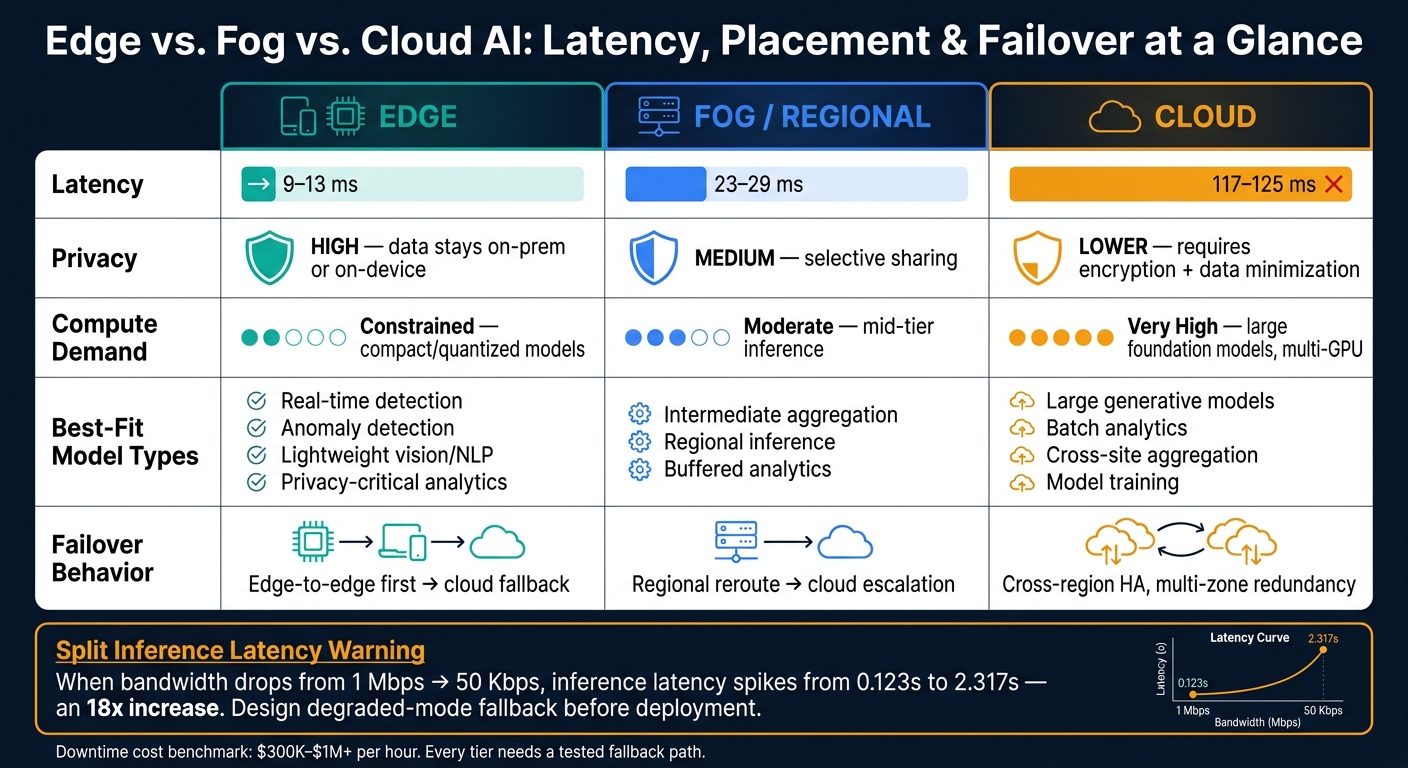
A few numbers help frame the problem. Edge-heavy setups can keep latency near 9–13 ms, while cloud paths can land around 117–125 ms. And in split inference tests, latency rose from 0.123 seconds to 2.317 seconds when bandwidth fell from 1 Mbps to 50 Kbps. That’s why I don’t treat cloud access as a given.
At a high level, this kind of architecture solves one job: keep AI services available when networks, hardware, or power fail - without sending every request to the cloud and hoping for the best.
Why AI Inference at the Edge Changes Performance, Security, and Cost | Ari Weil, Akamai

sbb-itb-903b5f2
Core Hybrid Edge-Cloud Patterns for Resilient AI
Once the tier stack is set, the next issue is simple: what happens to requests when one layer goes down? In most fault-tolerant edge AI setups, three patterns show up again and again. Each one makes its own trade-offs around latency, bandwidth, cost, and how smoothly the system keeps going under stress.
Hierarchical Edge-to-Cloud Design with Workload Fallback Between Tiers
In this setup, each tier handles work until it runs out of capacity or loses connectivity. Then it hands that work to the next tier up. The failover path is clear: device, edge node, regional edge, then cloud.
The main strength here is explicit fallback. If an edge node fails, devices reroute to a secondary edge node or drop back to on-device heuristics. If the WAN link goes down, the edge node keeps local inference running, logs events, and queues data for upload later. If a regional edge site fails, edge nodes switch to cloud endpoints and take the latency hit. The point is simple: every failure mode has a planned response, so the system steps down in stages instead of failing all at once.
This pattern can also cut bandwidth costs in a big way. Devices send upstream only filtered events or feature summaries, which means raw data stays local. In manufacturing, for example, edge servers can run real-time defect detection on camera feeds and send only defect stats and sample images to the cloud, not full video streams.
Split Inference and Local-Only Degraded Mode
Split inference breaks a neural network across tiers. The early layers run at the edge and turn raw input into feature representations. The later layers run in the cloud. For this to work well, those intermediate features need to stay small so they don't eat up bandwidth.
The weak point is cloud-link degradation. As bandwidth drops, latency climbs fast. Research shows that when bandwidth falls from 1 Mbps to 50 Kbps, inference latency rises from 0.123 seconds to 2.317 seconds. At that stage, waiting on the cloud part of the model just doesn't make sense.
That's where degraded mode comes in. If split inference loses cloud support, the edge falls back to a smaller backup model, usually a distilled version of the full network or a simpler rule-based system, that can still produce the main predictions without cloud access. The output gets less detailed, but the system keeps the core job alive. A video analytics system, for instance, may shift from rich attribute detection to a basic person detected versus no person result. Safety-related signals like machine stop commands or intrusion alarms still need to work in degraded mode.
On-Device Inference with Cloud Backup for Heavy or Rare Requests
This pattern keeps routine, low-latency, and privacy-sensitive inference on the device itself. The cloud is used only for heavier or less common requests that go beyond local compute limits, or when the local model returns a low-confidence result. For access-layer systems that need to keep working through outages, this is often the cleanest option.
The usual mechanism is confidence-based routing. If the local model's confidence falls below a set threshold, the device sends the request, or a compact representation of it, to the cloud model. That keeps cloud use limited to the cases that need extra compute. For generative work, such as complex text generation, multimodal reasoning, or large language model queries, cloud escalation is usually the default path.
If there's a temporary outage, cloud-bound requests are placed in a persistent local queue with priority metadata. Safety-related and business-critical jobs run first once connectivity comes back. Non-essential analytics can wait. To keep storage use under control, devices store compact representations like feature vectors instead of full images. That helps prevent data loss without keeping raw inputs around for long.
None of these patterns work well if failover paths, node roles, and model placement are left vague. They need to be defined up front.
Fault Tolerance Mechanisms, Node Roles, and Model Placement
Edge vs. Fog vs. Cloud AI Latency & Model Placement Guide
These patterns only hold up when three things are in place: fast failure detection, clear node roles, and smart model placement. Once you have fallback routes, the next job is figuring out who spots trouble, who steps in, and where each model should live so it can keep running when parts of the stack go down.
Failure Detection, Redundancy, and Failover Paths
Failure detection needs to happen at every layer, but the method depends on what the hardware can handle. On constrained devices, that usually means lightweight watchdogs and sparse heartbeats that report battery, CPU, and storage status. Edge and cloud nodes can do more. They can run synthetic inference requests against AI services, track fine-grained time-series metrics through Prometheus-style exporters, and watch latency and error-rate patterns for signs of trouble. Early warning signals matter a lot here. Rising hardware temperatures, longer inference queues, and climbing model error rates can point to saturation before a hard outage shows up.
Redundancy at the edge node layer is a must. Many teams use at least three nodes in a cluster to aim for 99.999% uptime. When one node turns unhealthy, failover usually follows a simple path: local retries first, then edge-to-edge rerouting, then edge-to-cloud fallback. Circuit breakers help keep that process from getting messy. If error rates on one path pass a set threshold, the breaker opens and traffic moves to another route until the path recovers. That helps stop traffic from bouncing back and forth between a shaky edge link and cloud endpoints.
Node Roles and Orchestration in Edge Clusters
Each node role should have a clear job. That sounds basic, but it's what keeps one fault from rippling across a whole site.
- Device agents collect data, preprocess it locally, enforce data policy, and run small on-device models.
- Edge workers handle inference and caching.
- Control-plane nodes schedule workloads and reschedule failed work.
- Cloud coordinators manage global policy, registries, rollouts, and cross-region failover.
Those roles need an orchestrator that can move work around without turning a local problem into a site-wide outage. Common edge orchestration tools include:
| Orchestrator | Role | Edge Autonomy | HA Support | Architecture Support | Overhead |
|---|---|---|---|---|---|
| K3s | Lightweight Kubernetes for edge and IoT clusters | Moderate-high; works with limited cloud connectivity | HA control plane with multiple server nodes; standard Kubernetes worker failover | ARM/x86; single-node and multi-node edge clusters | Very low; trimmed components and a single binary |
| MicroK8s | Kubernetes for single-node or small-cluster edge deployments | Moderate; suited for on-prem/edge sites with stronger central control | HA via clustering multiple nodes; automatic workload failover | ARM/x86; bare-metal and VM deployments | Low-moderate; add-ons increase resource use if enabled |
| KubeEdge | Extends Kubernetes to edge nodes with cloud-edge coordination | High; edge nodes keep running locally when disconnected | HA at the cloud-side control plane; edge autonomy mitigates cloud failures | Cloud core plus heterogeneous edge nodes; supports device integration | Low-moderate; adds edge-specific components for constrained environments |
Model Placement Rules for Latency-Sensitive, Private, and Large AI Workloads
Model placement comes down to five things: latency budget, privacy and regulatory limits, model size, bandwidth, and uptime goals. If a workload needs a response time under 50 ms, or if it processes raw video with identifiable faces, it should run locally. On the other hand, if a model is larger than 10 GB or needs more than 50 TFLOPS per request, it belongs in the cloud unless the edge site has specialized hardware.
In hierarchical edge-fog-cloud setups, measured latency usually lands around 9–13 ms at the edge, 23–29 ms at fog, and 117–125 ms in the cloud. That gap is hard to ignore. A safety-critical control loop can't wait around for cloud-tier timing.
| Placement | Latency | Privacy | Compute Demand | Failover Behavior | Best-Fit Model Types |
|---|---|---|---|---|---|
| Edge | Very low | High; data stays on-prem or on-device | Constrained; suits compact or quantized models | Usually edge-to-edge first, with cloud fallback if connectivity allows | Real-time detection, anomaly detection, lightweight vision/NLP, privacy-critical analytics |
| Cloud | Higher and variable | Lower unless strong encryption and data minimization are applied | Very high; supports large foundation models and multi-GPU pipelines | Cross-region and multi-zone HA; mature cloud failover mechanisms | Large generative models, batch analytics, cross-site aggregation, model training |
| Hybrid | Mixed; local components respond fast, cloud handles slower tasks | Balanced; raw sensitive data processed locally, selectively shared outputs to cloud | Split; edge handles lightweight inference, cloud handles heavy or long-running tasks | Layered: edge-to-edge within site, then edge-to-cloud for degraded mode; cloud provides global redundancy | Pipelines combining local detection with cloud-based enrichment, generative post-processing, or fleet-level optimization |
A good example is an industrial safety system. It can run detection at the edge, use the cloud for retraining, and use a hybrid setup for incident summaries.
With placement fixed, the next problem is keeping state aligned across disconnected tiers.
Synchronization and Consistency in Hybrid Edge AI
Placement decides where inference runs. Synchronization decides what each tier can trust when links fail.
Once model placement is set across tiers, the next job is keeping prompts, outputs, embeddings, policies, and model versions in sync when the network between those tiers gets shaky - even if connectivity drops for minutes or days.
Connectivity States and Offline Behavior
Treat connectivity like a state machine, not a simple on/off switch. Each edge node should know its current state and change behavior to match.
| Connectivity State | Serving Behavior | Sync Behavior | Storage Behavior |
|---|---|---|---|
| Always-connected (low latency, stable bandwidth) | Serve local requests and sync continuously. | Real-time push for policies and model updates; continuous log streaming | Keep only a small fallback buffer |
| High-latency (slow or congested link) | Serve locally and batch non-urgent sync. | Shift bulk embedding refresh and analytics to batch uploads every 15–60 minutes | Cache outputs locally and queue them for background sync |
| Intermittent (frequent short outages, flapping links) | Keep core local functions running and queue cloud work. | Queue cloud escalations with TTLs; apply the last-known-good policy snapshot | Use a durable local queue such as RocksDB or LevelDB for escalation jobs |
| Extended-offline (no cloud for minutes to days) | Operate from local state only and queue all cloud-bound changes. | Upload logs and state changes in batches after reconnect; record an offline flag | Keep enough local storage to buffer days of prompts and outputs per node |
Some edge platforms support indefinite offline operation: modules keep running locally, telemetry buffers on-device, and messages sync in order after reconnect.
Once a node knows its connectivity state, it can choose the right sync path.
Push, Pull, and Batch Synchronization Methods
These three methods don't compete with each other. They work best as a set, with each one handling a different kind of data.
| Sync Method | Latency | Bandwidth Use | Failure Tolerance | Typical Edge AI Use Cases |
|---|---|---|---|---|
| Event-driven push | Low (seconds) | Spiky, per event | Needs retries; sensitive to outages | Policy changes, access revocation, safety alerts, critical config |
| Scheduled pull | Medium (minutes) | Moderate, predictable | High; edge retries on schedule | Model version checks, policy refresh |
| Batch sync | High (hours) | Efficient for large volumes | Very high; works well after outages | Logs, offline prompts and outputs, bulk embeddings, usage metrics |
Use push for urgent changes, pull for scheduled refreshes, and batch for logs, outputs, and embeddings. A good rule is to sync high-value, low-volume data first - critical telemetry and model feedback - before bulk training data.
Use delta-based sync instead of full snapshots whenever possible. Sending only the changes cuts bandwidth use and speeds up reconnect recovery.
Consistency Trade-offs and Conflict Resolution
A sync method moves data. It doesn't settle disagreements. Conflict rules do that job.
Eventual consistency is the standard choice for most edge setups because it keeps systems available during network partitions, even when replicas disagree for a while. For AI recommendations, embeddings, usage logs, and non-critical metadata, that's usually fine. The edge can keep serving from local state and reconcile later in the background.
The exception is safety-critical and compliance-sensitive work. Controlling a physical actuator, revoking access, or applying a new content safety filter needs stricter guarantees. In those cases, require cloud validation or fall back to conservative local rules until confirmation comes back.
For conflict handling, keep it simple:
- Eventual consistency for non-critical data. Use last-write-wins for non-critical metadata, with synchronized time and origin node IDs.
- Ordered updates when sequence matters. Use queued, ordered updates for operational state changes such as inventory adjustments or workflow status.
- CRDTs for shared structures. CRDTs (Conflict-Free Replicated Data Types) are worth considering for shared counters, feature flag sets, and embedding indexes, since they merge automatically without custom conflict logic.
Placement defines performance. Synchronization defines correctness during outages. Together, they decide whether fallback tiers stay usable or drift out of sync when the network fails.
Where AI Model Access Platforms Fit and What to Build Next
With placement and sync rules in place, one design choice still matters: which cloud layer should handle the heavy requests?
Using NanoGPT as a Cloud-Backed Model Access Layer in a Hybrid Design
NanoGPT can act as the cloud-backed access layer for large text and image requests when local hardware hits its limit. It gives you one API layer for text and image models, so edge apps don't need separate integrations, API keys, or billing setups for each provider.
NanoGPT stores data locally on the user's device and uses pay-as-you-go billing. That setup helps keep sensitive prompts out of shared logs and avoids locking the system into fixed capacity.
A simple routing pattern works well here:
- Send routine, privacy-sensitive, and offline tasks to local models
- Send heavy or infrequent requests to NanoGPT
- If the cloud path goes down, switch to local-only mode and queue non-urgent jobs
Once the access layer is in place, day-to-day operating habits are what keep fallback behavior dependable.
Design Checklist for a Fault-Tolerant Edge AI Deployment
Before going live, work through these priorities in order:
- Define failure budgets. Set clear targets - for example, 99.9% of interactive requests should respond within 2 seconds, complete outage should stay under 5 minutes per month, and cache staleness should have a set maximum. Then tie routing and fallback rules to those numbers.
- Classify every request. Tag requests by latency sensitivity and privacy level. Those tags should decide whether a request goes to a local model or the cloud-backed NanoGPT layer.
- Pre-pull containers and cache critical models. Failover shouldn't depend on downloading files at the worst possible moment. Pre-fetch model containers to edge nodes, especially where connectivity drops in and out.
- Test offline and degraded modes explicitly. Simulate a full internet outage. Make sure local-only workflows still work and that the UI clearly tells users when capability is reduced.
- Validate failover paths end to end. Run chaos tests where the cloud endpoint is intentionally unavailable. Log mean time to recovery (MTTR), then tune thresholds based on what you see in practice.
These checks make the architecture operable when things go sideways, not just on a clean diagram.
Conclusion: Key Design Rules for Resilient Edge AI
Keep the topology simple. Hierarchical tiering with clear fallback paths is easier to test and run than custom one-off designs. Give each tier a clear job so there's no confusion during a failure event.
Model placement should follow three factors: latency, privacy, and size. Latency-critical and sensitive workloads stay close to the user. Large frontier models stay in the cloud and are reached through a dependable access layer.
Fault tolerance can't be treated like a side feature. You need to design, test, and monitor failover paths, connectivity states, sync policies, and degraded modes from day one.
FAQs
Which hybrid edge AI pattern fits my system best?
Choose based on three inputs: latency, request volume, and data movement.
- For sub-50 ms needs, use edge-first.
- For 50–150 ms with mixed local and cloud tasks, a balanced hybrid works best.
- For above 150 ms or low-volume, compute-heavy batch work, choose cloud-first.
NanoGPT supports these workflows with local processing for privacy and speed, plus pay-as-you-go cloud access for deeper reasoning.
What should still work when the cloud or network fails?
When the cloud or network goes down, an edge-based setup should still keep critical system functions running by handling work locally. That means the device can continue core tasks on its own, including inference with pre-deployed models.
NanoGPT can also rely on local storage during outages. It can use cached responses and previously generated content, then queue requests to sync with the cloud once the connection comes back.
How do I choose which AI tasks stay local versus go to the cloud?
Evaluate each workload by latency, request volume, and data-transfer needs.
Keep tasks local when you need sub-50 ms response times, real-time vision, safety-critical functions, strict privacy, or solid behavior during outages. Put compute-heavy, occasional, or large-model tasks in the cloud when 100+ ms response times are acceptable.
NanoGPT supports this hybrid setup with local data storage and pay-as-you-go access to advanced models.