
How Multi-Party Computation Meets GDPR Rules
MPC can lower data exposure, but it does not remove GDPR duties. If I handle EU personal data from the U.S., I still need to map each step of an MPC workflow to GDPR rules before launch.
Here’s the short version:
- Purpose still matters: I need to limit inputs, queries, and outputs to one defined use.
- Personal data can still exist in MPC: raw inputs, logs, shares, keys, and outputs may all fall under GDPR.
- Rights requests get harder: access, correction, deletion, and restriction must flow from the source record through each share, key, log, and result.
- Retention must cover every artifact: not just source data, but also temp files, logs, and backups.
- A node breach is not always a data breach: one share alone may be unreadable, but I still need to check whether enough pieces were exposed to rebuild the data.
- DPIAs and vendor checks still apply: more parties and more infrastructure mean more review, more contracts, and clearer role mapping.
One example stands out: Estonia’s 2015 Private Statistics project used MPC across 10 million tax records and 600,000 education records. That shows the goal: lower exposure and clear compliance controls.
If I had to reduce the article to one line, it would be this: MPC is a privacy control, not a GDPR exemption. So before go-live, I should check purpose limits, lawful basis, role setup, rights handling, retention, breach steps, DPIA status, and vendor contracts.
Purpose Limits and Data Minimization in MPC Design
Problem: Shared Analytics Often Drift Beyond the Original Purpose
Centralized data tends to invite scope creep. Teams start with one approved use, then later reuse the same records for something else.
Once raw records sit in a shared repository, that kind of reuse becomes easy. And MPC doesn't fix this by itself. If the computation is set up to allow open-ended queries, the same risk can show up through the results.
Solution: Lock Inputs, Queries, and Outputs to the Approved Purpose
The main control point isn't only who can touch the data. It's also which computations the protocol permits.
The fix is to treat the approved purpose as a technical limit, not just a line in a policy. Before computation starts, teams should define which queries are allowed and restrict results to aggregates or model parameters. In plain terms, that means setting rules at three checkpoints:
- allowed inputs
- allowed queries
- allowed outputs
This lines up directly with GDPR Articles 5, 6, and 25. Article 5 requires data minimization and purpose limitation, and Article 25 requires privacy by design. MPC turns the approved purpose into a technical control over which inputs, queries, and outputs are allowed.
That said, there's a tradeoff. MPC supports purpose limitation, but it can add heavy compute and communication overhead.
Compared with centralized pooling, MPC keeps raw data local, cuts down reuse risk, and limits exposure, but it also adds coordination and performance costs.
Data minimization also applies at the request layer, not only inside the dataset. For example, avoid attaching account identities or IP addresses to processing requests. Delete temporary IP addresses as soon as security checks are complete. That lowers re-identification risk without changing the computation.
sbb-itb-903b5f2
The Importance of Privacy Enhancing Technologies | Shirly Valge, Partisia Blockchain
Data Subject Rights, Retention, and Breach Response
Rights requests and incident handling get tougher when data is spread across nodes and broken into secret shares. Once that split happens, GDPR duties don’t stop at the source record. They follow each fragment. So every rights workflow needs to start at the source system and then move through shares, keys, logs, and outputs. In plain terms, the team needs a way to track every share, key, log entry, and downstream result tied to that data.
Handling Access, Rectification, Erasure, and Restriction in Distributed Setups
The practical rule here is source-first. Every rights request begins at the source system, then gets carried downstream.
If a data subject asks for erasure, delete the source record first. After that, the team also needs to delete or invalidate every related secret share and cryptographic key across all participating nodes. Otherwise, the data might still be rebuilt from what’s left behind.
Rectification works the same way. When a source record is corrected, any outputs based on the old version have to be found and recomputed. That’s where a computation log matters. It gives the team a trail to follow so old outputs don’t sit around quietly causing problems.
Access requests should stick to that same source-first path. Restriction requests should fit into the same workflow too, so downstream processing stays in step with the source status.
Role clarity matters just as much. Before launch, document which party is the controller and which is the processor.
Retention Rules for Shares, Keys, Logs, and Temporary Files
Retention rules need to cover every MPC artifact. GDPR storage limits apply not just to the source data, but also to shares, keys, logs, and temporary files.
The cleanest path is automated deletion checkpoints. Once a computation is finished, temporary files and shares should be purged instead of waiting for someone to clean them up by hand. Key material should be rotated or destroyed on a documented schedule. Audit logs should follow a set retention schedule too, instead of sitting around forever.
Breach Response When an MPC Node, Key, or Share Is Compromised
A compromise involving one MPC node or one share does not automatically expose personal data. A single share is cryptographically unintelligible without the other shares.
Still, Article 32 requires documented security and recovery controls, access controls, encryption, pseudonymization, and regular testing of the distributed setup. When an incident happens, the first question is simple: Were enough pieces exposed to rebuild the data? If the answer is yes, the team needs to assess the risk to individuals and follow the required notification process.
The incident response plan should also spell out what evidence must be preserved for review. That response process should tie back to the role definitions documented before launch, since those roles determine who handles each response step and what evidence each party has to produce.
That incident record also feeds the DPIA and vendor review that follow.
DPIAs, Vendor Review, and Accountability
The role map and incident record from the previous section should feed straight into the DPIA and vendor review. MPC brings in more parties, more contracts, and more infrastructure to check. That added complexity needs to be in the DPIA before launch.
When a DPIA Is Required and What to Examine
A DPIA is required when the MPC workflow is likely to create high risk to individuals. Common triggers include special-category data, large-scale inference or profiling, cross-border or cross-organization analytics, and designs where outputs could still reveal personal data through linkage or re-identification.
An MPC DPIA needs to go past a basic checklist. It should spell out output re-identification risk, trust assumptions, protocol maturity, and failure modes such as collusion, misconfiguration, and telemetry exposure. It also needs to explain why each of those failures leaves residual risk that standard controls may miss.
Store the DPIA with architecture diagrams, data-flow maps, role assignments, retention settings, incident steps, and approval history. Update it before launch and after any protocol or vendor change.
Vendor and Contract Checks Before Launch
Once the DPIA is documented, review every outside party that hosts, orchestrates, or manages keys. Vendor review is part of GDPR accountability. Require an Article 28 DPA covering scope, duration, purpose, security, subprocessors, breach notice, rights assistance, and deletion or return at contract end. Controllers remain responsible for checking that processors provide sufficient guarantees and for monitoring them over time.
Confirm in writing whether the vendor is a processor or joint controller, and make sure the system matches that role. Also ask whether the vendor limits node telemetry, supports customer-controlled keys, and can produce configuration records for audits or regulator inquiries. If the MPC is hosted, also ask whether the provider can access plaintext, whether shares are isolated by tenant, and how collusion risk is handled in the contract and in the system itself.
Conclusion: A GDPR-MPC Compliance Checklist
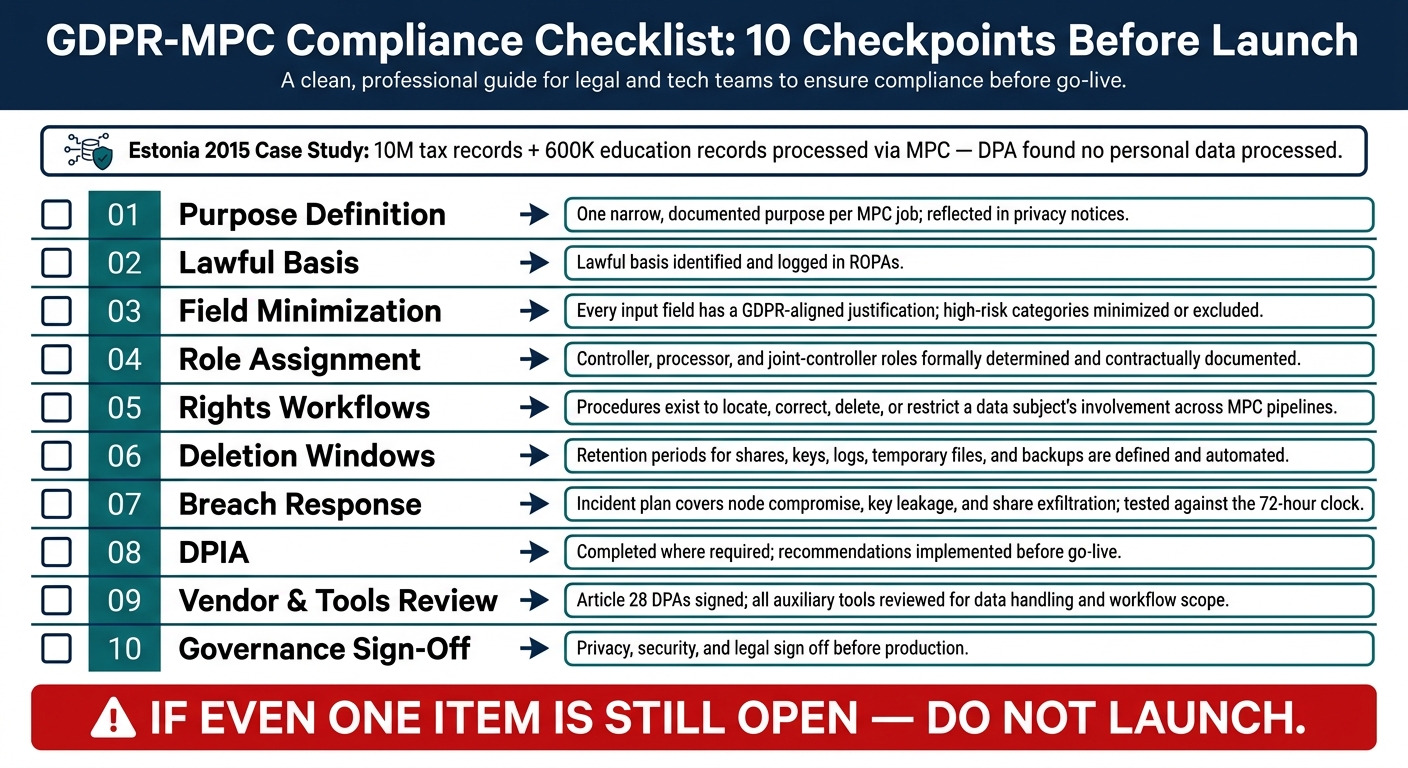
GDPR Compliance Checklist for MPC Workflows
Estonia's 2015 Private Statistics project used secure MPC on 10 million tax records and 600,000 education records. The data protection authority found that the workflow did not process personal data. That's the bar to aim for: stronger privacy, backed by clear GDPR controls.
MPC is a control. It does not replace GDPR compliance. Use the checklist below to review the workflow before launch.
Each item links one MPC design choice to one GDPR duty.
| Checkpoint | What to confirm |
|---|---|
| Purpose definition | One narrow, documented purpose per MPC job; reflected in privacy notices |
| Lawful basis | Lawful basis identified and logged in ROPAs |
| Field minimization | Every input field has a GDPR-aligned justification; high-risk categories minimized or excluded |
| Role assignment | Controller, processor, and joint-controller roles formally determined and contractually documented |
| Rights workflows | Procedures exist to locate, correct, delete, or restrict a data subject's involvement across MPC pipelines |
| Deletion windows | Retention periods for shares, keys, logs, temporary files, and backups are defined and automated |
| Breach response | Incident plan covers node compromise, key leakage, and share exfiltration; test it against the 72-hour clock |
| DPIA | Completed where required; recommendations implemented before go-live |
| Vendor and tools review | Security and privacy due diligence done; Article 28 DPAs signed; all auxiliary tools are reviewed for data handling and workflow scope |
| Governance sign-off | Privacy, security, and legal sign off before production |
If even one item is still open, don't launch.
FAQs
Does MPC make data anonymous under GDPR?
No. Multi-party computation (MPC) does not automatically make data anonymous under GDPR.
MPC can limit data exposure and let parties compute on data without laying all their cards on the table. That helps a lot from a privacy angle. But it does not on its own strip out personal identifiers to the standard needed for legal anonymization under GDPR.
That’s the key distinction. Data can stay protected during computation and still remain personal data in a legal sense. Metadata, transport data, or leftover identifiers may still make a person identifiable. So while MPC is a strong privacy tool, it is not a blanket anonymization fix.
Who is responsible in an MPC setup?
In a multi-party computation (MPC) setup, compliance and data protection don't sit with just one party. Everyone involved shares that responsibility.
Who answers for what depends on clearly defined roles and how those roles line up with GDPR duties. That includes things like purpose limitation, data subject rights, and breach response.
Things can get more complicated when third-party providers or model endpoints are part of the setup. In that case, organizations still need clear oversight. Why? Because those outside parties remain responsible for their own retention policies and their own legal obligations.
What should a DPIA cover for MPC?
A DPIA for multi-party computation (MPC) should explain why data is being collected, how long it will be kept, and the security setup behind the system. That includes encryption, secure communication channels, and the use of hardware security modules or cryptographic accelerators.
It should also spell out the trust boundary for data in use. In plain English, where is the line between data that stays protected and data that could be exposed during processing? On top of that, the DPIA should explain how the organization handles data subject rights, including deletion and access requests under laws like the CCPA or GDPR.