
Real-Time AI Task Scheduling Explained

Real-time AI task scheduling is transforming how tasks are managed in dynamic environments. By using AI algorithms, it prioritizes and adjusts tasks instantly based on shifting conditions, reducing response times by 26.3% and deadline misses by 41.7%. Unlike manual scheduling, which is slow and rigid, AI systems operate at machine speed, ensuring critical tasks are handled efficiently and resources are allocated effectively.
Key Takeaways:
- Efficiency Gains: AI scheduling automates task prioritization and resource management, completing up to 96% of tasks even during workload spikes.
- Predictive Analytics: Systems like EDZL and VARIMA forecast task deadlines and workload surges, minimizing delays and missed deadlines.
- Dynamic Resource Allocation: Fairshare balancing ensures optimal use of resources, while strategies like bin-packing and spreading improve performance.
- Privacy & Security: Platforms like NanoGPT prioritize data security with local storage, encryption, and compliance with global standards.
- Scalability: Suitable for both small tasks and large projects, it adjusts resource usage seamlessly.
With minimal setup time (under five minutes) and budget-friendly pay-as-you-go models, AI task scheduling enhances productivity while keeping you in control of decisions. Start small, experiment with various tools, and scale as needed to optimize your workflow.
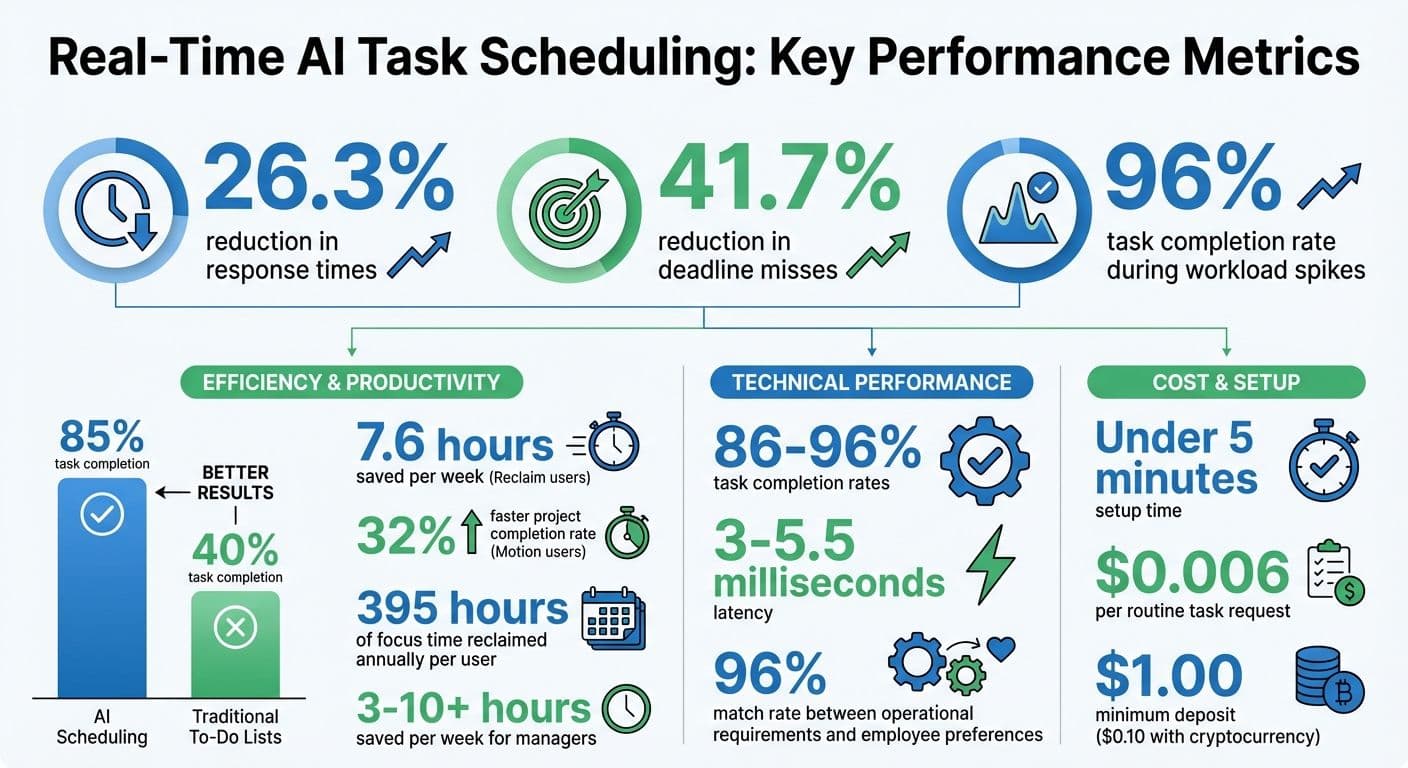
Real-Time AI Task Scheduling Benefits and Performance Statistics
How Real-Time AI Task Scheduling Works
AI Algorithms and Automated Decision-Making
Real-time AI schedulers are constantly working behind the scenes, re-ranking task queues to determine which task should run next. Take systems like Ray, for example: their algorithm evaluates each node based on resource usage. Nodes with utilization below 0.5 are assigned a score of 0 to encourage spreading workloads, while nodes above this threshold are scored according to their actual usage. From there, the scheduler randomly picks from the lowest-scoring 20% of nodes, helping to balance workloads and minimize cold starts.
Another key feature of these systems is how they handle resource conflicts. When high-priority tasks need resources, the scheduler can preempt lower-priority ones. NVIDIA’s Run:ai system, for instance, enforces this by marking tasks with a priority value of 100 or higher as non-preemptible, meaning they can’t be interrupted. Tasks with lower priority values, however, can be paused or delayed to make room for critical work. This ensures that essential tasks always take precedence.
These strategies make real-time schedulers highly effective at managing workloads and forecasting future needs.
Predictive Analytics for Task Forecasting
Predictive analytics play a crucial role in identifying and addressing potential issues before they arise. For instance, algorithms like Earliest Deadline Zero-Laxity (EDZL) track task laxity - the amount of delay a task can tolerate before missing its deadline. When a task’s laxity reaches zero, it’s moved to an "Urgent Queue", bypassing the usual scheduling process. This approach has been shown to reduce missed deadlines by 41.7%.
For long-term planning, statistical models like VARIMA (Vector Autoregressive Integrated Moving Average) are used to predict workload spikes. By anticipating these surges, the system can allocate resources in advance, ensuring smooth operations. These predictive methods enable task completion rates of 86% to 96%, with latencies as low as 3–5.5 milliseconds. The system also distinguishes between tasks that are critical to major milestones and those that are more routine, ensuring that high-priority work gets the attention it deserves.
This blend of real-time and long-term forecasting keeps tasks on track while optimizing resource use.
Resource Allocation and Task Prioritization
Dynamic resource allocation is another cornerstone of real-time AI scheduling. Schedulers use fairshare balancing to ensure each project gets its appropriate share of cluster resources. Fairshare values combine guaranteed resources with a proportional share of any unused capacity. If one project is under its fairshare while another is over, the system shifts resources to restore balance. Tasks are categorized into three states: in-quota, over-quota, and over-fairshare, with lower-priority tasks being the first to lose resources when adjustments are needed.
Administrators can also fine-tune performance by choosing between two workload placement strategies. Bin-packing consolidates as many tasks as possible onto a single node to free up space elsewhere, while Spreading distributes tasks across multiple nodes to reduce individual load. Additionally, the scheduler takes data locality into account, favoring nodes where large task arguments are already stored. This minimizes delays caused by network transfers.
Benefits of Real-Time AI Task Scheduling
Better Efficiency and Productivity
Real-time AI scheduling takes the hassle out of managing workflows by automating tasks that would otherwise require manual adjustments. Instead of relying on rigid "if-then" rules, these systems use reasoning to understand priorities - like recognizing the importance of a critical project milestone versus a routine administrative task. They track milestones and send notifications automatically, keeping everything on track.
The results speak for themselves. With AI scheduling, users complete 85% of their tasks, compared to just 40% with traditional to-do lists. For example, Reclaim users save an average of 7.6 hours per week through automated scheduling, while Motion users report a 32% faster project completion rate by minimizing downtime between tasks. When schedules change or resources shift, AI systems adjust tasks in real time - no need to wait for the next weekly planning session.
Recurring automated prompts also play a key role, ensuring tasks are completed on time, even when users are offline. Whether you're managing a small to-do list or a large-scale project, these productivity boosts make a noticeable difference.
Scalability for Different Project Sizes
One of the standout features of real-time AI scheduling is its ability to adapt seamlessly to projects of any size. From personal side projects to large-scale distributed operations, the system adjusts resource management dynamically. For smaller projects, resources are allocated efficiently within defined limits, while larger, compute-heavy tasks can tap into idle capacity when needed.
This flexibility ensures smooth scaling, whether you're handling a single-person task or coordinating across multiple teams. Organizations can even deploy specialized AI agents tailored to specific industries - like construction, finance, or customer service - allowing the scheduling system to grow alongside business demands.
Privacy and Data Security
Efficiency is important, but privacy and security are just as critical. Platforms like NanoGPT prioritize keeping your data secure by storing it locally on your device, rather than sending it to external servers. This approach gives you full control over your task schedules, project details, and work patterns. NanoGPT also offers a pay-as-you-go model, avoiding subscriptions while providing access to major AI tools like ChatGPT, Deepseek, Gemini, Flux Pro, Dall-E, and Stable Diffusion - all while safeguarding your privacy.
Top platforms also ensure data is encrypted both during transit and when stored. Many explicitly promise not to use customer data to train their own or third-party AI models. Additionally, administrators have the option to enable or restrict specific AI features at different levels - account, group, or user - so data access stays tightly controlled. Compliance with global security standards like SOC 2 Type II, GDPR, and CCPA further guarantees that personal data is managed responsibly.
AI-Powered Project Scheduling: How to Automate Your Workflow for Maximum Efficiency
sbb-itb-903b5f2
Common Misconceptions About Real-Time AI Task Scheduling
Let’s clear up some common misunderstandings about real-time AI task scheduling and what it actually offers.
Does Real-Time AI Replace Human Judgment?
Not at all. AI scheduling is designed to assist, not replace, your decision-making. It takes care of routine coordination tasks while leaving you in charge of the bigger decisions. For instance, you can set preferences like "no meetings after 4 p.m." or "keep Fridays light", and the AI will suggest options accordingly. However, the final decision always rests with you. In tricky or unclear situations, human-in-the-loop systems are built in to ensure your judgment takes precedence. As OpenAI acknowledges, "AI support can make mistakes", which is why these safeguards are in place to keep you in control.
Is Real-Time AI Scheduling Hard to Set Up?
Not at all - setup is quick and easy, taking less than five minutes. You can use natural language commands, either by text or voice, and no coding skills are required. Platforms like NanoGPT make the process simple, offering OpenAI-compatible endpoints and easy API key generation. All you need to do is generate an API key, add a small balance, and you’re ready to go. It’s as straightforward as it gets.
Is AI Scheduling Expensive?
No, it’s actually budget-friendly thanks to pay-as-you-go models. For example, NanoGPT allows you to start with just a $1.00 deposit - or even $0.10 if you’re using cryptocurrency. Routine tasks cost around $0.006 per request, and many platforms offer free tiers for individuals or small teams to test the features before committing financially. Since you only pay for what you use, the cost is minimal, and the time savings often outweigh the expense.
Conclusion and Key Takeaways
Real-Time AI Scheduling: A Game-Changer for Efficiency
Real-time AI task scheduling is transforming how individuals and businesses manage their time. Users can reclaim up to 395 hours of focus time annually, while managers save between 3 and 10+ hours per week. On a larger scale, businesses benefit from a 96% match rate between operational requirements and employee preferences, all while staying compliant with labor laws [31, 33, 34, 36]. The technology’s ability to adapt instantly to last-minute cancellations and changing deadlines eliminates the scheduling headaches that often disrupt productivity. These efficiency gains are further strengthened by the robust privacy features offered by NanoGPT.
The Case for Privacy-First Platforms Like NanoGPT
Efficiency is only part of the equation - privacy matters too. NanoGPT ensures your data stays secure with advanced measures like TEE-backed models that provide verifiable privacy through attestation reports and cryptographic signatures. The platform’s pay-as-you-go model is flexible, requiring a minimum deposit of just $1.00 (or $0.10 for cryptocurrency users), with routine scheduling tasks costing roughly $0.006 per request. With a single API key, you can access top-tier models such as ChatGPT, Claude 3.7 Sonnet, Gemini 2.0 Pro, and Perplexity.
How to Get Started with Real-Time AI Scheduling
Getting started is quick and simple. Generate an API key, add a small balance, and you’re ready to go in under five minutes. For real-time updates, use models with the :online suffix to leverage web search capabilities that pull information updated in less than a minute. As Darryl Kelly, CEO of Aspect, aptly puts it:
"When done right, AI frees up people to do the things only humans can do. It's about amplifying talent, not replacing it."
Begin with small tasks, experiment with various models to see what works best, and scale up as you gain confidence. By combining instant efficiency with trusted privacy protections, you’ll create a workflow that’s both seamless and secure.
FAQs
How does real-time AI task scheduling boost productivity?
Real-time AI task scheduling takes productivity to the next level by automating everyday tasks like setting reminders, sending prompts, and making bookings. The best part? It works seamlessly - even if you're offline - ensuring everything gets done right on schedule. This means less time spent on manual coordination and more time to concentrate on what truly matters.
By handling routine activities efficiently, real-time scheduling simplifies your workflow. It saves you time, reduces distractions, and helps you stay on top of your day-to-day tasks with ease. It's like having a personal assistant that keeps you organized and focused.
How do AI task scheduling platforms protect user privacy?
Privacy-focused AI task scheduling platforms are designed with your data security in mind, ensuring that all processing happens directly on your device. Tasks such as building schedules, managing timelines, and generating content are handled locally, eliminating the need to send any information to external servers.
By operating large language models (LLMs) on your hardware, these platforms significantly reduce the chances of data exposure and offer you complete control over your personal information. Additionally, data can be encrypted both during storage and use, providing an extra layer of protection throughout the scheduling process.
How does predictive analytics improve AI task scheduling?
Predictive analytics takes AI task scheduling to the next level by leveraging both historical and real-time data to forecast future needs. Through machine learning, patterns like workload variations, employee availability, and client no-show trends are analyzed. This enables the system to allocate resources effectively, tweak schedules proactively, and sidestep bottlenecks. The result? Scheduling time can drop by around 30%, and workforce utilization sees a boost of 10–20% compared to manual approaches.
Because predictions are updated in real time, the system can quickly adapt to changes. For instance, it can reassign tasks when an employee calls in sick, schedule promotions during slower periods, or shift work to underused resources. This flexibility helps meet deadlines while keeping idle time and overtime costs in check.
Tools like NanoGPT make it easier than ever to integrate predictive analytics into scheduling systems. Developers can tap into these AI capabilities without needing subscriptions or relying on external data storage, streamlining the entire process.