
Regulatory Compliance for AI Data Retention

Managing AI data retention is complex, with compliance varying by platform and jurisdiction. Here's what you need to know:
- NanoGPT: Stores data locally by default, with configurable retention (0–365 days). Prioritizes privacy with encryption and PII masking options.
- Cloud-Hosted Platforms: Retain data for varying periods (e.g., OpenAI: 30 days). Enterprise options include Zero Data Retention (ZDR) and regional data residency.
- Enterprise-Configured Services: Offer maximum control over data residency, retention, and encryption but come with added cost and complexity.
Key takeaway: Choose a platform that aligns with your compliance needs, balancing privacy, features, and legal risks.
Best Practices for Keeping AI Data Systems Compliant
1. NanoGPT
NanoGPT prioritizes user privacy by ensuring that prompts and conversation history are not stored on its servers. Instead, all chat data remains in your local browser storage, meaning it stays on your device by default. This approach aligns with core privacy principles like data minimization and storage limitation - key aspects of regulations such as GDPR and CCPA/CPRA. Here’s a closer look at how NanoGPT handles data retention and privacy controls.
For server-side storage, NanoGPT provides configurable options. The Responses API defaults to a retention period of 7 days, adjustable between 0 and 365 days, while Context Memory defaults to 30 days, with a range of 1 to 365 days. If you prefer not to store content, you can disable storage entirely by setting store: false or retention_days: 0.
| Feature | Default Retention | Configurable Range | Storage Location |
|---|---|---|---|
| Standard Chat | None | N/A | Local browser only |
| Responses API | 7 days | 0–365 days | Server-side (AES-256-GCM) |
| Context Memory | 30 days | 1–365 days | Partner server (Polychat) |
Data stored on NanoGPT’s servers is encrypted using AES-256-GCM for enhanced security. For users who need additional control, the platform supports Bring Your Own Key (BYOK) via the x-encryption-key header. Stored content can also be deleted immediately by using the DELETE endpoint. As highlighted in the NanoGPT Privacy Policy:
"Our policy is to collect and store only the minimum information necessary to provide our services."
- NanoGPT Privacy Policy
It’s worth noting that NanoGPT functions as a front-end hub for upstream model providers, which may have their own data retention policies. For instance, some providers, like OpenAI, retain data indefinitely. NanoGPT advises regulated industries to carefully evaluate these vendor practices. This transparency reflects NanoGPT’s dedication to privacy and compliance with regulatory standards.
2. Cloud-Hosted Generative AI Platforms
Major cloud-hosted AI platforms like OpenAI, Anthropic, and Google Vertex AI have integrated compliance features directly into their API offerings. One prominent example is the Zero Data Retention (ZDR) mode, which ensures customer data isn't stored at rest. Both Anthropic and Google Vertex AI provide ZDR options, though data may still be temporarily retained for abuse monitoring - such as 30 days for OpenAI and Google, or up to 2 years for Anthropic.
For consumer-facing applications, chat data is often used for model training by default. However, API access comes with a contractual "no training" guarantee, making APIs a safer option for handling sensitive information.
Data residency is another critical compliance measure. Enterprise customers can typically select the geographic region - such as the U.S., EU, UK, Japan, or others - where their data is stored to meet local data sovereignty requirements. But physical storage location alone doesn't guarantee full protection:
"Data residency and data sovereignty are not the same thing. Choosing a Canadian data centre does not insulate your data from U.S. legal process if the provider is a U.S. corporation." - Shawn Freeman, Founder & CEO, Always Beyond Corp.
This highlights the need for strong legal frameworks to ensure compliance. For instance, the U.S. CLOUD Act allows law enforcement to compel companies headquartered in the U.S. - like AWS, Google, and OpenAI - to access data stored on overseas servers, even bypassing local judicial oversight.
From a legal standpoint, cloud platforms typically address compliance with regulations like GDPR and CCPA through Data Processing Addendums (DPAs). For HIPAA-regulated data, they manage compliance via Business Associate Agreements (BAAs).
Here’s a breakdown of key compliance features across major providers:
| Provider | Default API Retention | Used for Training (API) | ZDR Available | Data Residency Options |
|---|---|---|---|---|
| OpenAI | 30 days | No | Yes | US, EU, UK, JP, CA, and more |
| Anthropic | 7–30 days | No | Yes | Regional routing available |
| Google Vertex AI | 30–55 days | No | Partial | Regional deployments |
The stakes for compliance are high. By 2026, GDPR enforcement had reached €5.88 billion, with an average of 443 daily breach notifications reported in 2025. In May 2023, Samsung banned generative AI tools after a breach involving sensitive data, emphasizing the importance of careful platform selection to manage regulatory risks effectively.
sbb-itb-903b5f2
3. Enterprise-Configured AI Services
Enterprise-configured AI services take compliance and control to the next level, offering organizations more direct oversight compared to standard consumer or cloud-hosted platforms. These services empower businesses to manage critical aspects such as data residency, configurable retention windows, PII redaction, and encryption key management. Each of these tools addresses specific compliance needs.
Data residency allows companies to determine where their data is stored and processed. This includes two key elements: storage residency, which governs where data like chat histories or files are stored at rest, and inference residency, which dictates where model processing occurs on GPUs. These are distinct settings, and confusing one for the other can lead to compliance errors. This level of control ensures a solid foundation for implementing anonymization protocols.
For anonymization, many services use a mask-and-restore method. Personally identifiable information (PII) - like names, Social Security Numbers, or email addresses - is replaced with placeholders (e.g., NAME1) during processing. These placeholders are swapped back with the original data only in the final user-facing response. However, high-risk data like API keys, tokens, or passwords is treated differently - it is permanently removed and never reintroduced into outputs.
Retention policies are highly customizable. Enterprise APIs often enable time-to-live (TTL) settings on a per-request basis, ranging from immediate deletion (0 days) to as long as 365 days. Some features, however, come with mandatory retention periods. For example, Anthropic's batch processing requires data to be retained for 29 days, while its Compliance API Activity Feed stores metadata for up to six years.
Google Cloud's Gemini models, on the other hand, enforce a 30-day storage period for prompts and outputs when features like "Grounding with Google Search" or "Google Maps" are enabled. This retention is for debugging purposes and cannot be disabled, even in enterprise setups. Organizations working with sensitive data should steer clear of these features to avoid compliance risks.
"Where an API or feature doesn't require storage of customer prompts or responses, it may be eligible for ZDR. Where it necessarily requires storage, Anthropic designs for the smallest possible retention footprint." - Anthropic
For organizations managing HIPAA-regulated workloads, it's crucial to separate API environments that handle protected health information (PHI) from those used for general purposes. Mixing these can inadvertently expose sensitive data to non-HIPAA-compliant features.
Pros and Cons of Each Platform
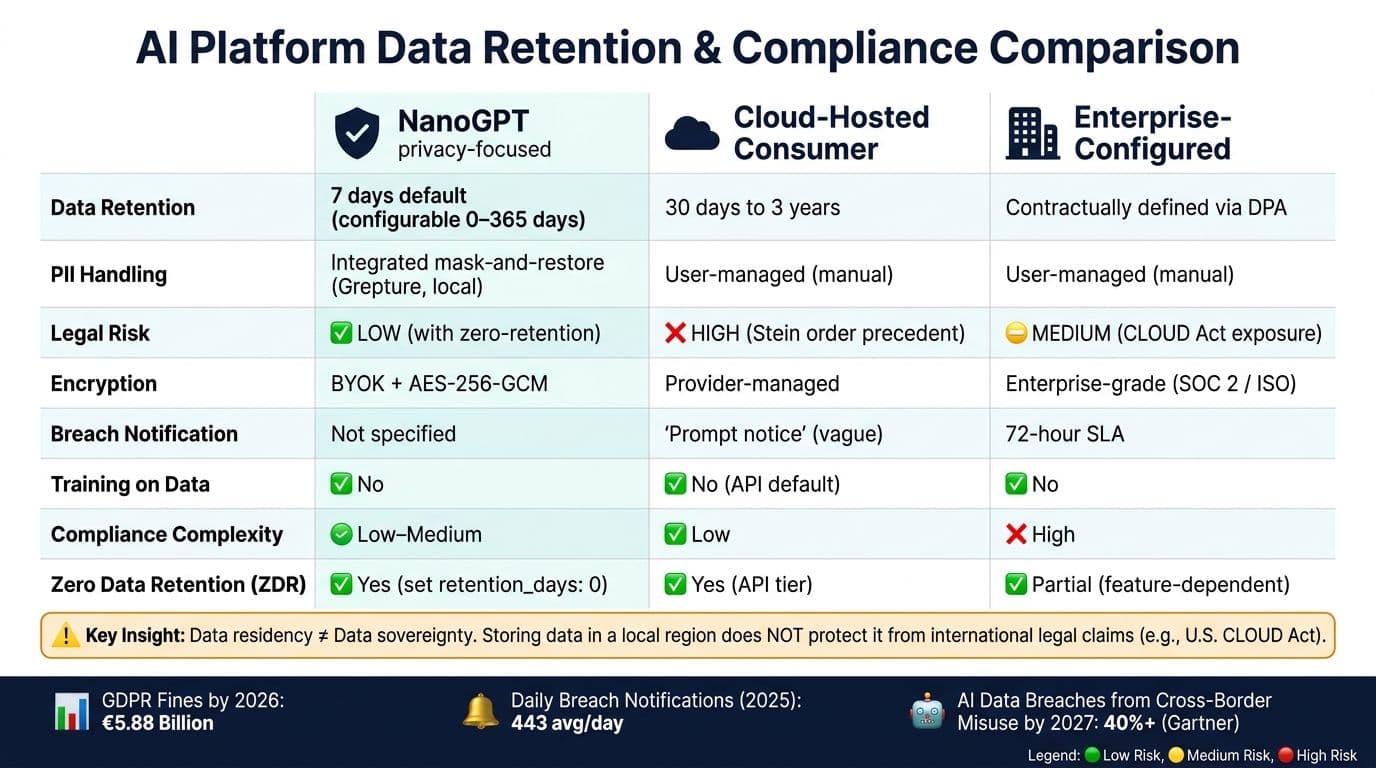
AI Platform Data Retention & Compliance Comparison 2025
When considering compliance features, each platform offers its own advantages and challenges, which can influence regulatory decisions. NanoGPT excels in privacy-focused features, cloud-hosted platforms emphasize ease of use but face compliance hurdles, and enterprise-configured services provide robust control but come with added complexity. The right platform depends on your specific regulatory requirements, technical capabilities, and risk tolerance.
NanoGPT is particularly strong in handling sensitive data, thanks to its integrated PII mask-and-restore layer called "Grepture." This feature ensures redactions are processed locally, preventing sensitive data from ever reaching the model provider. Additionally, it supports Bring Your Own Key (BYOK) encryption and a local deletion sync feature, allowing users to delete data locally and have it removed from backend systems instantly. However, prioritizing maximum privacy, such as setting zero-retention (retention_days: 0), disables certain functionalities like conversation threading and async processing. This trade-off highlights the balance between privacy and functionality.
On the other hand, cloud-hosted generative AI platforms offer simplicity in deployment but come with significant compliance risks. Consumer-tier plans often retain chat data for model training by default, as noted in a 2025 study. Furthermore, a 2026 legal case (the Stein order) required OpenAI to provide 20 million de-identified ChatGPT logs for legal discovery. This incident underscores the vulnerability of data stored on vendor-managed servers, making centralized data management a potential compliance concern.
"The most common GDPR compliance failure is not a gap in the DPA, it is employees using personal ChatGPT or Claude.ai accounts for tasks that involve work data." - AI Policy Desk
Enterprise-configured AI services provide advanced controls, such as contractual data residency, 72-hour breach notifications, and customizable retention policies. However, these features come with increased complexity and cost. The U.S. CLOUD Act adds another layer of risk, as it allows U.S. authorities access to data stored in EU regions. Gartner predicts that by 2027, over 40% of AI-related data breaches will result from improper cross-border use of generative AI. Organizations must weigh these risks against their need for strong compliance measures.
Below is a comparison of key compliance factors across the three platforms:
| Feature | NanoGPT | Cloud-Hosted (Consumer) | Enterprise-Configured |
|---|---|---|---|
| Retention | 7 days (configurable 0–365) | 30 days to 3 years | Contractually defined (DPA) |
| PII | Integrated mask-and-restore | User-managed (manual) | User-managed (manual) |
| Legal Risk | Low (with zero-retention) | High (Stein order precedent) | Medium (CLOUD Act exposure) |
| Encryption | BYOK for stored responses | Provider-managed | Enterprise-grade (SOC 2/ISO) |
| Breach Notification | Not specified | "Prompt notice" | 72-hour SLA |
| Training on Data | No | No (API default) | No |
| Compliance Complexity | Low–Medium | Low | High |
Each platform has its strengths and weaknesses, and the choice ultimately hinges on how well these align with your organization's compliance strategy and operational needs.
Conclusion
Choosing the right AI platform comes down to how much control your organization needs over its data.
NanoGPT is a strong option for teams working with sensitive data that require privacy controls without the hassle of enterprise-level systems. Features like a configurable data retention window (ranging from 0 to 365 days), built-in PII masking and restoration, and a pay-as-you-go pricing model make it particularly appealing for organizations focused on compliance.
On the other hand, cloud-hosted consumer platforms come with added legal risks. A court order in 2026 brought about policy changes allowing consumer-level conversations to be stored indefinitely. For organizations dealing with regulated data, this raises concerns about increased liability.
For those needing stricter compliance, enterprise-configured solutions provide guarantees like data residency, ensuring data remains within specific jurisdictions. However, these solutions often involve greater complexity and higher costs. It’s worth noting that data residency isn’t the same as data sovereignty - just storing data locally doesn’t shield it from international legal claims.
With enterprises identifying data privacy and security as the top AI-related risk, it’s crucial to align your platform choice with your organization’s specific compliance and operational needs. Make sure the solution you pick addresses both your regulatory obligations and your day-to-day requirements.
FAQs
What retention setting should I use for my regulated data?
When handling regulated data, it's crucial to match retention settings with legal and audit obligations. For example, decision records often require retention periods of 7 to 10 years. On NanoGPT, you can manage data retention using the retention_days parameter, which accepts values from 0 to 365. Setting this parameter to 0 enables a zero-retention policy.
For context memory, use the memory_expiration_days header to define retention periods between 1 and 365 days. Always ensure your configurations align with industry standards to support both data minimization and audit requirements.
Does data residency protect me from U.S. legal requests?
Under the U.S. CLOUD Act, data residency alone won't shield you from U.S. legal requests. U.S. law enforcement can compel U.S.-based companies to hand over data they control, even if that data is stored in another country. While selecting a specific storage region might help meet internal or regional compliance needs, it doesn't ensure data sovereignty or block extraterritorial access if the provider is subject to U.S. jurisdiction.
How can I delete stored prompts and outputs immediately?
To remove prompts and outputs on NanoGPT, you have a couple of options depending on how you're using the system:
- For local use: Deleting conversations ensures that no data remains stored on NanoGPT's systems. This is a straightforward way to manage privacy.
- For API users: You can send a
DELETE /v1/responses/{id}request to remove specific responses. Additionally, settingretention_daysto0ensures that no data is retained. To enhance privacy further, enable PII redaction, which processes data without storing sensitive information.
These steps help you maintain control over your data while using NanoGPT.