
Why Role-Based Access Matters for AI Privacy
AI systems can expose sensitive data if access controls are weak. Role-Based Access Control (RBAC) minimizes these risks by assigning permissions based on job roles, not individuals. This ensures that users and AI agents only access data relevant to their tasks. For example:
- A marketing team member can generate images but cannot access compliance logs.
- AI agents have permissions tied to their roles, preventing them from accessing unrelated data.
RBAC also supports privacy regulations like GDPR and HIPAA, reduces insider threats, and helps prevent data breaches. However, traditional RBAC struggles with AI's dynamic nature, requiring more context-aware systems for better security. Organizations are addressing this by combining RBAC with real-time monitoring, anomaly detection, and AI-enhanced auditing.
Key Takeaways:
- RBAC limits data access to reduce privacy risks in AI systems.
- It aligns with privacy laws and supports secure scaling of AI tools.
- Context-aware controls and AI-enhanced auditing improve RBAC's effectiveness.
RBAC is essential for managing AI privacy, but evolving threats demand smarter, more adaptive access control systems.
The Security Problem with MCP | Identity, RBAC & Audit
sbb-itb-903b5f2
How RBAC Protects Privacy in AI Systems
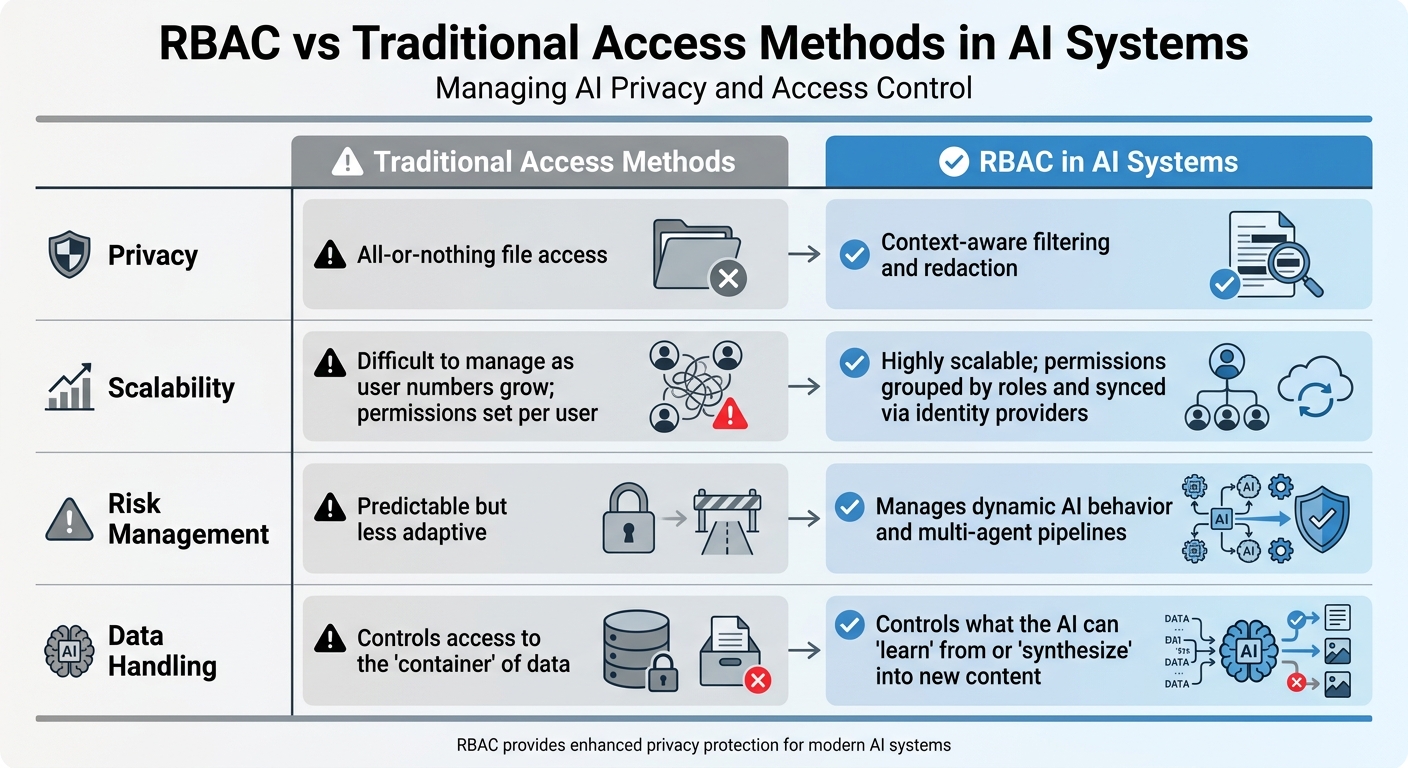
RBAC vs Traditional Access Control Methods for AI Systems
RBAC (Role-Based Access Control) plays a crucial role in addressing privacy challenges within AI systems. By establishing a structured framework, RBAC goes beyond traditional access methods, focusing on controlling what data an AI system can access, process, and reveal. This approach directly reduces privacy risks in AI environments, especially in sensitive applications like image generation.
Improved Privacy and Security
RBAC operates on the principle of granting only the permissions needed for specific roles. For instance, on an AI image generation platform, a marketing team member might use DALL-E 3 to create promotional images, while a compliance auditor has read-only access to logs without the ability to generate content. This ensures that permissions are tightly controlled, reducing the risk of unauthorized actions.
A key feature of RBAC is its ability to prevent privilege escalation. This occurs when an AI system inherits a user's full permissions, potentially accessing unrelated or sensitive data. For example, an AI assistant supporting the sales team should not have access to HR records, even if the user it assists has permissions for both systems. Michael Lansdowne Hauge, Managing Partner at Pertama Partners, highlights this challenge:
"AI systems create access control challenges that traditional IT models don't fully address. The AI might have broader data access than any individual user".
Modern RBAC implementations also use filtered retrieval, allowing AI systems to access only specific data subsets permitted for a user. This prevents sensitive information from being synthesized into AI-generated outputs, such as images or text. Platforms like OpenAI now enable administrators to grant or restrict "Model Capabilities" for image generation, ensuring only authorized users can activate these features.
Meeting Privacy Regulations
RBAC aligns with major privacy regulations, such as GDPR, HIPAA, SOX, PCI DSS, and SOC 2, by enforcing role-based access, adhering to "privacy by design" principles, and maintaining audit trails for compliance.
Shankar Rajamani, Technical Content Writer at Protecto, emphasizes the importance of RBAC in meeting compliance standards:
"RBAC is the backbone of enterprise security frameworks. It enforces least-privilege access, simplifies policy management, and creates the audit trails required by SOC 2, HIPAA, GDPR, and other compliance standards".
Additionally, frameworks like the EU AI Act and ISO 42001 require clear role definitions for managing AI systems. RBAC supports these requirements by ensuring that data scientists, ML engineers, and auditors handle training and inference data securely.
RBAC vs. Traditional Access Methods
When managing AI systems, the limitations of traditional access methods become evident. RBAC offers distinct advantages in handling the dynamic and complex nature of AI systems, as shown below:
| Feature | Traditional Access Methods | RBAC in AI Systems |
|---|---|---|
| Privacy | All-or-nothing file access | Context-aware filtering and redaction |
| Scalability | Difficult to manage as user numbers grow; permissions set per user | Highly scalable; permissions grouped by roles and synced via identity providers |
| Risk Management | Predictable but less adaptive | Manages dynamic AI behavior and multi-agent pipelines |
| Data Handling | Controls access to the "container" of data | Controls what the AI can "learn" from or "synthesize" into new content |
Traditional access control lists (ACLs) assign permissions at the user level, often leading to "permission sprawl" as organizations grow. RBAC addresses this by grouping permissions into roles, streamlining management and improving auditability.
For example, platforms like NanoGPT, which store data locally on users' devices, can apply RBAC principles to regulate AI model access and capabilities. This adds an extra layer of privacy protection, complementing the security of local storage.
RBAC not only enhances privacy and security but also establishes a foundation for integrating AI systems with robust monitoring and auditing features.
Where RBAC Falls Short in AI Image Generation
RBAC has been a reliable system for managing access control, but it struggles to keep up with the complexities of AI image generation. The static nature of RBAC isn't well-suited for handling the dynamic and unpredictable processes that define AI systems.
Problems with Standard RBAC in AI
Traditional RBAC operates on a simple premise: users either have permission to access a resource, or they don't. This binary approach works for straightforward systems but falls apart when applied to AI image generation. For instance, when someone submits a natural-language prompt to an AI model like DALL-E or Stable Diffusion, the system might pull data from multiple sources, combine it in unexpected ways, and inadvertently create outputs that include sensitive or private information.
The speed of AI operations compounds this issue. A single misconfigured permission can lead to a cascade of unauthorized actions before anyone notices. Nizamudheen T I, an expert in large language models, puts it succinctly:
"RBAC only answers one question: 'Who are you and what role do you have?' This model doesn't understand: What data the agent is touching, Why it needs the data, [or] The sensitivity of the information".
The risks are real and costly. Breaches caused by malicious insiders average $4.92 million in damages - higher than the overall average breach cost of $4.44 million. As organizations attempt to create more precise permissions for AI-related tasks, the sheer number of roles required can overwhelm the system, making it unmanageable. Even worse, RBAC focuses on controlling access to tools but doesn't address the content of what those tools produce, leaving sensitive information vulnerable to accidental exposure. These shortcomings highlight the need for more adaptive access control systems.
Why Context-Aware Access Controls Matter
The limitations of traditional RBAC point to the importance of adopting context-aware access controls. These systems evaluate permissions in real time, taking into account not just who the user is, but also what data they're accessing and the circumstances under which they're doing so.
For example, a context-aware system could analyze the sensitivity of an AI-generated output as it's being created. Imagine an AI image editor processing a photo containing identifiable faces. A context-aware control could automatically mask biometric features, such as eyes or facial structure, before further processing occurs. Research from Purdue University found that masking sensitive areas locally can reduce AI attribute-classification accuracy - like identifying eye color or age - by over 80%. This demonstrates the privacy risks of uploading unaltered images to external servers and underscores the importance of real-time protective measures.
To address these challenges, organizations are increasingly turning to hybrid models that combine RBAC with Attribute-Based Access Control (ABAC) or Policy-Based Access Control (PBAC). In these systems, RBAC sets the baseline permissions, while ABAC applies task-specific restrictions. For platforms like NanoGPT, which store data locally on users' devices, integrating context-aware controls ensures that users only access the specific tools and data needed for their tasks, without risking exposure of sensitive information.
This shift toward context-aware controls marks a significant evolution in AI security. As Rajesh Mittal from Avancer Corporation explains:
"The static frameworks and manual processes that once formed the backbone of access management are no match for today's dynamic, complex IT environments".
Using AI to Improve RBAC for Auditing and Monitoring
Traditional Role-Based Access Control (RBAC) systems are designed to log human actions, but they often fall short when it comes to AI activities. Most AI frameworks today don’t generate comparable access logs. To address this gap, AI tools are being integrated into RBAC systems, making them more dynamic and effective for monitoring and managing access decisions.
Adding AI to RBAC Frameworks
In AI-enhanced RBAC, each AI agent is assigned a unique identity and role, rather than being treated as a background process. For example, when an AI agent generates an image, its actions are governed by a specific set of permissions. This ensures every decision is tracked and enforced automatically, minimizing the risk of large-scale data exposure.
Machine learning plays a key role in monitoring real-time access patterns. It flags anomalies such as repeated access denials, unusually large data requests, or attempts to access sensitive resources by users who don’t typically need them. Imagine an employee accessing sensitive image data at 2:00 AM - well outside their usual work hours. The system could immediately trigger an alert or require additional verification. These analytics also help combat "privilege creep", where users accumulate unnecessary permissions over time. By identifying and recommending the removal of these excess privileges, the system maintains a least-privilege environment. As Shankar Rajamani from Protecto notes:
"The organizations winning with AI are not the ones that deploy the most agents, they are the ones that deploy agents they can trust".
Auditing Sensitive Image Outputs
AI-powered RBAC operates on three essential layers: authentication (verifying identity), authorization (controlling data access), and AI response filtering (managing outputs). For example, any query for restricted data can be filtered at the retrieval layer before processing even begins.
Response filtering acts as a safeguard, analyzing AI-generated outputs - like images from tools such as Dall‑E or Stable Diffusion - and redacting sensitive content that users are not authorized to view. This process is a cornerstone of effective auditing. Comprehensive audit logs should include the prompt that initiated the action, the data sources accessed, and any filtered or redacted information. Such transparency is critical for meeting compliance requirements under regulations like SOC 2, HIPAA, or GDPR. The urgency for robust auditing mechanisms was highlighted in February 2026, when 61 global data protection authorities issued a Joint Statement emphasizing the need to prevent non-consensual intimate imagery generated by AI systems.
AI-RBAC Framework Components
AI integration extends the privacy protections of traditional RBAC by adding new layers of governance for sensitive image generation. Below is a breakdown of the main components in an AI-enhanced RBAC framework and their impact on privacy:
| Component | Function | Impact on Privacy |
|---|---|---|
| Real-Time Role Validation | Continuously checks user or agent roles against permissions at decision points. | Prevents unauthorized data exposure as it happens. |
| AI Response Filtering | Reviews and redacts sensitive information from AI outputs. | Reduces the risk of sensitive data leakage in generated content. |
| Dynamic Tool Filtering | Restricts AI agents’ access to tools based on user permissions. | Limits actions to authorized tools, reducing misuse risks. |
| Anomaly Detection | Tracks unusual access patterns, volumes, or timing. | Detects potential insider threats or compromised accounts. |
| Audit Logging | Captures prompts, accessed data, and redactions. | Ensures transparency and supports compliance and forensic needs. |
For platforms like NanoGPT, which store data locally on user devices, incorporating these AI-RBAC components ensures sensitive information stays under user control while maintaining strong access governance. By catching threats early, AI-enhanced RBAC helps organizations avoid costly breaches and maintain trust.
RBAC as a Base for Privacy Governance in AI
This section explores how Role-Based Access Control (RBAC) serves as a cornerstone for managing privacy in AI systems, offering a scalable approach to mitigate risks and maintain security.
How RBAC Supports Scalable Privacy Governance
RBAC works by assigning permissions to specific roles, ensuring consistent policy enforcement across all APIs and AI models. For example, if your marketing team’s access to customer financial records is revoked, that change is applied instantly across every AI tool they use. This level of control makes RBAC an essential framework for securely scaling AI systems.
Another critical feature of RBAC is tenant isolation, which ensures that one user’s data is never mistakenly included in another’s outputs. Take tools like Dall-E or Stable Diffusion: RBAC allows organizations to manage access at the project level. This includes controlling who can make model requests, read or write files, and handle API keys. Andrios Robert from hoop.dev highlights this importance:
"Generative AI without RBAC is like giving everyone root access to production. It's fast, until it's catastrophic".
RBAC operates on a "least privilege" basis, meaning AI systems access only the data they’re explicitly authorized to use. This approach prevents broad administrative access to sensitive databases, which is especially critical given that AI often has more extensive data access than any individual user.
These capabilities provide the framework for implementing RBAC systematically, as outlined in the next section.
Steps to Implement RBAC
A structured six-week rollout plan can help organizations implement RBAC effectively:
- Week 1–2: Conduct an inventory of your AI systems. Document what data each system accesses, who uses it, and where outputs are directed.
- Week 3: Define access requirements based on data sensitivity. Create 3–5 core roles (e.g., Viewer, Editor, Admin) to simplify management while maintaining security.
- Week 4: Deploy technical tools like Single Sign-On (SSO), Multi-Factor Authentication (MFA), and API gateways.
- Week 5: Set up audit logging to capture key details, such as user identity, submitted prompts, accessed data sources, and redacted outputs.
- Week 6: Establish a quarterly review process to remove outdated permissions and refine roles as organizational needs evolve.
To strengthen access control, embed logic directly into your data retrieval layer using filtered retrieval. This ensures AI systems only access data that users are permitted to see. Additionally, use SCIM (System for Cross-domain Identity Management) to sync AI groups with your existing identity systems like Active Directory. This allows permissions to update automatically when an employee’s role changes. However, note that role updates may take up to 30 minutes to propagate across some AI platforms.
With these steps in place, the benefits of RBAC for privacy governance become even more apparent.
Key Privacy Benefits of RBAC
RBAC significantly reduces exposure to personally identifiable information (PII) and provides audit trails critical for compliance with regulations like GDPR, HIPAA, and SOC 2. It ensures multi-tenant isolation, preventing one customer’s data from leaking into another’s environment. Limiting access to AI tools also helps avoid unnecessary data exposure.
For platforms like NanoGPT, which store data locally on user devices and operate on a pay-as-you-go model, RBAC ensures sensitive information remains under user control while maintaining strict access governance. Considering that stolen credentials take an average of 292 days to detect and contain, RBAC becomes a vital defense mechanism for organizations deploying AI systems, especially in areas like image generation, as we approach 2026.
FAQs
How is RBAC different for AI agents versus humans?
Role-Based Access Control (RBAC) works differently for AI agents compared to humans, mainly due to differences in scope and adaptability. For humans, RBAC typically involves assigning stable, predefined permissions based on job roles - think of roles like "IT admin" or "HR manager." These permissions remain relatively fixed and align with the person's responsibilities.
AI agents, on the other hand, require a more dynamic approach. Their permissions often need to be task-specific and adjust in real-time. For instance, an AI tasked with processing patient data might need highly granular access to specific records. This ensures compliance with regulations and prevents the agent from having unnecessary or overly broad permissions. Unlike humans, AI agents operate autonomously and at machine speed, making this level of precision and flexibility essential.
Why can AI image generation leak sensitive data even with RBAC?
Generative AI models, even with Role-Based Access Control (RBAC) in place, can still unintentionally reveal sensitive data. This happens because these models are built on large datasets and operate using probabilistic algorithms. Their architecture can sometimes make them vulnerable, leading to the exposure of internal prompts or confidential information - especially when exploited through carefully designed prompts.
What adds “context” to RBAC for better AI privacy?
Adding context to Role-Based Access Control (RBAC) strengthens AI privacy by tailoring permissions to match system capabilities. This approach enforces the least privilege principle, ensuring users can only access the features and models necessary for their role. Regular audits further refine this process, keeping permissions aligned as roles and requirements evolve. Together, these measures help protect sensitive data more effectively.