
RNN Regularization: Ultimate Guide

RNNs can overfit fast, even when the dataset looks big. A model with 10.7 million parameters trained on about 1 million characters can already need tight regularization.
If I had to boil this guide down to a few rules, it would be this:
- I use plain dropout on inputs and outputs
- I use variational dropout for recurrent connections
- I add weight decay to weight matrices and embeddings, not biases or norm terms
- I watch validation loss first, and perplexity for language models
- If training loss is higher than validation loss, I check whether dropout is too high
- If the model still fails with dropout set to
0.0, I check model capacity instead of blaming overfitting - I pick regularization based on the task: weight tying for generation, layer normalization for classification, and light dropout + L2 for forecasting
The main idea is simple: cut overfitting without wiping out sequence memory. That matters more in RNNs than in feed-forward models because the same weights are reused across time steps, and noise in the wrong place can hurt long-range context.
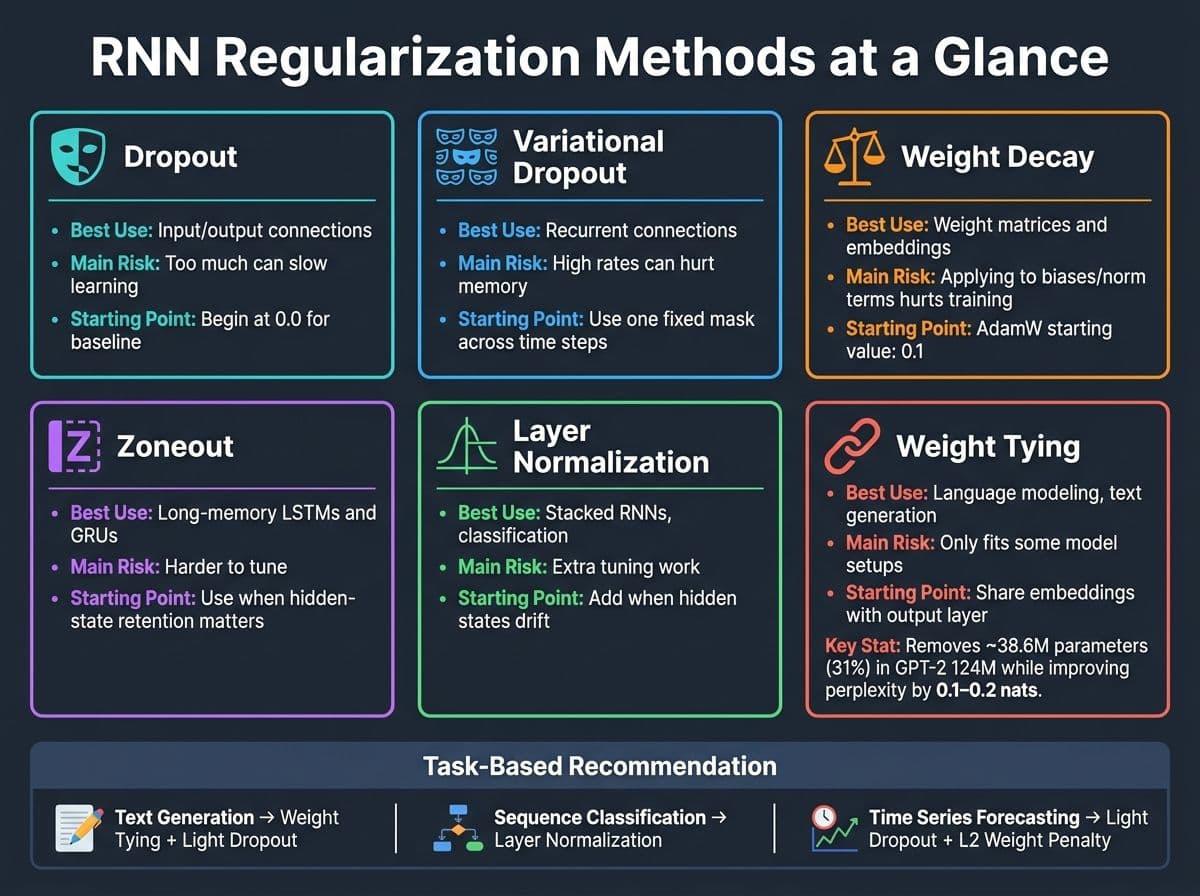
RNN Regularization Methods: Quick Comparison Guide
Training RNNs Techniques and Best Practices
sbb-itb-903b5f2
Quick Comparison
| Method | Best Use | Main Risk | Simple Starting Point |
|---|---|---|---|
| Dropout | Input/output connections | Too much can slow learning | Start low or at 0.0 for baseline |
| Variational dropout | Recurrent connections | High rates can hurt memory | Use one fixed mask across time |
| Weight decay | Weight matrices, embeddings | Applying it to biases/norm terms can hurt training | With AdamW, start around 0.1 |
| Zoneout | Long-memory LSTMs/GRUs | Can be harder to tune | Use when hidden-state retention matters |
| Layer normalization | Stacked RNNs, classification | Extra tuning work | Add when hidden states drift |
| Weight tying | Language modeling, text generation | Only fits some model setups | Share embeddings with output layer |
One stat stands out: in a 124 million parameter GPT-2 model, weight tying can remove about 38.6 million parameters - about 31% - while also improving perplexity by 0.1 to 0.2 nats. That’s a strong tradeoff when parameter count is part of the problem.
So if you want the short answer: I’d start with a clean baseline, add the least disruptive regularizer first, and judge it by validation behavior and output quality - not by training loss alone.
The Main RNN Regularization Methods
Each method hits a different part of the network, and using the wrong one in the wrong spot can quietly drag down results. The tradeoff stays the same: better generalization without damaging sequence memory.
Dropout, Recurrent Dropout, and Variational Dropout
Standard dropout randomly zeros out activations during training. For the input and output connections of an RNN, it’s a common and solid choice. But on hidden-to-hidden connections, standard dropout can mess with memory because it resamples noise at every time step.
That’s the core issue. You want regularization, but you don’t want the signal shifting from one step to the next.
Variational dropout solves that by reusing the same mask across every time step in a sequence. That makes it the best match for recurrent connections.
Weight Penalties and Norm Constraints
L2 weight decay adds a cost based on the square of each weight, which pushes weights toward smaller values. A good rule of thumb is to tune weight decay on a small log scale and then pick the best setting using validation data.
In practice, apply weight decay to 2D+ parameters, such as weight matrices and embeddings, but skip 1D parameters like biases and layer normalization terms. Penalizing biases or norm parameters can make optimization less stable without improving generalization.
L1 is less common in RNNs because it can remove recurrent weights that the model still needs.
Normalization and Zoneout
Masking and weight penalties aren’t the only tools here. Some methods regularize the hidden state itself.
Zoneout randomly keeps the previous hidden state instead of updating it. That helps preserve information across steps. It’s especially useful for LSTMs and GRUs, where holding onto cell state information matters a lot on long sequences.
In deep LSTMs and GRUs, variational dropout plus layer normalization can help stabilize activations while also limiting overfitting.
Next comes the practical part: tuning these methods and figuring out whether they’re helping.
How to Tune and Evaluate RNN Regularization
A Step-by-Step Tuning Workflow
Once you’ve picked a regularizer, keep it simple at first. Begin with the least disruptive setup, and only add more if validation loss stops improving. That means starting with no dropout so you have a clean baseline.
From there, tune dropout first. On smaller datasets, small nonzero dropout rates often make more sense during fine-tuning. After that, add weight decay. A common starting point with AdamW is 0.1. Apply weight decay to weight matrices and embeddings, but leave out biases and normalization terms.
Metrics That Show Whether Regularization Is Working
The main thing to watch is validation loss. It’s the clearest signal for whether your regularization setup is helping or getting in the way.
For language models, track perplexity alongside validation loss. It gives you an easier-to-read sense of how well the model generalizes across sequences. Put simply, validation loss tells you what’s happening under the hood, while perplexity helps you see the effect in terms that are easier to judge.
Comparison Table: Methods, Strengths, and Tuning Cost
| Method | Strength | Tuning Cost |
|---|---|---|
| Dropout | Reduces overfitting on inputs and outputs; recurrent variants protect hidden-state paths | Low - one rate to set |
| Weight Decay | Limits weight growth; works well with AdamW | Low - start at 0.1 and adjust on validation |
Next, check the warning signs that regularization is hurting memory instead of helping generalization.
Common Failure Cases and How to Spot Them
After tuning, the next job is diagnosis. At this point, you’re trying to catch cases where regularization is hurting memory or hiding a model that just doesn’t have enough capacity.
When Dropout or Noise Breaks Sequence Memory
Too much recurrent dropout can wreck sequence memory. The usual signs are repetitive output, looping text, and weak context retention. So don’t stare at loss alone. Look at what the model actually produces.
If the loss looks decent but generation keeps drifting into repetition, recurrent dropout is one of the first places to look. Dial it back and check whether the output gets more coherent.
Also, run inference in eval mode so dropout is turned off during generation. If you forget to call model.eval() before inference, dropout stays active and the output can become noisy and inconsistent.
Over-Regularization, Under-Regularization, and Misleading Training Curves
Training curves can tell you a lot. But they only help if you know how to read them.
| Regularization State | Training Loss | Validation Loss | What It Means |
|---|---|---|---|
| Under-regularized | Very low | High / rising | Model is memorizing, not generalizing |
| Over-regularized | High | High | Model can't learn the data at all |
| Dropout too high | Higher than val | Low | Training is artificially harder than testing |
One pattern trips people up all the time: training loss ends up higher than validation loss. That can happen when dropout is active only during training, which makes training harder than evaluation. It does not mean the model is generalizing well. More often, it means your dropout rate is too high.
There’s another catch. A dropout setting that works fine on a large model can completely stall a smaller one. When you’re debugging, strip regularization out first. Set dropout to 0.0 and check whether the model can overfit the training data. If it still can’t overfit with no regularization, then overfitting isn’t the issue - capacity is.
These failure patterns don’t always look the same across tasks. They can show up one way in generation, another in classification, and another in forecasting.
Choosing Regularization by Task: Text Generation, Classification, and Forecasting
Pick the regularizer based on the way the model is most likely to fail.
Text Generation and Language Modeling
In generation tasks, the goal is to keep sequence memory intact while trimming parameter count.
For language modeling, one of the most useful moves is weight tying. That means sharing the token embedding matrix with the output projection layer. In a 124M parameter GPT-2 model, weight tying removes about 38.6 million parameters - roughly 31% of the total - while also improving perplexity by 0.1 to 0.2 nats.
That tradeoff is hard to ignore. You cut a big chunk of parameters without hurting the model's ability to track context. In practice, that's a clean fit for generation work.
Sequence Classification and Time Series Forecasting
For classification, the main job is to keep hidden states stable, not to pile on noise.
For sequence classification, use layer normalization to stabilize hidden states in stacked RNNs. This helps the model stay steady across layers, which matters when small shifts in state can snowball into bad predictions.
Forecasting needs a different touch. Data is often small and noisy, so heavy regularization can backfire and push the model into underfitting.
For forecasting, lighter regularization usually works better. A modest amount of dropout, paired with L2 weight penalties, can help the model avoid fitting noise without knocking out too much signal.
Conclusion: A Simple Framework for Picking the Right Regularizer
Use weight tying and light dropout for generation, layer normalization for classification, and modest dropout plus L2 for forecasting.
FAQs
How do I choose between dropout and variational dropout?
Choose based on how each method affects recurrent hidden states. Standard dropout randomly turns neurons off, but in an RNN, doing that at each time step can interrupt long-term memory.
Variational dropout uses the same dropout mask across the whole sequence. That makes training more stable when you need to preserve gradient flow.
When should I use weight tying in an RNN?
Use weight tying by default in standard RNNs, LSTMs, and GRUs. Reusing the same weight matrices across time steps is a core part of how these models process sequential data without blowing up parameter count.
That reuse matters. It lets the model apply the same learned rules at each step in the sequence, which is exactly how these architectures are meant to work.
If shared recurrent weights lead to sensitivity or instability, fix the training setup instead of turning off weight tying. In most cases, techniques like gradient clipping are the right place to start.
How can I tell if my RNN is over-regularized?
Watch your loss curves and performance metrics. One common warning sign is underfitting: both training and validation scores stay low, or barely move, because the model is too constrained.
If both curves stay low or flat even after more training, your regularization may be too aggressive. Consistently low gradient norms, such as <1e-5, can also be a clue. The same goes for excessive dropout, which can stop the model from learning the patterns it needs.