Best AI Subscription Alternative in 2026: How to Use 400+ AI Models Without Paying for Multiple Plans
AI bills creep up faster than most people expect.
It starts with one subscription for chat. Then another for image generation. Then a separate video tool. Then maybe one more app because you want access to Claude, Gemini, or a better coding model.
Before long, you're paying for overlapping tools, switching between dashboards, and still not getting the flexibility you want.
That's why more people are looking for an AI subscription alternative in 2026: one place to access the best models across chat, image, and video without stacking multiple monthly plans.
Why AI subscription fatigue is getting worse in 2026
AI is no longer a one-tool category.
The same person might use one model to brainstorm, another to write, another to generate images, and another to turn that idea into a short video. Developers also want API access. Researchers want model comparison. Teams want less tool sprawl.
The old approach of buying one subscription per product breaks down quickly:
- You pay for duplicate capabilities
- You manage multiple accounts and invoices
- You hit usage caps in one app while barely using another
- You cannot compare outputs easily before deciding which model is best
That is the core problem an AI model aggregator solves.
What makes a good AI subscription alternative
Saving money matters, but cost alone is not enough. A real alternative should also make your workflow simpler.
You need access to more than one model type
Most users do not need text alone. A typical workflow now crosses multiple formats:
- Ask a chat model for ideas or structure
- Generate an image from the concept
- Turn it into a short video
- Refine the result with another model
If those steps live in separate tools, you lose time to switching and rework. A better setup gives you multiple AI models in one platform.
You need easy comparison before you commit
Different models are good at different things.
One may be better for reasoning. Another may write cleaner copy. Another may generate stronger creative outputs. If you cannot compare them side by side, you end up choosing based on branding instead of results.
That is why comparison is not a bonus feature. It is one of the fastest ways to avoid paying for the wrong tool.
You need flexible ways to use AI
Some people want a browser-based app. Others want API access for automations, internal tools, or client work. Many want both.
The best AI tools without multiple subscriptions should support casual use and deeper workflow integration from the same account.
How to use 400+ AI models without paying for multiple plans
The simplest answer is to stop stacking isolated AI apps and move to one platform that aggregates the models you actually want to use.
Use one platform instead of stacking apps
Instead of paying separately for chat, image, and video tools, use one service that gives you broad model access in a single place.
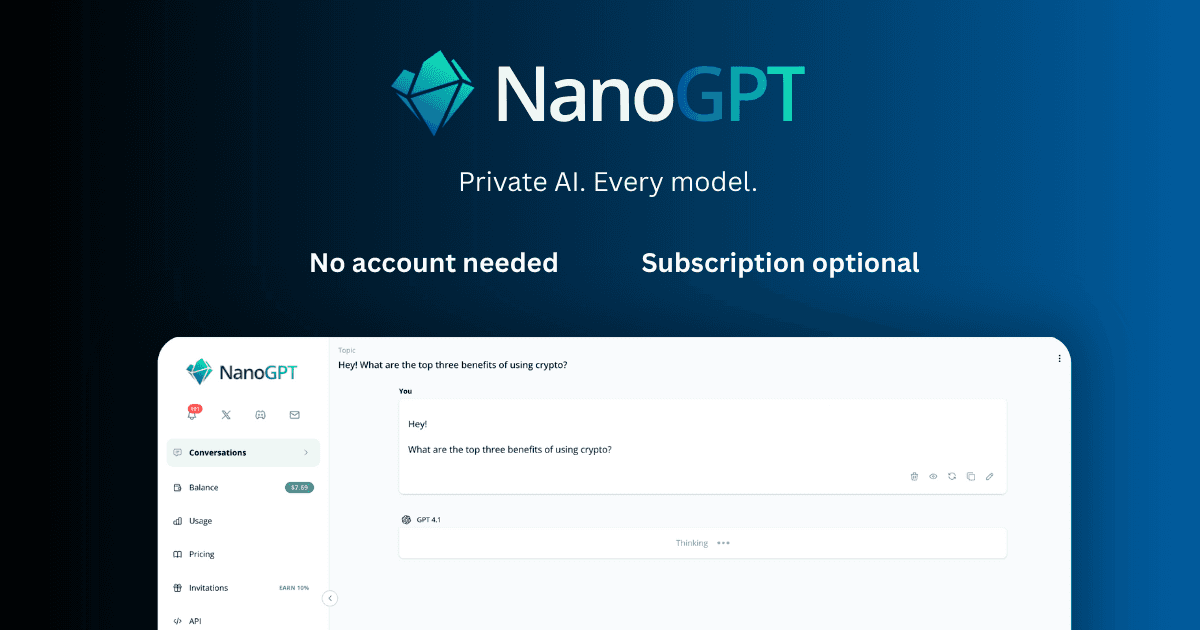
NanoGPT does that. You get access to 400+ AI models in one product, so you can chat, generate images, generate videos, and test different models without juggling separate subscriptions. Instead of committing to several flat monthly plans, you can just pay for what you actually use.
For users looking for an alternative to paying for ChatGPT Plus and other AI apps at the same time, this is the key shift: stop subscribing to silos and start using one flexible layer across providers.
Compare outputs side by side
If you run the same prompt through multiple models, you can see very quickly which one is best for your actual use case.
That matters for:
- writers choosing the strongest draft
- marketers comparing product copy
- developers testing coding and reasoning models
- researchers checking clarity, depth, and factual coverage
NanoGPT supports side-by-side comparison, so you do not have to copy the same prompt across five tabs just to evaluate model quality.
Use chat, image, and video tools in one workflow
The practical advantage of an aggregator is not just access. It is workflow compression.
You can move from idea to draft to visual to video in one place:
- Generate an outline with a chat model
- Create an image concept from that outline
- Turn the concept into a short video
- Iterate with a different model if the first result is weak
That is much faster than stitching together separate apps for each step.
Connect AI to the tools you already use
If you want AI inside your existing workflow, the platform should not trap you in a single interface.
NanoGPT also supports:
- API access for apps and automations
- a browser extension for using AI while browsing or working in web apps
That makes it useful both as a daily tool and as infrastructure for lightweight builds.
Why NanoGPT fits this use case
When people search for the best AI subscription alternative, they usually want three things:
- fewer recurring bills
- broader model access
- less friction switching between tools
NanoGPT fits that well because it gives you one place to use 400+ AI models across chat, image, and video, with side-by-side comparison, pay-per-use pricing, and flexible access through both the app and API.
It is especially useful if you:
- want one account instead of several AI subscriptions
- test models before committing to one workflow
- work across text, image, and video
- need API access without setting up separate vendor accounts
- want an alternative to paying for ChatGPT Plus and other AI apps separately
Who should choose an AI model aggregator in 2026
An AI model aggregator makes sense if you care more about flexibility and efficiency than staying inside one provider's ecosystem.
This approach is usually the right fit for:
- freelancers handling varied client work
- solo creators moving between writing, visuals, and video
- marketers testing different outputs fast
- developers building automations or lightweight AI products
- researchers comparing models for quality and coverage
If you regularly ask, "Which model is best for this specific task?" then an aggregator is usually a better fit than a single-model subscription.
How to decide if this approach is right for you
Look at your last 60 to 90 days of AI usage and ask four simple questions.
Are you paying for duplicate capabilities?
If multiple subscriptions mostly help with the same writing, brainstorming, or ideation tasks, you are probably overspending.
Do you need more than text generation?
If your work includes images or video, a one-tool-per-format setup becomes messy fast.
Do you compare models often?
If yes, side-by-side testing will save you time every week.
Do you need browser or API access?
If you want AI inside your existing workflow, flexible access matters more than a standalone chat box.
When those needs add up, an AI subscription alternative usually beats a stack of disconnected apps.
FAQs
What is an AI subscription alternative?
An AI subscription alternative is a platform or setup that lets you use AI without paying for several separate monthly plans. In practice, that usually means one service that gives you access to many models for chat, image, and video tasks.
What does it mean to use multiple AI models in one platform?
It means you can access different models from one account and interface instead of signing up for separate products. That makes it easier to test, compare, and pick the right model for each job.
Is NanoGPT an AI model aggregator?
Yes. NanoGPT gives you one place to use 400+ AI models, compare outputs side by side, and work across chat, image, and video from the same platform.
How is this different from paying for ChatGPT Plus and other AI apps?
A single subscription usually gives you one provider's environment. An aggregator gives you broader model access in one place, which reduces tool switching and can eliminate the need for multiple paid plans.
Can I use NanoGPT for more than chat?
Yes. NanoGPT supports chat, image generation, video generation, side-by-side comparisons, API access, and a browser extension.
Who benefits most from this type of platform?
Freelancers, solo creators, marketers, researchers, and small builders usually benefit most because they need flexibility without managing a pile of separate subscriptions.
Conclusion
If you're tired of stacking AI bills, the fix is usually not another subscription. It is a simpler setup.
Use one platform that lets you access the models you actually need, compare them before committing, and move across chat, image, and video without constant tool switching.
If that is what you want, NanoGPT is a straightforward way to use 400+ AI models in one place without paying for multiple plans.