Gemini 3.6 Flash vs Gemini 3.5 Flash Lite: Which Should You Use?
Google has released two new Flash models with very different jobs.
Gemini 3.6 Flash is the stronger all-rounder. It is designed for coding, research, document work, computer use, and other tasks where you want good reasoning without moving up to a slower flagship model.
Gemini 3.5 Flash Lite is the volume option. It gives up some capability in exchange for lower cost and very high speed, making it better suited to classification, extraction, search, document processing, and other work repeated thousands of times.
The split between them is clear:
- Choose Gemini 3.6 Flash when the quality of each answer matters: coding, analysis, reports, tool use, and longer multi-step tasks.
- Choose Gemini 3.5 Flash Lite when the task is simple, repeated, or latency-sensitive.
- Test both on your own work. Google's benchmark results are useful, but a small trial with real prompts is more valuable than choosing from a leaderboard alone.
Gemini 3.6 Flash is the everyday workhorse
Gemini 3.6 Flash follows Gemini 3.5 Flash, but the improvement is not just a higher benchmark score. Google says the model reaches better results with fewer reasoning steps, fewer tool calls, and fewer unwanted code edits.
Fewer loops can make an agent faster and cheaper while reducing the chance that it drifts away from the original task.
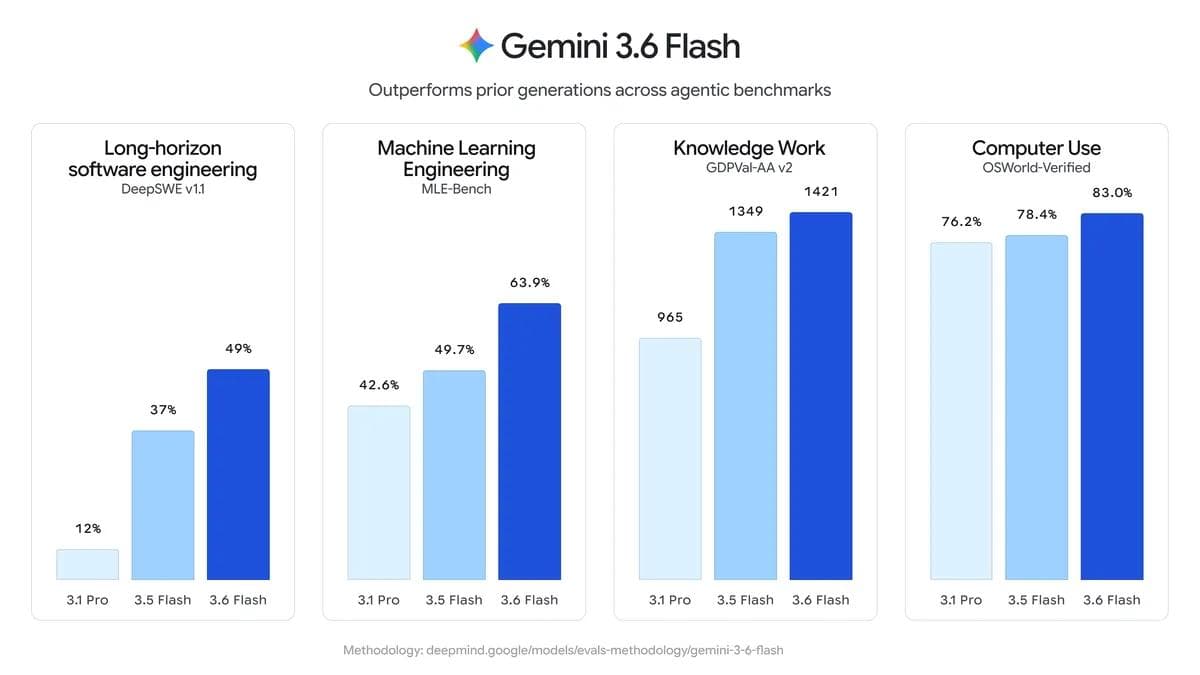
Google reports gains across four useful categories:
| Benchmark | Gemini 3.5 Flash | Gemini 3.6 Flash | What it tests |
|---|---|---|---|
| DeepSWE v1.1 | 37% | 49% | Longer software engineering tasks |
| MLE-Bench | 49.7% | 63.9% | Machine-learning engineering |
| GDPval-AA v2 | 1349 | 1421 | Professional knowledge work |
| OSWorld-Verified | 78.4% | 83.0% | Using software through a computer interface |
Source: Google. These are first-party results, so treat them as a guide rather than a neutral ranking.
The biggest jump in the chart is machine-learning engineering. The gains also span coding, office-style knowledge work, and computer use, which makes 3.6 Flash a useful default when a task combines several skills.
Examples include reviewing a repository and proposing a fix, reading a group of reports and producing a recommendation, or using tools to research a question before returning a structured answer.
Better answers with fewer tokens
Artificial Analysis found that Gemini 3.6 Flash used 17% fewer output tokens than 3.5 Flash on its Intelligence Index. Google's DeepSWE testing showed an even larger reduction for that particular coding workload: about 97,000 output tokens per task instead of 276,000.
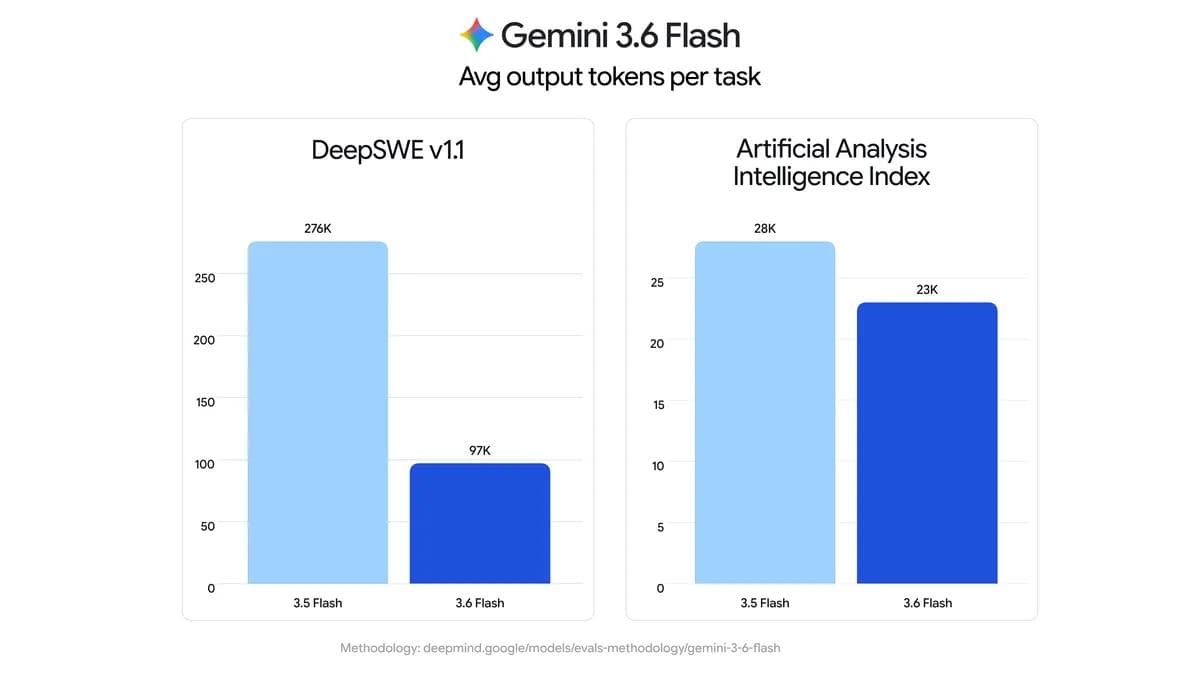
Source: Google, including Artificial Analysis and DeepSWE results.
Token counts are not a quality score by themselves. A short wrong answer is not an improvement. But when quality rises while output gets shorter, it is meaningful: you spend less time waiting, reviewing repeated reasoning, and paying for text that did not help complete the task.
This efficiency is one of the strongest reasons to test 3.6 Flash for agents. Multi-step workflows can become expensive when a model repeatedly calls tools, revisits decisions, or rewrites large sections of code.
Flash Lite trades capability for throughput
Flash Lite is not intended to beat 3.6 Flash on difficult reasoning. Its advantage is doing straightforward work quickly and cheaply.
Artificial Analysis measured approximately 350 output tokens per second. Google also reports large gains over Gemini 3.1 Flash Lite:
| Benchmark | Gemini 3.1 Flash Lite | Gemini 3.5 Flash Lite | What it tests |
|---|---|---|---|
| Terminal-Bench 2.1 | 31% | 54% | Completing tasks through a terminal |
| GDM-MRCR v2 | 60.1% | 72.2% | Finding and using information in long inputs |
| GDPval-AA v2 | 642 | 1140 | Professional knowledge work |
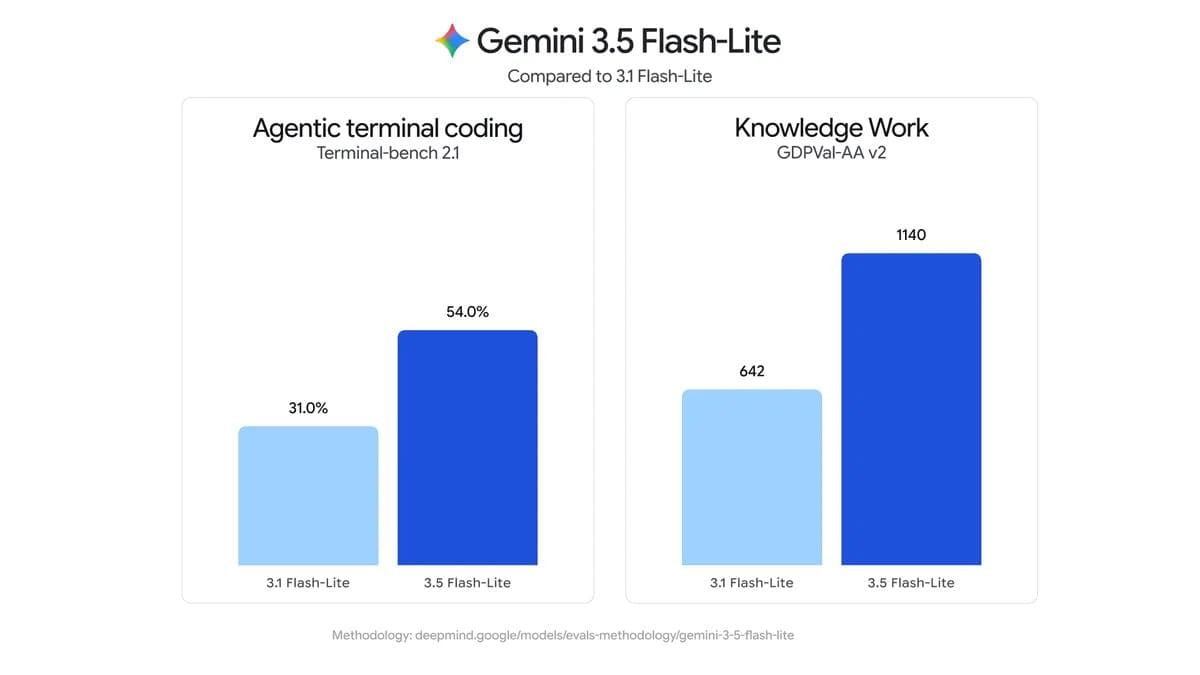
Source: Google. Results are reported by Google.
Google says 3.5 Flash Lite also beats the older Gemini 3 Flash on SWE-Bench Pro (54.2% versus 49.6%) and OSWorld-Verified (74.0% versus 65.1%). The “Lite” label no longer confines it to trivial text processing. It can handle agent and coding work, provided the task does not demand the stronger judgment of 3.6 Flash.
Good uses for Flash Lite include:
- Sorting support messages or feedback
- Extracting fields from documents
- Summarizing large batches of short texts
- Generating search queries or checking search results
- Tagging, moderation, and routing
- Fast autocomplete and lightweight assistants
- Processing images, PDFs, or video at high volume
Price and capabilities on NanoGPT
At publication, NanoGPT lists these pay-as-you-go rates:
| Model | Input per 1M tokens | Output per 1M tokens | Context window |
|---|---|---|---|
| Gemini 3.6 Flash | $1.50 | $7.50 | 1,048,576 tokens |
| Gemini 3.5 Flash Lite | $0.30 | $2.50 | 1,048,576 tokens |
Both models can work with text, images, video, and PDFs on NanoGPT. They also support reasoning, tool calls, and structured outputs, with responses up to 65,536 tokens.
Flash Lite costs one-fifth as much for input and one-third as much for output. That difference may be negligible for one prompt, but it becomes substantial when processing millions of documents, search results, product records, or messages.
The context window is the same, but that does not make the models interchangeable. A model being able to read a very large input does not guarantee it will reason equally well over every detail. Use 3.6 Flash when the answer depends on subtle connections across the material; use Flash Lite when the job is more mechanical.
Where each model fits
Start with Gemini 3.6 Flash if you are:
- Writing or reviewing production code
- Comparing evidence and making a recommendation
- Building an agent that uses several tools
- Analyzing charts, documents, or mixed media
- Drafting a report that needs reliable structure and judgment
- Working on a task where a weak answer creates more work later
Start with Gemini 3.5 Flash Lite if you are:
- Processing a large queue of similar requests
- Extracting, tagging, classifying, or routing data
- Building a fast user-facing feature
- Summarizing material where occasional nuance is less important
- Trying to minimize the cost of a well-defined workflow
One routing setup can use both: send routine work to Flash Lite, then escalate uncertain or difficult cases to 3.6 Flash. That keeps the more expensive model focused on requests where its stronger judgment is useful.
A note on benchmarks
Most figures in Google's announcement were produced or selected by Google. They show the intended direction of the models, but benchmark scores can change with prompts, tool setup, reasoning settings, and evaluation rules.
Run a small comparison before changing a real workflow. Use 20 to 50 representative tasks, hide the model names during review if possible, and compare accuracy, latency, output length, and total cost. For agent work, also count failed tool calls and how often a person has to correct the result.
Use those results, rather than one headline score, to decide whether the switch helps your workload.
Try both models
You can use both models in NanoGPT now:
API users can select google/gemini-3.6-flash or google/gemini-3.5-flash-lite through NanoGPT's OpenAI-compatible API.