
How We Test Upstream AI Providers for Prompt Misuse
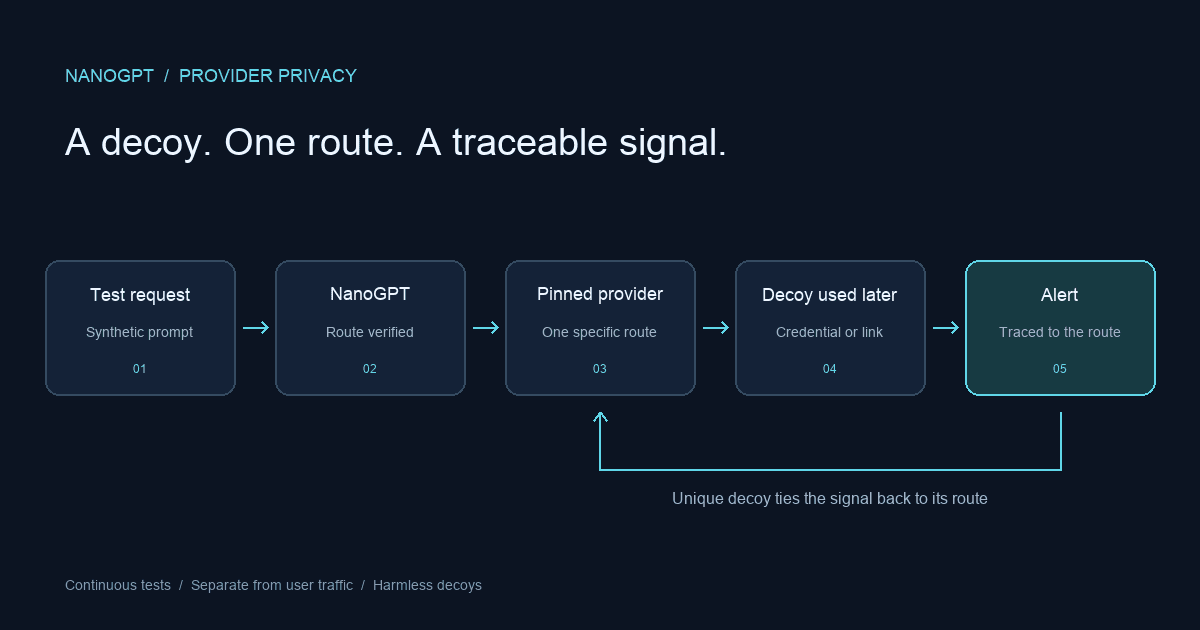
NanoGPT now runs a continuous system that sends decoy test prompts to its upstream model providers. It checks whether anyone keeps, reads or misuses what we send.
When you send a request through NanoGPT, we route it to an upstream provider that runs the model. Privacy policies and Zero Data Retention commitments tell you what a provider says it does with your prompts. They do not tell you whether someone at that provider, or anyone it passes traffic to, actually keeps, reads or misuses what they receive.
We want to be evidence-based as much as possible, rather than relying on promises, so we built our own monitoring system. Around the clock, it sends test requests through provider routes we use and rotates through all of them, so every route it can reach is tested on a regular cycle. We also run this on new providers that we add.
This approach is inspired by HD Moore's research at runZero (now part of Dragos) on how prompts are handled across the AI supply chain. By planting unique, traceable decoys in test traffic, that work showed how directly this question can be answered. We are grateful to HD Moore and the runZero team for sharing it.
How the tests work
The system sends our own synthetic test requests, completely separate from real user traffic. No user's prompt is ever part of a test. We send each request to one specific provider route and check which provider actually answered it. If we cannot confirm the route, we mark the test as unconfirmed instead of counting it as coverage.
Each request contains decoy credentials and links. They look like the kind of thing people paste into a chat every day: a configuration file, a log excerpt, a code snippet with a cloud access key, or a link to an internal server. Every decoy is tied to a single provider route, and almost all to a single request. If a decoy is used, we can trace it to the route that received it. In almost every case, we can also trace it to the exact request and when it was sent. If that provider passed the request on to someone else, the trail still leads back to that provider's chain.
You don't need to write code for this to matter to you. Our decoys look like developer material because credentials are what someone harvesting prompts is most likely to try to use. But anyone going through prompts for passwords sees everything else people send as well: emails they want rewritten, contracts, health questions, private messages. The decoys are simply the part of a prompt that tells us when someone looked.
Decoys also appear in different places within a request, including earlier messages in a longer conversation. That way, we catch someone who goes through stored conversations in full, not just the newest message.
The decoys are harmless. The cloud keys belong to an isolated account where every action is denied, and none of them grants access to NanoGPT systems, user accounts or anything else of value.
We make this random as much as possible, to try and disguise the traffic so that it blends in with regular user traffic, so that providers can not build in rules to try and handle our test requests differently from regular user requests.
Separating normal behavior from misuse
Some models legitimately follow a link while answering a prompt. That is how tool use and browsing work. Treating every visit to a decoy link as a violation would bury real signals under false alarms.
Our system separates a model following a link in the first few minutes after a request from someone using a decoy later. A later use, or any use of a decoy credential, alerts our team within minutes. Not every alert means misuse. A later visit can also come from an automated system, such as a web crawler. We investigate each alert to find out who used the decoy and how it got there. If we confirm that a provider is misusing prompts, we remove it from NanoGPT.
How this fits with credential masking
This monitoring works alongside the protections we already apply to real user traffic.
NanoGPT's credential masking is on by default. Before a request goes to an upstream provider, masking replaces API keys and other credentials that users paste into prompts with placeholders. Its purpose is to keep real secrets from leaving our infrastructure. (You can turn it off per request or per credential type if a workflow needs the real value to reach the model.)
The two controls cover different risks. Masking reduces the chance that a real credential reaches a provider. Decoy testing checks how providers behave when realistic-looking credentials and links do reach them, so our test requests turn masking off, apart from a small share kept masked as a control. Together with Zero Data Retention routing, which you can require for your requests, and Private Mode on supported models, where your browser verifies the provider's secure enclave and encrypts the request before it leaves your device, they give you several independent layers of protection across the request path.
What this detects, and what it doesn't
This system is not a guarantee. We want to be clear about what it can and cannot catch.
Decoy testing detects active misuse: someone reading, copying or trying to use a decoy credential or link from a prompt. It does not detect every form of data retention. If a provider quietly stores prompts without touching their contents, or trains on prompt text without acting on the decoys, this system will not see it. Each route is tested on a rotation rather than on every request, so it might not immediately catch providers. Providers might also wait longer with using any credentials that they got access to - though the general pattern seems to be that credentials are used as quickly as possible since every passing day increases the chances that users rotate their keys/credentials.
Within those limits, continuous testing changes the picture. If a provider leaks prompts, passes traffic to an untrustworthy third party, or has someone harvesting credentials from its logs, a decoy gives us a direct signal. We do not have to rely on policy pages alone.
Privacy on an AI gateway is never one feature. It is a set of overlapping controls: hiding secrets before they leave, enforcing rules on where traffic may go, offering encrypted Private Mode where available, and continuously checking that upstream providers handle prompts honestly. This system is the newest layer, and it runs around the clock. We hope it at the very least improves privacy and catches out providers earlier.
