
Memory Efficiency in LLMs: Study Summary

More context does not always mean better recall. From what I see in the research, long prompts often hit two limits at once: memory cost goes up fast, and recall can get worse after a certain point.
If I boil the article down, the message is simple:
- Attention cost grows hard with context length, which pushes up VRAM use and latency
- Models can suffer from "lost in the middle", where details in the middle of a long prompt are easier to miss
- KV cache growth is a big part of the memory problem during inference
- Memory-saving methods like efficient attention, recurrent memory, and context compression can cut cost, but each gives up something in speed, prompt capacity, or verbatim recall
- For NanoGPT and local setups, memory design affects per-request cost, device fit, privacy, and overall user experience
A few numbers stand out:
- Standard KV cache at 1,024 tokens can be about 80 MB for GPT-2-scale models and about 4.5 GB for GPT-3-scale models
- Some optimized cache setups cut that to about 2 MB and 115.2 MB
- One meta-token approach showed 2x length generalization with about 1.11x throughput slowdown
- One memory module added about 1.8% compute overhead
- IMM-based models cut final training loss by 35% to 57%
How KV Cache Speeds Up LLMs and Caused Memory Shortage
sbb-itb-903b5f2
Quick comparison
| Approach | Main goal | Main upside | Main downside |
|---|---|---|---|
| Standard attention | Keep full token-to-token access | Full prompt detail | High VRAM use and slower inference as context grows |
| Efficient attention | Cut attention and cache cost | Lower memory load | May slow throughput or change recall behavior |
| Recurrent/sliding memory | Focus on recent tokens | Lower memory use | Weaker long-range exact recall |
| Compression | Store a smaller memory state | Less repeated prompt overhead | Output quality depends on compression quality |
| Knowledge in model weights | Reduce need for long prompts | Very low runtime memory demand | Needs training for the target domain |
So if you ask me for the bottom line: the best memory setup is usually not the one with the biggest context window. It’s the one that keeps cost, speed, and recall in balance for the job at hand.
What Research Shows About Recall Limits and Context Scaling
Expanding a context window does not guarantee better recall. In practice, each model and dataset can hit a sweet spot. Push context past that point, and performance may slip instead of improve. Benchmarks show the limit is not only cost. It's also recall.
Why Larger Context Windows Do Not Guarantee Better Recall
Researchers from Tsinghua University and Carnegie Mellon University tested this on the RULER benchmark with Qwen series models. They found that retrieval thresholds can show up as context length grows beyond what the model can use well. In plain English: adding more context can help at first, but after a certain point, the model has a harder time pulling out the right detail from all that text.
A common failure mode is the "lost in the middle" effect. Models tend to recall information near the start or end of a prompt more reliably than content buried in the middle. So with long documents, the most relevant passage can get missed for a simple reason: it sits in the wrong spot in the sequence.
How Context Length Affects Latency, VRAM, and Usable Prompt Size
Long contexts also increase KV cache size and latency. There are ways to cut those costs, including multi-query attention, hybrid attention horizons, and KV sharing across layers.
You can see the scaling problem in KV cache size:
| Model Scale | Context Length | KV Cache Size (Standard) | KV Cache Size (Optimized) |
|---|---|---|---|
| GPT-2 (124M) | 1,024 tokens | ~80 MB | ~2 MB |
| GPT-3 (175B) | 1,024 tokens | ~4.5 GB | ~115.2 MB |
Bigger caches also slow decoding, which shrinks usable prompt size in practice. The prefill phase is compute-bound and drives time to first token. The decode phase is memory-bound and gets slower as the KV cache grows. That tradeoff shows up fast once prompts get long.
To stay within memory limits, some GPT-2-scale experiments even cut transformer layers from 12 to 6. That detail makes the tradeoff pretty clear: longer context is not free, and the hit shows up in both system speed and how much of that context a model can use well.
Memory-Efficient Methods in Long-Context LLM Research
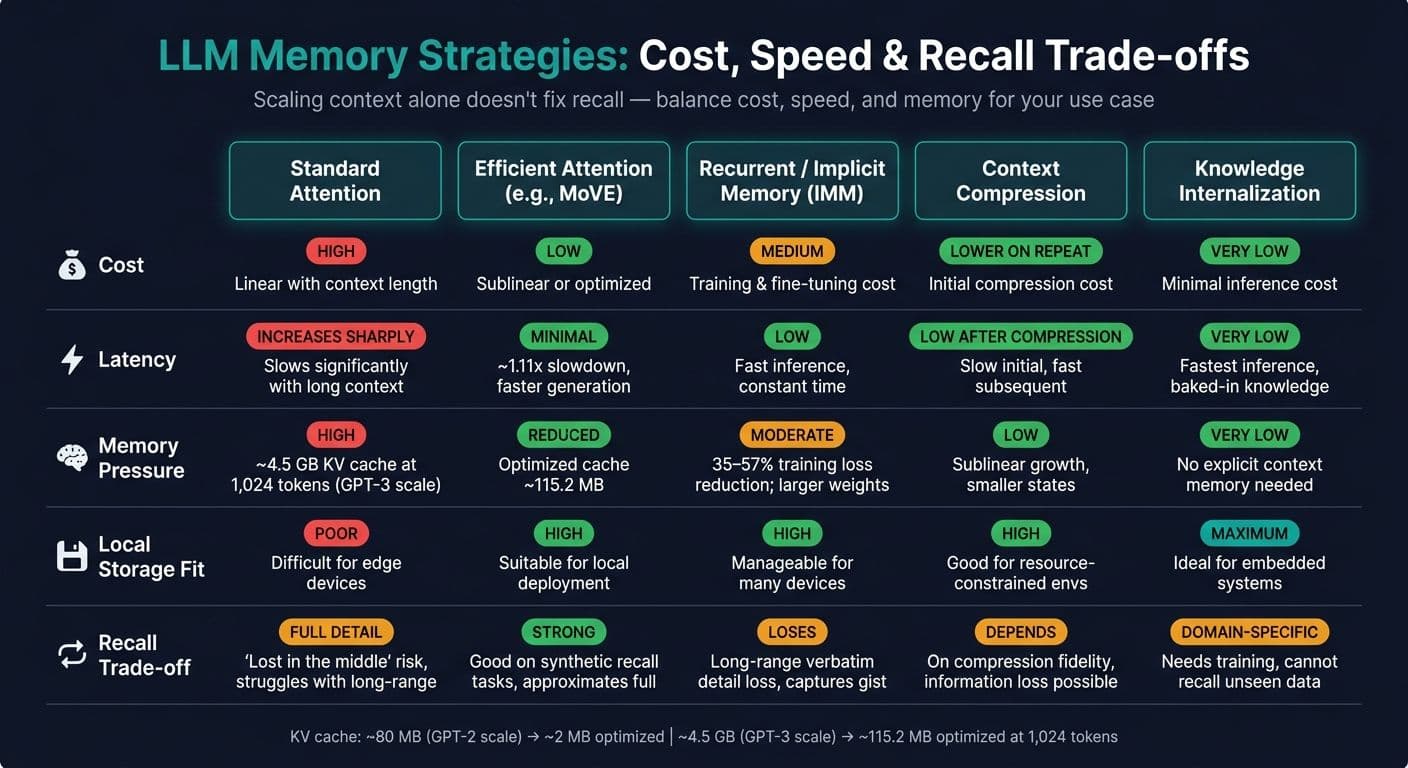
LLM Memory Strategies: Cost, Speed & Recall Trade-offs Compared
To cut memory use and reduce latency, researchers are testing three main paths. Each one tackles recall limits, KV-cache growth, and inference delay from a different angle. The catch is simple: when you save memory, you usually give something up in prompt capacity, recall quality, or speed.
Efficient Attention: Linear, Sparse, and Hybrid Patterns
One way to lower cost is to change how attention works. Instead of letting every token attend to every other token at full cost, some papers test sparse and hybrid patterns.
One studied method uses "meta-tokens" - trainable landmarks added during pretraining that compress earlier context into cached state for later retrieval.
In synthetic recall tests, meta-token models trained on fewer than 100 billion tokens beat GPT-Neo-125M, which was trained on 300 billion tokens. The trade-off was a 1.11x throughput slowdown, and the method supported up to 2x length generalization.
Sliding-Window and Recurrent Memory Designs
Another path is to avoid keeping every token interaction at full cost. Fixed-size and decay-based memory designs do that by putting more weight on recent information and less on older context.
One studied approach, "fleeting memory," applies recency-weighted attention to self-attention weights. Studies found that fleeting memory only improved performance when paired with an "echoic memory buffer" of 5–10 tokens, or about 3–7 words. Without that small buffer, local dependencies got weaker. With the buffer in place, models showed a 2.30% improvement in syntactic accuracy, measured by BLiMP scores, when trained on 100 million tokens.
Context Compression and Summary-Based Memory
A third path is compression. Instead of storing raw token sequences, these methods encode long prompts into compact states that can be used later. In plain terms, the model keeps a smaller memory of what came before instead of carrying the whole prompt forward token by token.
The meta-token mechanism also fits here. It works like an inline cache, compressing preceding context without needing a separate retrieval step.
| Method Family | Memory Complexity | Key Strength | Recall Trade-off | Inference Impact |
|---|---|---|---|---|
| Sparse/Meta-Attention | Sparse/Linear | 2x length generalization | Strong on synthetic recall tasks | ~1.11x throughput slowdown |
| Fleeting/Recurrent Memory | Fixed/Decaying | Improved syntactic learning | Loses long-range verbatim detail | Low; generally maintains speed |
| Compression/Caching | Sublinear | Reduces KV-cache growth | Depends on compression fidelity | Varies by implementation |
These method families all shrink memory demand, but they do it in different ways. Some keep recall stronger on test-style tasks. Others hold speed better. And some reduce KV-cache growth by compressing what the model carries forward.
What These Findings Mean for Text Generation Platforms and NanoGPT

How Memory Efficiency Affects Per-Request Cost and User Experience
Technical limits turn into product limits the moment a model goes live on a platform.
On pay-as-you-go systems, longer prompts cost more and take more time with every extra token. That’s the plain trade-off users feel: more context can help, but it also slows things down and adds to the bill. Methods like MoVE help ease that tension. They expand usable memory with only a small compute bump, adding about 1.8% computational overhead while giving models access to a much larger knowledge bank without increasing active FLOPs.
Implicit memory helps from another angle: it can reduce how many tokens need to be pushed through the model in the first place. Models that use Implicit Memory Modules (IMM) cut final training loss by 35% to 57% compared with standard baselines. On NanoGPT, that can mean lower token use, less latency, and lower per-request cost.
Why Local Data Storage Changes the Memory Discussion
Memory pressure also shapes where user history should live and how often it needs to be pulled back into context.
It helps to separate two things. Active context memory is what the model holds during inference. Stored user history is what stays around between sessions. Those are not the same, and mixing them up can lead to clunky product choices.
NanoGPT stores user data locally on the device, not on a remote server. That changes the math in a useful way. Conversation history can stay on-device and be selectively brought back in, summarized, or compressed, instead of sending the same large prompt prefixes through the context window again and again.
Drexel University researchers found that a 124-million-parameter nanoGPT model trained on 250,000 specialized tokens achieved strong domain-specific recall. When knowledge is internalized in the weights, it doesn’t take up prompt space. For privacy-sensitive workflows, that matters even more: sensitive information can remain local instead of being repeatedly exposed in cloud-bound prompt payloads.
Platform-Level Trade-Offs of Long-Context Strategies
At the platform level, the trade-offs come down to cost, latency, memory pressure, and how well a method fits local storage.
| Strategy | Cost | Latency | Memory Pressure | Local Storage Fit |
|---|---|---|---|---|
| Standard Attention | High | Increases sharply | High | Poor |
| Efficient Attention (MoVE) | Low | Minimal | Reduced | High |
| Recurrent/Implicit Memory (IMM) | Medium | Low | Moderate | High |
| Context Compression | Lower on repeat | Low after compression | Low | High |
| Knowledge Internalization | Very low | Very low | Very low | Maximum |
For platforms, long context only makes sense when the extra memory is worth the extra cost. In practice, that turns memory strategy into a pricing and user experience call, not just an architecture decision.
Conclusion: Key Lessons from Current Memory-Efficiency Research
Across these studies, the same pattern shows up again and again: scaling context alone doesn't fix recall. Bigger context windows can drive up cost, but they don't always improve what the model remembers.
Each approach helps with memory efficiency in its own way. But there's always a tradeoff. You might pay in compute, speed, or recall fidelity.
For NanoGPT, memory strategy isn't just an engineering choice. It's a product choice too. Pay-as-you-go pricing, local data storage, and lower per-request cost all depend on picking the memory approach that fits the job.
The big takeaway is simple: separate memory growth from runtime cost whenever you can. In practice, the goal isn't maximum context. It's the memory setup that does the job with the least waste.
FAQs
Why can longer prompts hurt recall?
Long prompts can hurt recall because of position bias. People often call this the “lost in the middle” problem.
Here’s the simple version: models usually remember details better when those details show up at the start or the end of a prompt. Put the same detail deep in the middle, and it’s more likely to get missed.
There’s another issue too. If a prompt goes past the model’s trained context length, the positional signals can start to break down. When that happens, the model may lose focus or start treating tokens as if they matter equally, even when they don’t.
What makes the KV cache so memory-heavy?
The KV cache uses a lot of memory because it grows linearly with sequence length. In plain English, the longer the input, the more memory the model needs to store it.
During autoregressive decoding, the model keeps the keys and values for every previous token so it can run self-attention at each step. That means the cache keeps growing as generation continues.
As context windows get larger, this turns into a major memory bottleneck. At some point, the KV cache can eat up so much space that it pushes past the limits of the available hardware.
Which memory-saving method is best for local LLM use?
For local large language model (LLM) use, the best method depends on what you need, but hierarchical compression and quantization are two of the most practical options.
NanoGPT’s Context Memory uses hierarchical B-tree compression to handle long sessions without retraining. If you want broader memory savings, a mix of methods often works best. In many cases, that means using 4-bit KV cache quantization, retrieval-augmented generation (RAG), prompt caching, and semantic compression together to cut memory use while keeping accuracy in place.