
OpenRouter Alternatives (2026) | Compared by use case
OpenRouter serves 446 models from 109 providers through a single API, and the models on its leaderboard process trillions of tokens a week. OpenRouter is one of the biggest names in AI model routing, and we're glad to share a market with a product that innovative.
Growing across that many fields like routing, observability, provider transparency, free tiers, BYOK, agent tooling and being good at all of them blocks you from being the best at any single one, and their users are starting to feel it.
So we did the research and split their offering into the jobs it actually does, then found the best product for each one.
Why people leave OpenRouter
Four reasons come up over and over, and which one is yours decides everything below.
The 5.5% credit fee. OpenRouter charges 5.5% when you buy credits by card or Alipay, 5% on USDC, with a $0.80 minimum. On a $10 top-up that minimum works out to an effective 8%. USDC deposits aren't refundable.
You want your prompts in your own infrastructure. Compliance, data residency, or just a preference for owning the stack.
Cache misses from provider switching. This is the expensive one and it gets the least attention.
People on r/openrouter are describing it as:
"Same task +5$ gone in openrouter. Deepseek still under 0.5$. The problem is the cache, openrouter keeps switching me to other providers with terrible cache hits."
A 10x cost difference. Not from the platform fee, from losing a cached prompt prefix every time the router moved him to a different provider. He tried blacklisting providers and still got switched.
If that's your problem, the 5.5% fee is a rounding error.
Provider choice you don't control
Routing to the cheapest available provider means the same model can come from different hosts on different days. Most of the time that's invisible. Occasionally it isn't, and output quality shifts without anything in your code changing.
OpenRouter gives you unusually fine-grained control here if you use it, which most people don't.
Where to go instead
OpenRouter does several jobs at once, so "what replaces it" depends on which of those jobs you came for. Seven products cover the ground between them.
1. NanoGPT
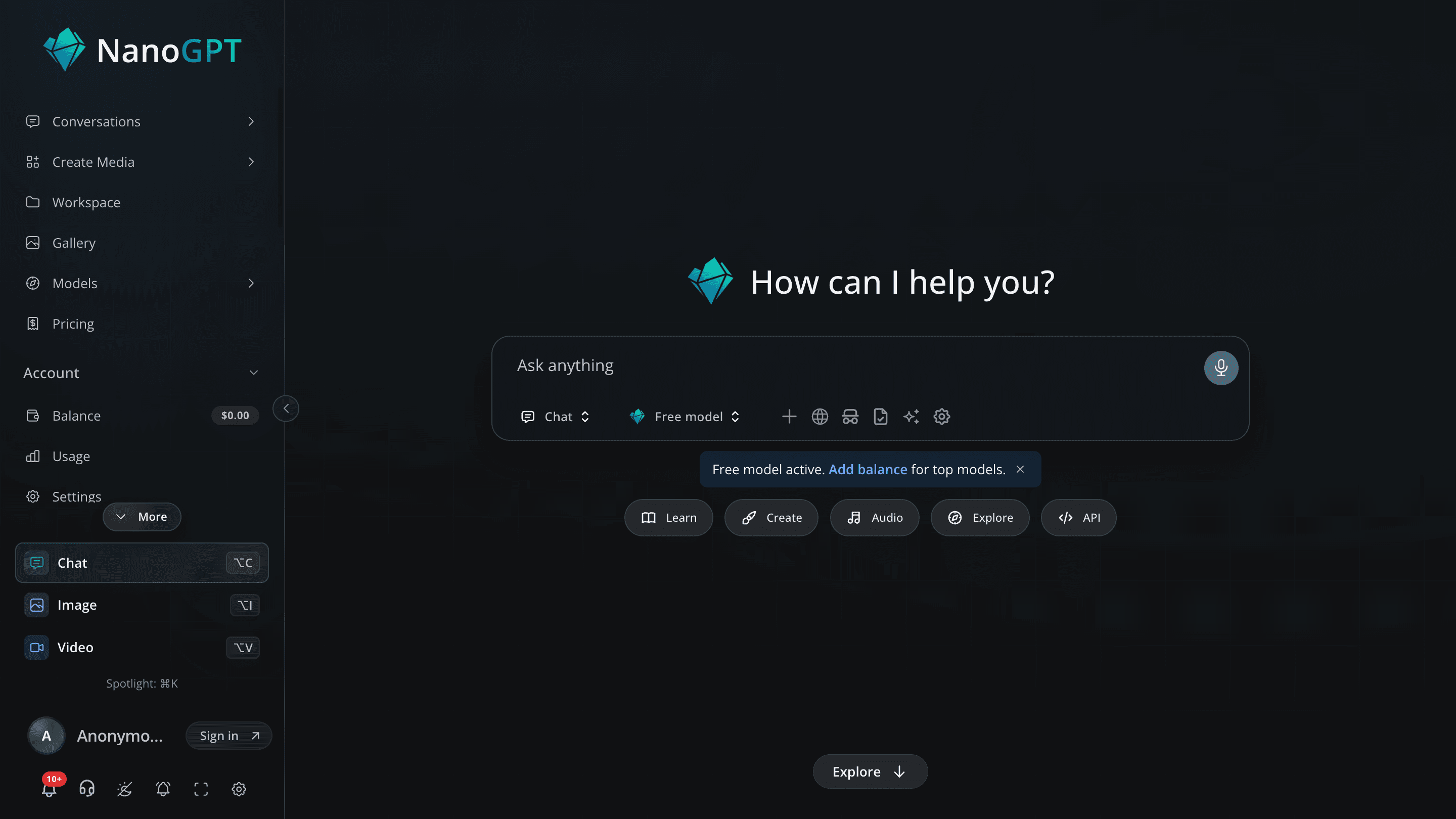
NanoGPT is the best AI multi-model aggregator.
Aggregation is the one job on this list you don't have to run yourself. One balance, one API key, every model, nothing to deploy. It's what most people liked about OpenRouter in the first place.
NanoGPT is the best AI multi-model aggregator, with 993 models across text, image, video and 3D from a single balance, no fee to add funds, and prompt caching that survives provider switching.
NanoGPT provides 900+ AI models
NanoGPT carries 599 text, 216 image, 170 video and 8 3D models from 57 providers, counted on 21 September 2026. Count them yourself at nano-gpt.com/api/models.
No fee to add funds, and no minimum per query
NanoGPT credits deposits in full on card and crypto, and bills text models at the provider's list price. Every response includes the exact amount charged, so you can verify it on your first request.
Does prompt caching survive routing?
NanoGPT uses cache-affinity routing by default, keeping matching requests on the same provider so long prefixes stay cached. Set caching: true and a request will only go to a cache-capable provider, or fail rather than silently cost you full price.
NanoGPT publishes cache-read pricing on 590 of 599 text models, most at 90% or more below the input rate.
Does NanoGPT require logging in?
NanoGPT does not log or retain prompt content by default. Turn on ZDR-only and requests route exclusively to providers that don't retain prompt data, or fail. NanoGPT also offers PII redaction on both API and chat.
Can you call a NanoGPT API without an account?
NanoGPT accepts accountless requests through x402: send a request with no Authorization header, get a payment quote, pay in Lightning or crypto, replay it.
Does it support both provider selection and reasoning-effort control?
Yes, NanoGPT supports both on models that allow it. Pinning adds 5%.
Does NanoGPT provide an interface as well as the API?
NanoGPT ships drop-in setup for Claude Code, Cline, Roo Code, Kilo Code, OpenHands and Droid.
Does NanoGPT offer a monthly subscription plan, aside from pay-as-you-go model?
NanoGPT bills pay-as-you-go by default, with no subscription required. If predictable cost suits you better, the subscription covers open-source models with a weekly allowance of 60 million input tokens plus 100 images a day, with burst limits of 10 requests per 10 seconds and 10 concurrent.
Sixty million input tokens a week is more than it sounds. At a 50k-token context, that is roughly 1,200 messages a week, or about 170 a day, every day, on open-source models. Two different people asked publicly what that allowance meant in practice and never got an answer, so there it is.
NanoGPT provides models other aggregators don’t
NanoGPT hosts several permissive and derestricted models that OpenRouter doesn't list, including Mistral Large 3 675B, GLM 4.6 Derestricted v5, and the Qwen3.5 27B BlueStar V2 and Omega Evolution fine-tunes. A user who tested them side by side rated Mistral Large 3 675B the biggest of them that stays permissive on long contexts.
| NanoGPT | OpenRouter | haimaker.ai | |
|---|---|---|---|
| Deposit fee | None | 5.5% card, 5% USDC | None |
| Minimum fee per query | None | $0.80 minimum on credits | Not stated |
| Models | 993 | 446 | 200+ |
| Modalities | Text, image, video, 3D | Mostly text | Text |
| Chat interface | Yes | API-first | API only |
| Accountless access | Yes | No | No |
| Prompt caching | Affinity routing by default | Provider-dependent | Not stated |
| Optional subscription | $12/mo, 60M input tokens weekly | No | No |
Five of those rows go to NanoGPT, and they're the ones that decide the bill. If you don't want to run infrastructure, that's the whole job: put money in, get tokens out, reach any model.
Start with $1 by card or $0.10 by crypto. NanoGPT charges no deposit fee, so all of it becomes tokens.
If aggregation isn't the job you need doing, the next six are better answers.
2. LiteLLM
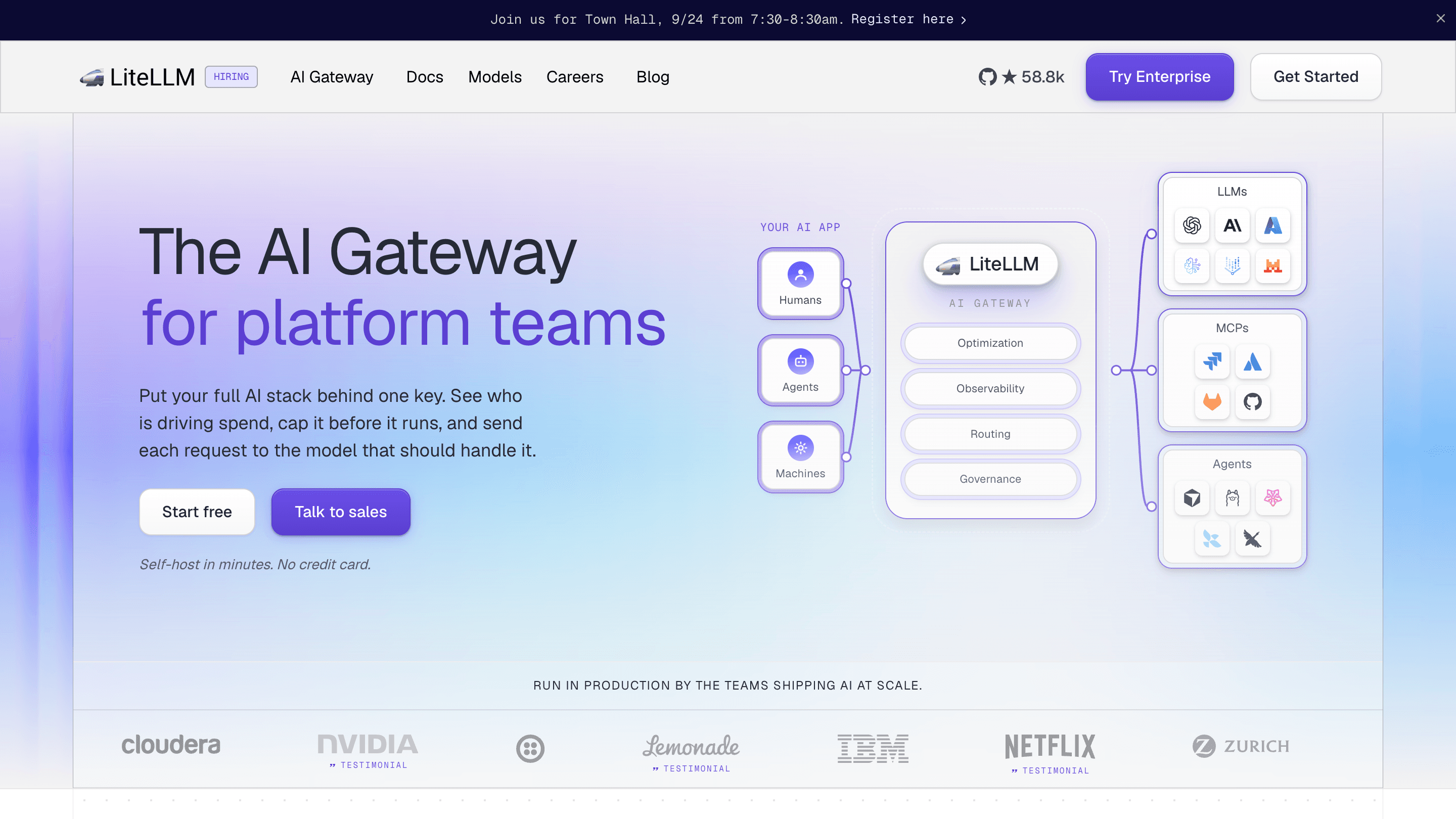
Great if you want to run the proxy yourself.
LiteLLM is the closest open-source alternative to OpenRouter and the one most teams land on when they want the routing without the hosted layer. It runs as a proxy inside your own infrastructure, standardises 100+ providers into an OpenAI-compatible format, and uses your own provider keys, so there is no platform margin on anything.
Named features: virtual keys for API access management, per-user budgets and rate limits, load balancing, routing and failover, caching, a guardrails system with custom policies, and logging, alerting and metrics integrations. It also supports traffic mirroring for A/B testing and custom plugins through call hooks.
Pricing: the open-source core is free under MIT. LiteLLM sells a hosted and enterprise tier separately, priced on request.
The cost: you are now operating a service. It ships as a Docker deployment and wants PostgreSQL for virtual keys and usage tracking, and somebody has to keep it up. Some frameworks also send parameters LiteLLM does not support, which needs a --drop_params workaround.
Bifrost is worth a look if you want something lighter. Also open source, also self-hosted, 23+ providers, and faster to stand up.
3. Portkey
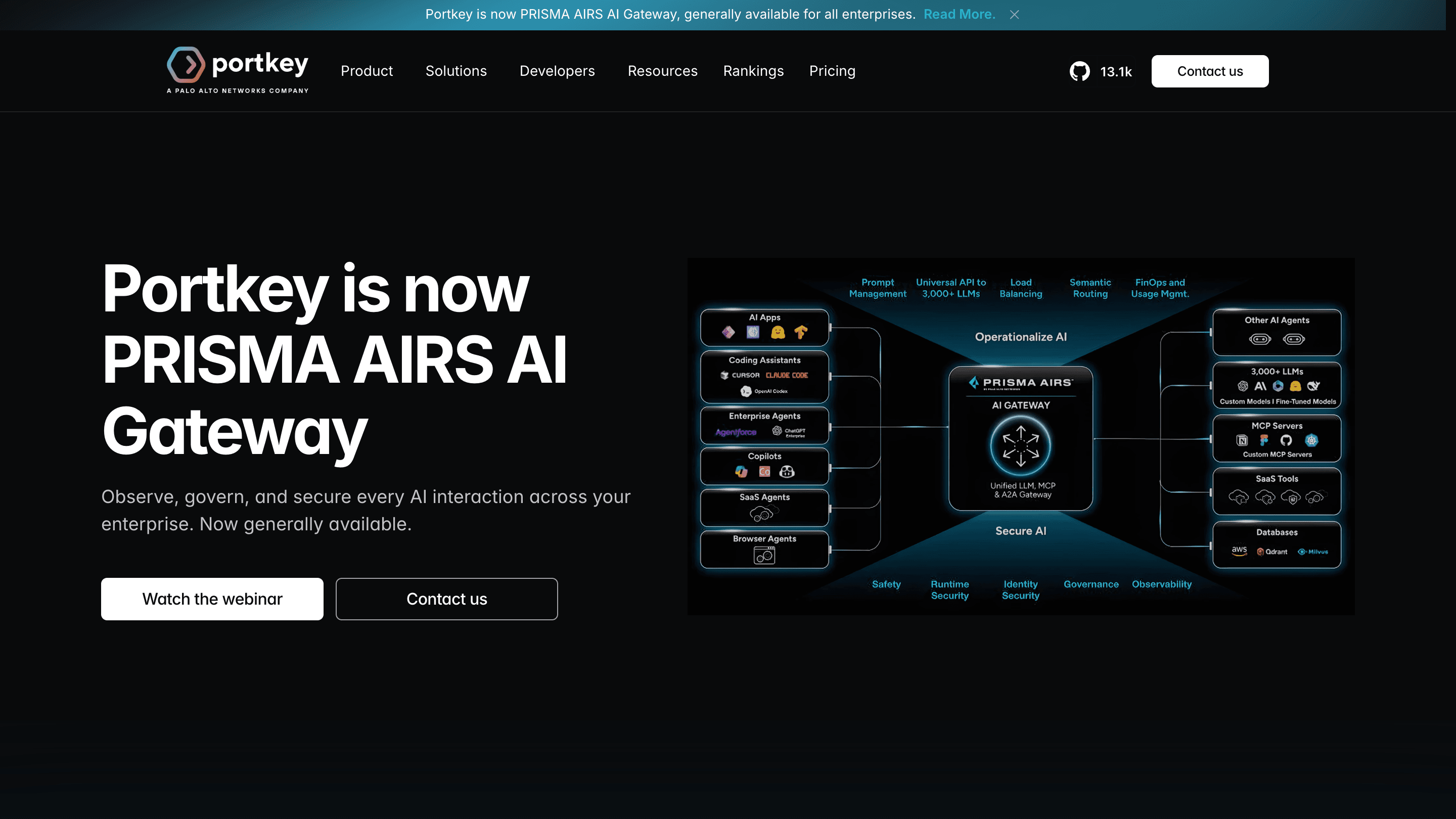
Portkey is the leading option for enterprise AI gateways.
Portkey sits on top of your existing provider keys and adds the reliability and governance layer most teams end up building themselves. If somebody in your company has to sign off on how model traffic is controlled, Portkey is the standard answer.
Named features: prompt templates with versioning, virtual keys and key management, semantic caching, a PII anonymiser, guardrails with custom hooks, role-based access control, service account API keys, automatic user attribution, and granular budget and rate limits.
Pricing: the self-hosted gateway is free and open source, with no log limit. Developer is free for 10,000 logs a month, with 3-day log retention.
Production is $49/month for 100,000 logs, then $9 per additional 100,000. Enterprise starts at 10 million logs and adds SSO, VPC hosting, custom guardrail hooks, SOC2 Type 2, GDPR and HIPAA.
Worth knowing: the open-source tier is genuinely usable, not a demo. Universal API, retries, routing, guardrails, fallbacks and load balancing are all in it.
4. Opper
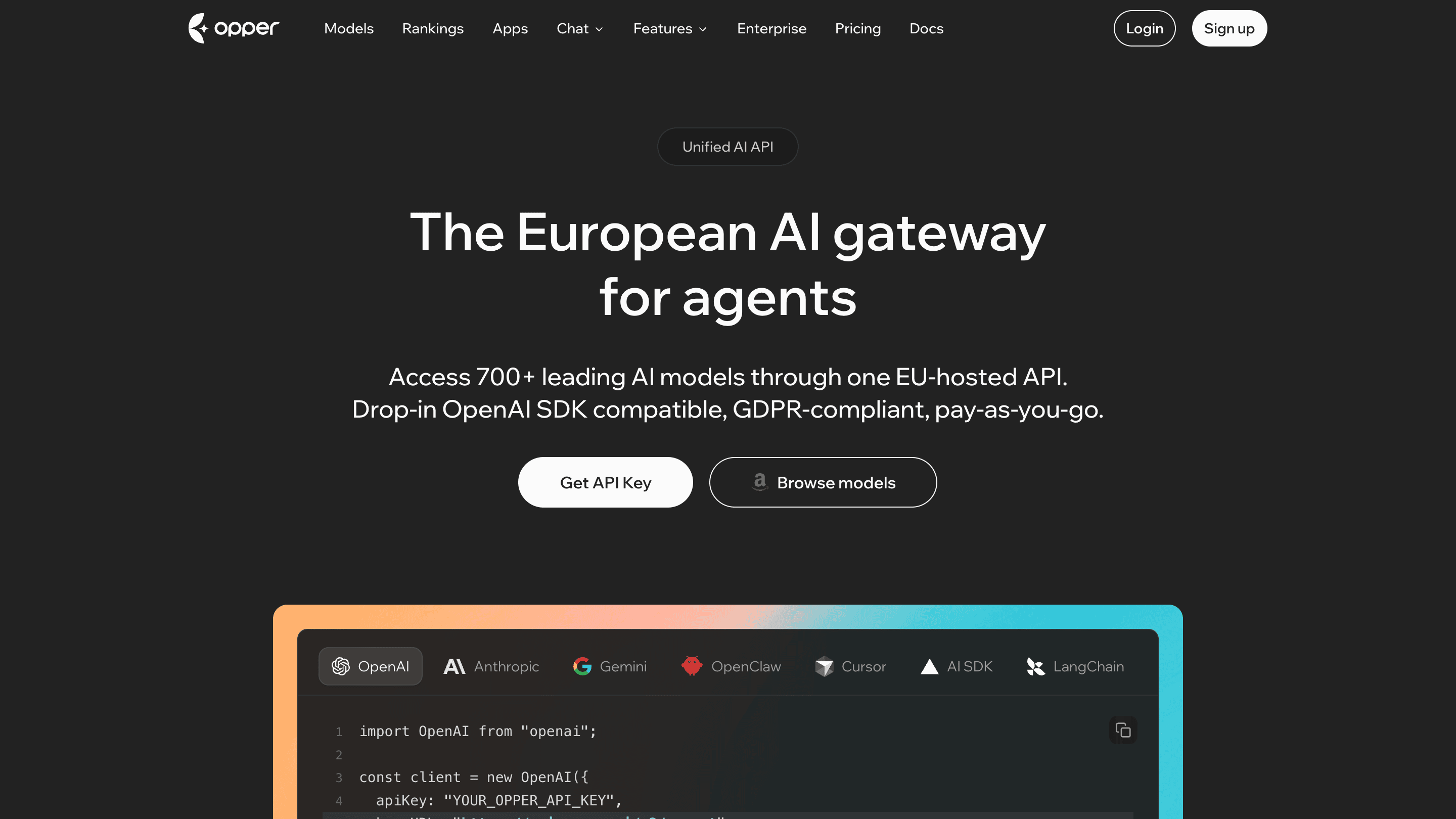
Opper is worth a look if compliance is the blocker.
Opper is the specialist when EU data residency is an actual requirement rather than a preference. Everything runs out of AWS Stockholm, and Opper applies a zero data retention rule on every plan rather than reserving it for enterprise contracts.
Named features: 700+ models, manual routing and fallbacks, metadata-only tracing on the base tier, free BYOK, and four opt-in controls higher up: Observe, Steer, Guard and Comply. Per-provider data policies are published in the models directory.
Pricing: Opper charges a platform fee on credit purchases rather than a subscription. Gateway is 3%. Control Plane is 5.5% and adds full tracing plus the Route feature. Enterprise is custom, with SSO/SAML, audit logging and custom hosting regions.
No minimum, and no card needed to try the free models. Note that Observe bills the judge model cost on top of the 5.5%.
Worth knowing: the Gateway tier stores only analytics and error metadata, no prompts or responses. Opper also states data is never used for training or shared with third parties. That is a stronger default than most of this list.
5. Braintrust Gateway
Braintrust is strong choice when routing and evaluation belong together.
Braintrust puts trace, dataset and CI evaluation workflows in the same place as the routing, so you can run regression tests and compare prompt performance before shifting production traffic. If your problem is "we don't know whether the new model is actually better", this is the one.
Named features: evals and scorers, traces, datasets, playgrounds, experiments, custom charts, environment tagging for production and staging, S3 data export, and the Loop agent on paid tiers.
Pricing: Starter is free: $10 of model credits a month, 1 GB of processed data, 10,000 scores, 14-day retention, and unlimited users and projects.
Pro is $249/month and raises all four, with overages at $3/GB and $1.50 per 1,000 scores. Enterprise adds SAML SSO, on-prem deployment, BAA and DPA agreements, and an uptime SLA.
Worth knowing: the free tier has unlimited seats, which is unusual. If you want to evaluate model changes across a whole team without a procurement conversation, that matters.
6. Cloudflare AI Gateway
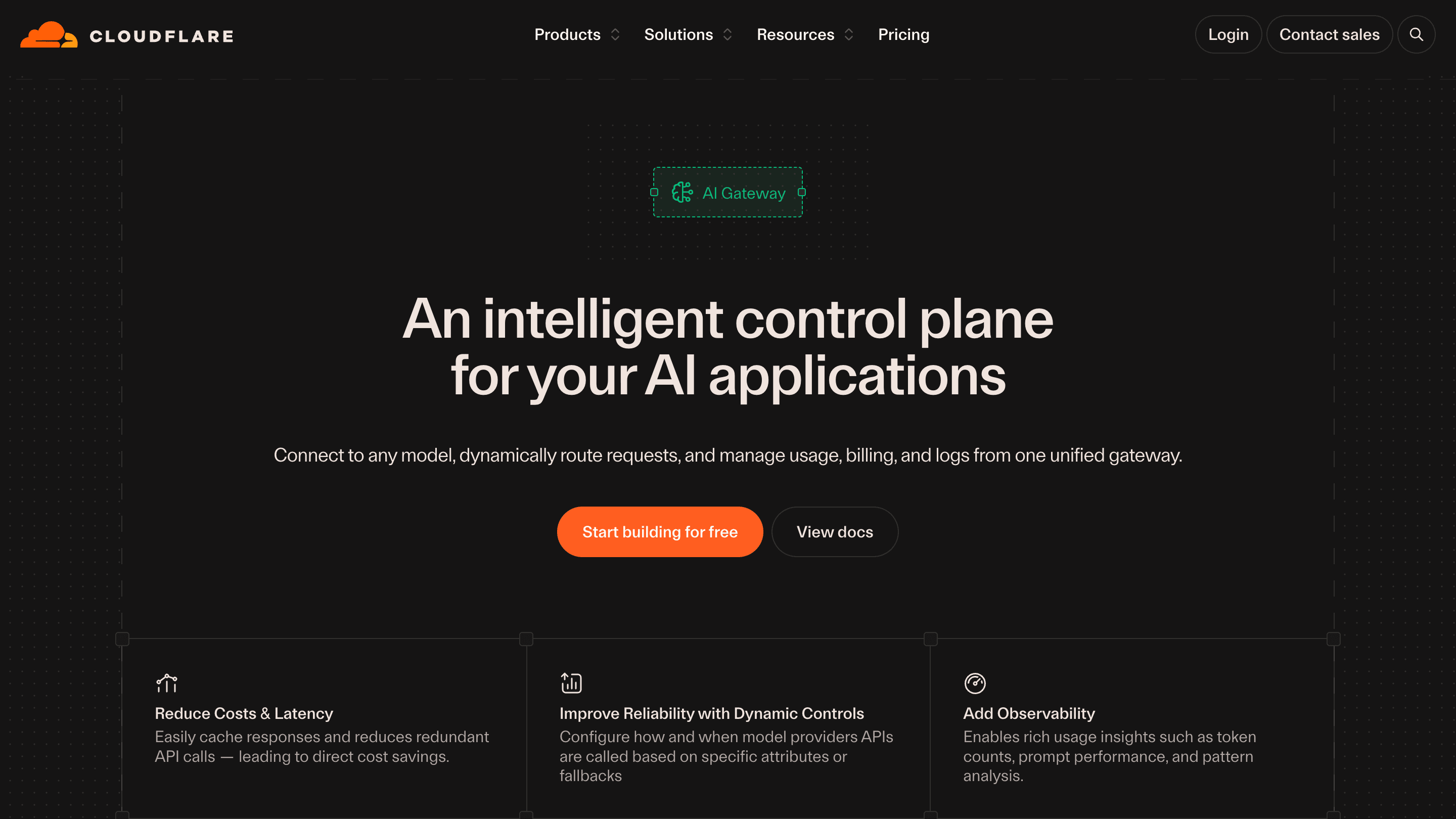
Hard to beat if you're already on Cloudflare.
Cloudflare AI Gateway is one line of code if your infrastructure already lives there, and it gives you the observability layer without a new vendor relationship or a new bill.
Named features: analytics on requests, tokens and cost; logging for requests and errors; caching served from Cloudflare's edge rather than the model provider, which cuts both latency and spend on repeated requests; rate limiting to cap how fast your application scales; and request retry with model fallbacks.
Pricing: available on all Cloudflare plans, with the core gateway features free. You still pay your model providers directly, since this is a layer rather than a marketplace.
The limit: Cloudflare AI Gateway has no model catalogue of its own. You bring your own provider keys, so it solves observability, caching and rate limiting, but not access. If you do not already have provider accounts, this is not the product you are looking for.
7. DeepInfra and Together AI
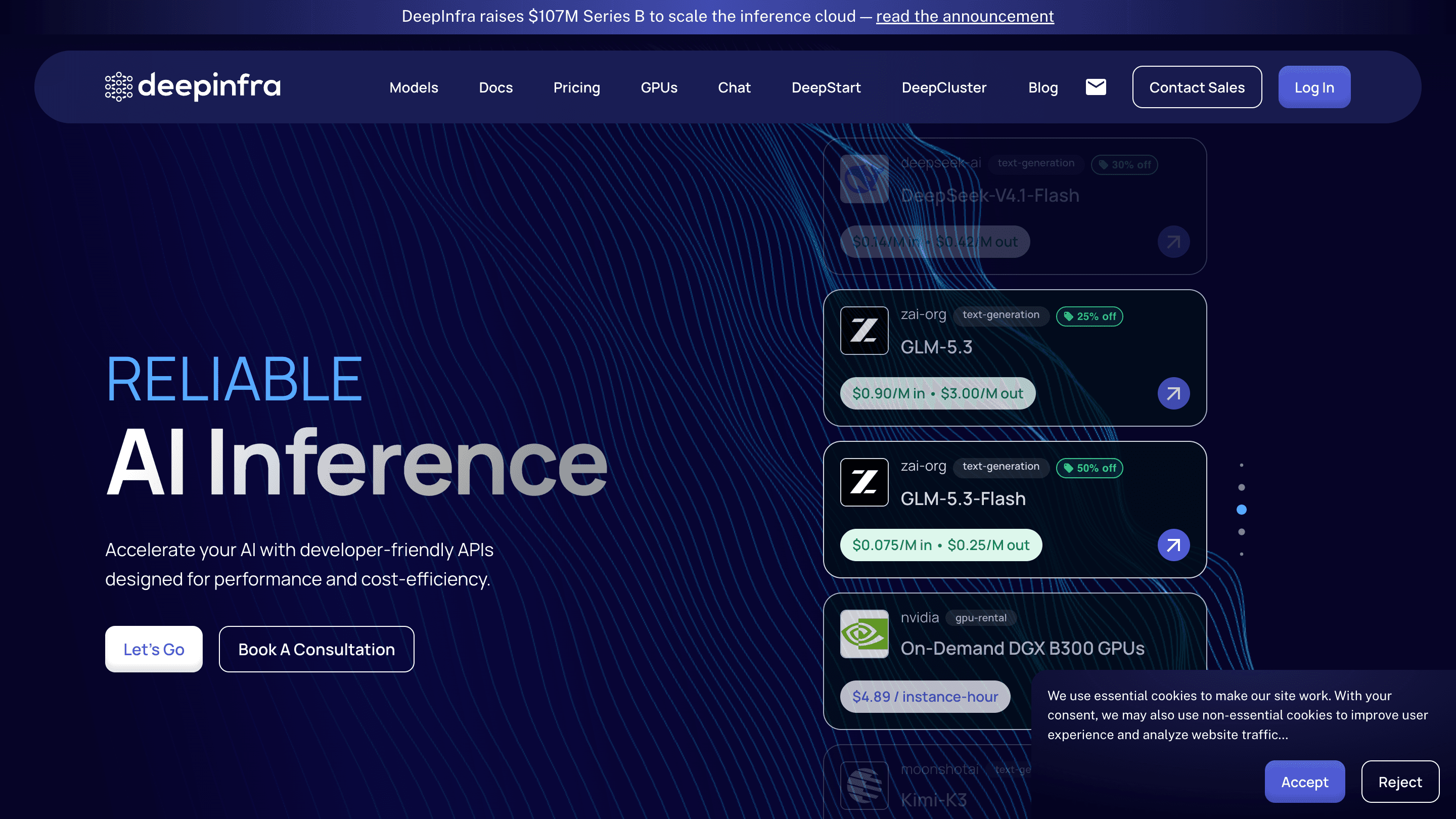
Often the right answer if you've settled on a model
Plenty of people skip the aggregator entirely. Both sell inference directly, with no middleman and frequently cheaper per-token rates on popular open models.
DeepInfra runs cheap and simple. DeepSeek V4 Flash is $0.06 in / $0.18 out per million tokens. Llama 3.3 70B is $0.10 / $0.32. Claude Sonnet 5 is $3.00 / $15.00.
Dedicated GPUs run $0.89/hour for an A100, $2.20 for an H100 and $2.69 for an H200. Three service tiers let you trade speed against price: Flex at 0.8x base, Standard at 1x, Priority at 1.5x.
No platform fee, no minimum deposit, and you can set a spending cap.
Together AI is the one to pick if you need fine-tuning. Serverless rates run from $0.0015 to $4.50 per million tokens depending on model. Dedicated H100s are $3.99/hour on demand, or $3.19 to $3.69 reserved.
Supervised fine-tuning runs $0.34 to $40 per million tokens, with a $4 to $60 minimum per job. DPO runs higher.
Prompt caching and provisioned throughput are both supported, and some models price cached input separately.
The catch, for both: you get one provider. The moment you want a second model from a different vendor, you are managing two API keys, two billing relationships and two SDKs. That is the trade an aggregator exists to solve.
NanoGPT vs OpenRouter
Both are aggregators, both are OpenAI-compatible, and on most models the per-token rates are identical. The differences are at the edges.
| NanoGPT | OpenRouter | |
|---|---|---|
| Cost to add $10 | $10 of tokens | ~$9.20 of tokens |
| Models | 993, every modality | 446, mostly text |
| Caching | Affinity routing by default | Provider-dependent |
| Content filtering | Passed through as-is | Extra layer on some routes |
| Use it in a browser | Yes | API-first |
| Use it without an account | Yes | No |
| Free models | 0 | 22 |
| Providers | 57 | 109 |
OpenRouter is genuinely excellent at provider routing, and it is worth being specific about how far ahead they are.
You can sort by price, throughput or latency. You can filter by minimum throughput or maximum latency at a chosen percentile, cap the price per token, and restrict to an ordered list of providers. You can exclude providers that store data, enforce zero-retention endpoints only, and filter by quantization level. :nitro sorts by throughput, :floor by price.
Nothing else on this list matches that.
Their free tier is also a real reason to start there. On everything else in that table, NanoGPT is the better aggregator.
NanoGPT or OpenRouter Reddit
Users, in their own words:
On spending anxiety, from a six-month customer in r/SillyTavernAI:
"I'm really satisfied with NanoGPT. Been using it for like 6 months. Best part is to not having to feel anxious spending cash trying prompts / swiping. They are also quick to add new open models as they come."
On filtering, from the top comment in the same thread:
"There's not an extra filter thrown on top of some models like OR, so the models are less fussy about anything violent, NSFW, or anything that might be considered questionable."
On support, same thread, when caching broke for a day:
"I lost like a dollar when their caching broke a couple days ago, and when I asked if something was wrong, he went and refunded more than double that even though I had told him I really didn't care about the money."
And on keeping up with new models, from a later thread, correcting someone who assumed otherwise:
"Nano does have all the latest open models included with the subscription (including the very newly released DeepSeek V4)."
One claim keeps circulating: that subscription models are quantized to save money. NanoGPT does not quantize subscription models. What people ran into last spring were the burst and concurrency caps introduced on 17 February, plus provider stability issues flagged on 1 March. Both were announced at the time, and neither involved changing model weights.
Which one should you pick
| You want | Use |
|---|---|
| The widest catalogue with no entry fee | NanoGPT |
| Prompt caching that survives routing | NanoGPT |
| Chat and API from one balance | NanoGPT |
| No account, crypto payment, no retention | NanoGPT |
| Prompts in your own infrastructure | LiteLLM, or Bifrost |
| Enterprise budgets, guardrails, governance | Portkey |
| GDPR, a DPA, EU data residency | Opper |
| Routing tied to evals and regression testing | Braintrust |
| You're already on Cloudflare | Cloudflare AI Gateway |
| Cheapest tokens on a single model | DeepInfra or Together AI |
| Free models to experiment with | OpenRouter |
Most people leaving OpenRouter fall into one of two camps. Either you want infrastructure, in which case take LiteLLM and run it properly. Or you want the same convenience without the entry fee, which is the job NanoGPT is built for.
FAQ
What is the best OpenRouter alternative?
NanoGPT. It has the widest catalogue at 993 models across text, image, video and 3D, charges no fee to add funds and no minimum per query, and keeps prompt caching intact when routing, which makes it the best AI multi-model aggregator on the market. If what you need is self-hosting, compliance or production observability rather than aggregation, the sections above name the right product for each.
Does OpenRouter charge a fee?
Yes. 5.5% on credit purchases by card or Alipay, 5% on USDC, with a $0.80 minimum. On a $10 top-up the minimum works out to an effective 8%. Token rates themselves are passed through without markup.
Is there an OpenRouter alternative with no fees?
NanoGPT and haimaker.ai both charge nothing to add funds. NanoGPT also has no minimum fee per query, and bills text models at list price. Self-hosted options like LiteLLM have no platform fee at all, since you use your own API keys.
Why does OpenRouter cost more than calling a provider directly?
Usually prompt caching. Routers move requests between providers, and each provider keeps its own cache. Every switch is a cache miss, so a long prompt prefix gets reprocessed at full price. Cached input tokens are around 90% cheaper, so the gap compounds fast on repeated calls.
Can I keep a single provider on an OpenRouter alternative?
Yes on most of them. LiteLLM and Portkey let you pin providers directly. NanoGPT supports provider selection on models that allow it, at a 5% provider-selection markup, and uses cache-affinity routing by default to keep matching requests on one provider without pinning.
Which OpenRouter alternative has the most models?
NanoGPT, at 993 as of 21 September 2026: 599 text, 216 image, 170 video and 8 3D, across 57 providers. OpenRouter lists 446, mostly text. You can check the live count at nano-gpt.com/api/models.
Is there an OpenRouter alternative that works without an account?
NanoGPT supports accountless API calls on selected endpoints through x402. Send a request without an Authorization header, get a payment quote, pay in Lightning or crypto, then replay the request. It doesn't yet cover streaming chat or long-running video generation.
How much AI does $10 actually buy?
More than most people expect, and the model matters far more than the platform. A developer in r/SillyTavernAI put real numbers on it: a DeepSeek call with 40k of context runs about a cent, so "$10-20 can last you 100s of API calls", while a single Opus call can run $1 to $3 and "you can blow your money away in an hour".
On NanoGPT that $10 is $10 of tokens, since there's no deposit fee. On OpenRouter it's about $9.20 after the 5.5%.
Does NanoGPT have a subscription?
It's optional. NanoGPT is pay-as-you-go by default, and the subscription is there for people who prefer a predictable monthly cost. It runs $12 a month and covers open-source models with 60 million input tokens a week and 100 images a day, which works out to roughly 170 messages a day at a 50k context. Closed models like Claude and GPT stay pay-per-token either way.
Is OpenRouter free?
There's a free tier, capped at 50 requests a day, or 1,000 once you've bought $10 of credits. The free models are a separate set from the paid catalogue, so a model you want may not be on it. Everything beyond that is pay-per-token, plus 5.5% when you buy credits.
Is LiteLLM similar to OpenRouter?
They solve the same problem in opposite ways. LiteLLM is an open-source proxy you run on your own infrastructure with your own provider keys, so there's no platform fee but you operate the service. OpenRouter is hosted, so there's nothing to run, and you pay 5.5% on credits for that. NanoGPT sits closer to OpenRouter, hosted and nothing to run, without the fee on deposits.
Is OpenRouter worth using?
It depends what the 5.5% is buying you. Their provider routing is genuinely the best in the category, with cheapest-provider and fastest-provider sorting plus automatic fallback, and their free tier is a real place to start. If you're not using those, you're paying an entry fee for model access you can get without one.
Is there anything better than OpenRouter?
For aggregation, yes: NanoGPT carries more than twice the models, charges nothing to add funds, and keeps caching intact across requests. For self-hosting, LiteLLM. For compliance, Opper or Portkey. For production observability, Braintrust. OpenRouter is strongest when provider-level routing control is the thing you actually need.
Model counts and pricing checked against live vendor endpoints and documentation on 21 September 2026. OpenRouter fee figures from OpenRouter's own documentation.