
The Cheapest Way to Use Claude in 2026
We all know that Claude is one of the best AI models out there, but how you access it dramatically affects what you pay. Here's a breakdown of every option in 2026.
Which Claude models people actually use
Since we are the Claude provider ourselves, we can answer this with a bit more than just guessing. The top Claude models by weekly usage share across NanoGPT are:
| Model | Share of all NanoGPT text usage |
|---|---|
| Claude Opus 5 | 10.1% |
| Claude Fable 5 | 9.4% |
| Claude Fable 5.1 | 8.1% |
| Claude Sonnet 5 | 3.8% |
Claude models take 4 of the top 8 spots on our platform, and Claude Opus 5 is the single most-used text model of any provider.
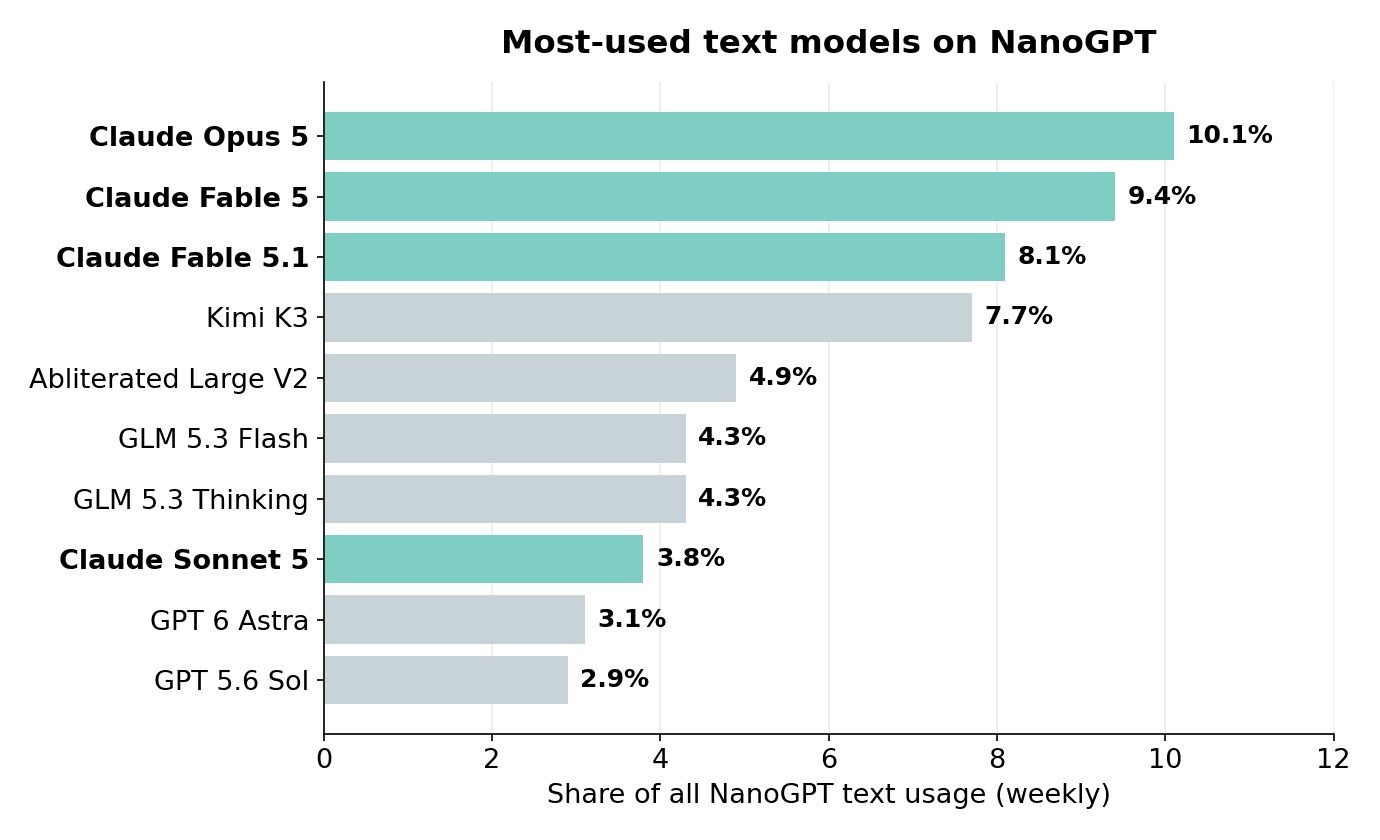
The interesting part is what people pick when there's no subscription pushing them anywhere: they choose Opus. When you pay per token, using the best model for an hour costs cents — so there's no reason to ration it the way a rate-limited plan forces you to.
You can always check our live data at: nano-gpt.com/benchmarks, updated weekly.
Your options
There are three main ways to use Claude:
- Claude Pro — Anthropic's subscription ($20/month)
- Anthropic API — Direct API access, pay per token
- NanoGPT — Pay-per-use access to Claude (and 200+ other models), no subscription
Which Claude model is cheapest?
Of course, Haiku is the cheapest Claude model, Sonnet 5 is the best everyday value, and Fable is the most expensive.
| Model | Input (per 1M) | Output (per 1M) | Relative cost |
|---|---|---|---|
| Claude Haiku 4.5 | $1.00 | $5.00 | Baseline |
| Claude Sonnet 5 | $2.00 | $10.00 | 2× Haiku |
| Claude Opus 5 | $5.00 | $25.00 | 5× Haiku |
| Claude Fable 5.1 | $10.00 | $50.00 | 10× Haiku |
As you can see, Opus costs 5× more than Haiku for the same amount of text, and Fable 5.1 costs 10×. That gap matters more than which platform you use it on.
If you wonder which one you should actually pick, here is some help:
- Haiku 4.5 — classification, summaries, extraction, simple chat. Fast and nearly free.
- Sonnet 5 — coding, writing, analysis. The right default for almost everyone, with a 1M-token context window.
- Opus 5 — hard reasoning, complex refactors, roleplay, work where a wrong answer is expensive.
- Fable 5.1 — creative writing and long-form prose, where it tops our rankings.
Which Claude model is best per dollar
Price only matters next to capability. We work hard on publishing a composite ranking that blends Artificial Analysis, LMArena, LiveBench and our own usage share — here's where Claude lands, with blended cost per 1M tokens:
| Use case | Best Claude model | Score | Blended cost |
|---|---|---|---|
| Overall | Claude Fable 5 | 90.8% | $20/1M |
| Coding | Claude Fable 5 | 69.0% | $20/1M |
| Creative writing | Claude Fable 5.1 | 82.2% | $20/1M |
| Roleplay | Claude Opus 5 | 97.0% | $10/1M |
| Math | Claude Fable 5 | 100% | $20/1M |
Claude Opus 5 tops the roleplay ranking at 97% and places second overall — at half the blended cost of Fable 5. For most people that makes Opus 5 the better buy: near-frontier quality without the premium tier's price.
Feel free to check live rankings at: nano-gpt.com/benchmarks.
The cheapest real strategy: run Sonnet 5 by default and reach for Opus 5 only when a task actually needs it. Most people default to the most expensive model out of habit and pay several times more than they need to.
So why is Claude so expensive?
There are three reasons, and none of them are arbitrary.
Opus is a large model. Bigger models need more GPUs per request. That cost is real and it gets passed on.
Subscriptions bundle in headroom you don't use. Claude Pro is priced for the average of light and heavy users. If you send 10 messages a day, you're subsidising someone sending 500.
You're paying for the app, not just the model. Projects, artifacts, memory, mobile apps — that's product engineering baked into the $20.
This is exactly why per-token access is cheaper for most people: you pay for the tokens you actually use, and nothing else.
Claude cost comparison
Claude Pro ($20/month)
You get access to Claude Sonnet 5 and Opus 5 through Anthropic's web app and mobile apps. The experience is polished - you get Projects, artifacts, computer use, and the full Claude feature set.
The catch: usage caps. Heavy users hit rate limits, especially on Opus. And if you're a light user, you're paying $20 whether you send 5 messages or 500.
Anthropic API (pay per token)
Anthropic's API gives you uncapped access. Current pricing:
| Model | Input (per 1M tokens) | Output (per 1M tokens) |
|---|---|---|
| Claude Opus 5 | $15.00 | $75.00 |
| Claude Sonnet 5 | $3.00 | $15.00 |
| Claude Haiku 4.5 | $1.00 | $5.00 |
This is the raw provider cost. You need to set up billing directly with Anthropic, manage API keys, and either build your own frontend or use a third-party client.
NanoGPT (pay per use, no subscription)
NanoGPT provides access to all Claude models through both a chat interface and an OpenAI-compatible API.
Claude pricing is:
| Model | Input (per 1M tokens) | Output (per 1M tokens) | ~Cost per conversation |
|---|---|---|---|
| Claude Opus 5 | $5.00 | $25.00 | ~$0.05 |
| Claude Sonnet 5 | $2.00 | $10.00 | ~$0.02 |
| Claude Haiku 4.5 | $1.00 | $5.00 | ~$0.01 |
Sonnet 5 costs $2/$10 here versus $3/$15 direct — a third less than Anthropic's own API rate, for the same model.
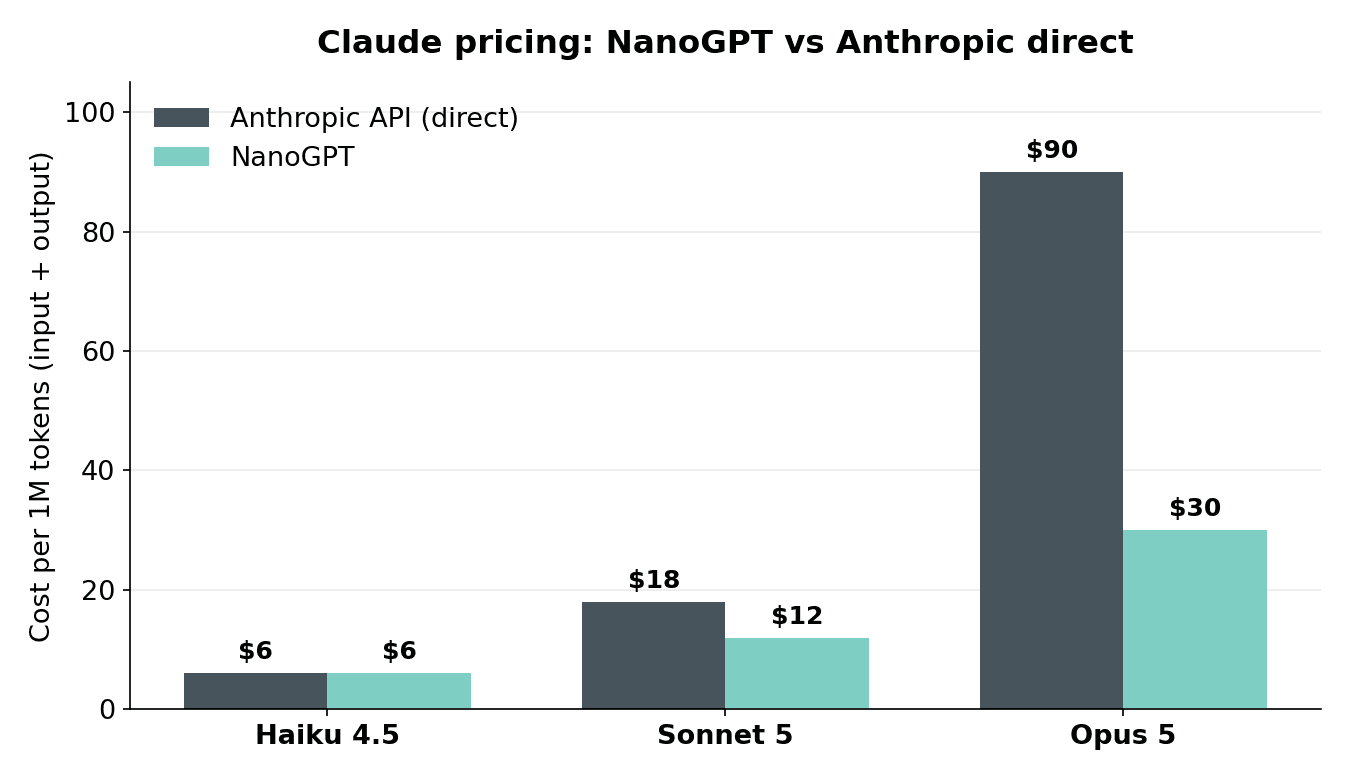
No subscription, no minimum deposit, and you also get access to every other major model — GPT-4o, Gemini, DeepSeek, Llama, and 400+ more — from the same account.
So what's cheaper, Claude plan or subscription?
Anthropic sells three consumer tiers:
| Plan | Price | What you get |
|---|---|---|
| Free | $0 | Limited Sonnet access, tight daily caps |
| Pro | $20/month | Sonnet + Opus, higher limits, Projects |
| Max | $100–200/month | Much higher limits, priority access |
Pro is the cheapest paid Claude plan. There is no cheaper official tier, no annual discount that meaningfully changes the math, and no legitimate resale market for discounted accounts.
Is there a student discount? Anthropic does not currently offer a general student discount on Claude Pro. Occasional education and campus programs appear in some regions, but there's no standing student price — if a site claims to sell you one, treat it as a scam.
The honest summary: if you want a subscription, $20 Pro is the floor. If you want to pay less than that, you need per-token access rather than a plan.There are still a couple of ways to shave the Pro price down, and we covered them in how to get Claude Pro for a less price.
Is Claude cheaper in another country?
Short answer: no, and trying is a bad idea.
Anthropic prices Claude Pro at $20 in essentially every market. Unlike Netflix or Spotify, there's no meaningful regional pricing to arbitrage. What you see quoted in other currencies is the same $20 plus tax and FX.
Using a VPN to buy from a "cheaper" country also breaks Anthropic's terms of service, and payment-method mismatches are a common trigger for account suspension. You'd be risking the account to save nothing.
Pay-per-use has no geography problem. There's no regional pricing to game because there's no subscription to begin with — you pay the same per-token rate wherever you are.
Real-world cost scenarios
Let's put real numbers to this.
Light user (5–10 messages/day)
- Claude Pro: $20/month
- NanoGPT (Sonnet 5): ~$2–3/month
- NanoGPT (Opus 5): ~$4–8/month
Cheapest option: NanoGPT — you save $12–18/month.
Moderate user (20–40 messages/day)
- Claude Pro: $20/month (may hit caps on Opus)
- NanoGPT (Sonnet 5): ~$6–12/month
- NanoGPT (Opus 5): ~$15–30/month
Cheapest option: NanoGPT on Sonnet 5, and Opus 5 is still competitive. Only at the top of this band does Claude Pro edge ahead on Opus — and only if you stay within the rate limits.
Heavy user (50+ messages/day, long conversations)
- Claude Pro: $20/month (will hit rate limits)
- NanoGPT (Sonnet 5): ~$15–24/month
- NanoGPT (Opus 5): ~$38–60/month
Cheapest option: it's a coin flip on Sonnet 5 — around $20 either way, except NanoGPT never rate-limits you. For heavy Opus use, Claude Pro is cheaper if you can live with the caps.
Developer (API usage)
- Anthropic API direct: Provider rates + you manage billing, keys, and infrastructure
- NanoGPT API: Similar rates, OpenAI-compatible endpoint, works with Cursor/Cline/Claude Code out of the box
NanoGPT is convenient for developers who want to integrate Claude into their workflow without Anthropic's API setup, or who want to switch between Claude and other models (GPT-4o, Gemini, etc.) from one API.
What's the cheapest way to use Claude Code?
Claude Code is the expensive one. It reads files, holds large contexts, and runs long agentic loops — so token usage climbs fast, and it's usually pointed at Opus.
Three ways to pay for it:
| Route | Cost | Trade-off |
|---|---|---|
| Claude Pro / Max | $20–200/month | Rate limits hit hard during long sessions |
| Anthropic API | $15/$75 per 1M (Opus 5) | Uncapped, but you manage keys and billing |
| NanoGPT API | $5/$25 per 1M (Opus 5) | Uncapped, OpenAI-compatible endpoint |
Claude Code works with any OpenAI-compatible endpoint, so you can point it at NanoGPT and keep the same workflow:
export ANTHROPIC_BASE_URL="https://nano-gpt.com/api/v1"
export ANTHROPIC_API_KEY="your-nanogpt-key"
Two things that cut Claude Code costs the most, whichever route you pick:
- Run Sonnet 5 instead of Opus 5 for routine work. Most coding tasks don't need Opus.
- Keep contexts tight. Long sessions re-send history on every turn, and that's where the bill actually comes from.
Can you use Claude for free?
Yes you can, but with limits.
Anthropic's free tier gives you limited Claude Sonnet access with tight daily caps that reset every few hours. It's fine for occasional questions, not for sustained work. Also, there's no free Opus access.
Claude Pro has no free trial. Anthropic doesn't currently run one.
Claude Code is not free. It needs either a Pro/Max subscription or API credits.
What "cheap" realistically looks like: there's no free path to heavy Claude usage. But pay-per-use gets close for light users — at Haiku rates, a month of casual chat costs under a dollar, and you only pay on the days you actually use it.
The breakeven point
Using our own published average cost per conversation, here's where a $20/month subscription starts winning:
| Model | Conversations per day to reach $20/month |
|---|---|
| Claude Haiku 4.5 | ~133 |
| Claude Sonnet 5 | ~67 |
| Claude Opus 5 | ~27 |
For Claude Sonnet 5, you'd need around 67 conversations a day before Claude Pro is the cheaper option. Below that, NanoGPT wins.
For Claude Opus 5, the breakeven is much lower — around 27 conversations a day. Opus is an expensive model, and a subscription gives you a lot of value if you're hammering it (assuming you don't hit rate limits).
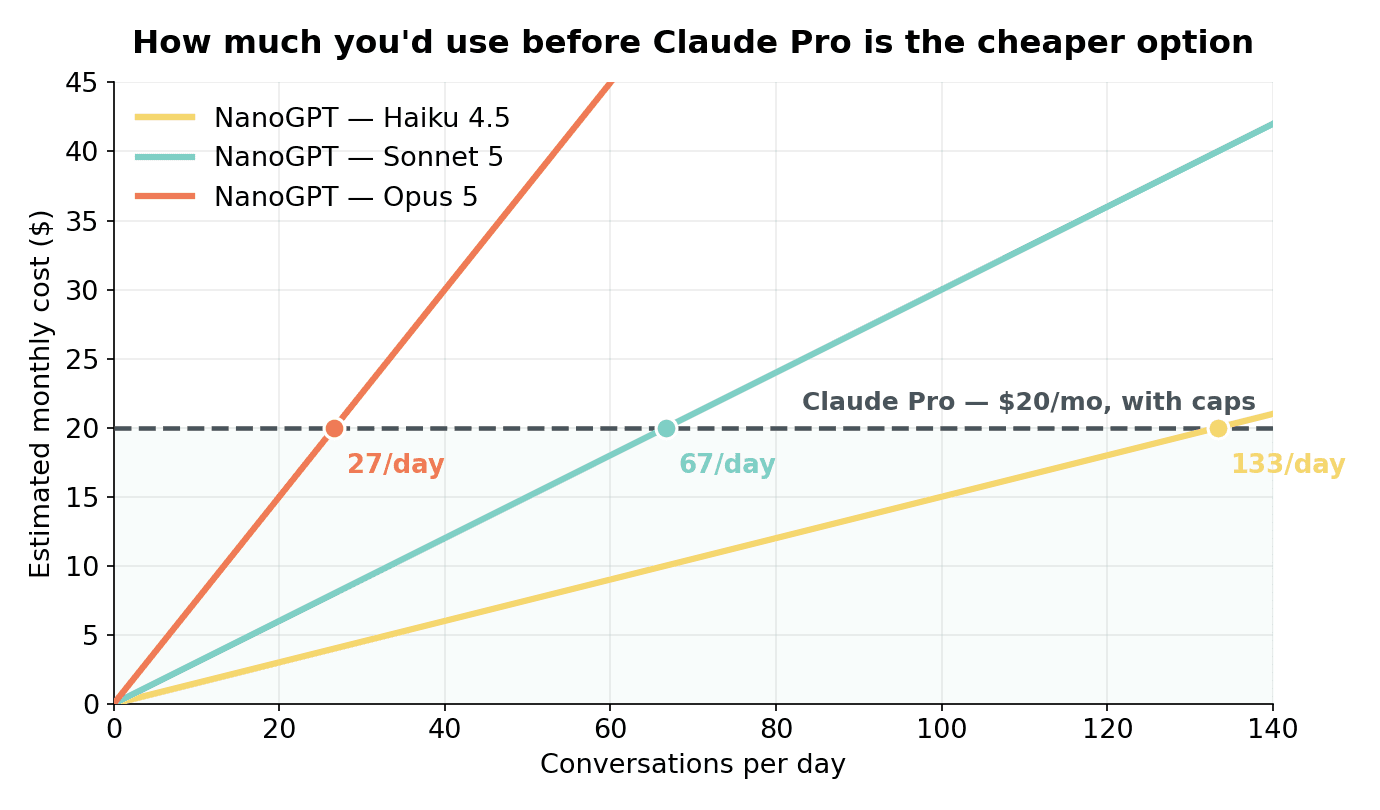
Most people fall well below these thresholds. The median user sends fewer than 20 messages a day.
Beyond pricing
Cost isn't the only factor. Here's what else to consider:
Claude Pro advantages:
- Native web and mobile apps built by Anthropic
- Projects, artifacts, and computer use features
- Memory across conversations
- The most polished Claude experience
NanoGPT advantages:
- Access to Claude AND 400+ other models from one account
- No subscription — pay only when you use it
- Compare Claude against GPT-4o, Gemini, or DeepSeek on the same prompt
- OpenAI-compatible API for tools like Cursor, Cline, and Claude Code
- Image generation, video generation, audio, and TTS in the same interface
- Web search across multiple providers
- Crypto payment support (Nano with zero fees)
- No usage caps — ever
The cheapest path
For most people, the cheapest way to use Claude in 2026 is NanoGPT with Sonnet 5. It's the best balance of capability and cost. You get a strong Claude model at roughly $2–12/month for typical usage, plus instant access to every other major model when you need them.
If you need Opus specifically and use it heavily, Claude Pro gives you the most Opus for $20 — but you're locked into Anthropic's ecosystem and subject to rate limits.
Start with a small deposit on NanoGPT, try Sonnet 5, and see what your actual monthly cost looks like. Most users are surprised how little they spend.